
Frutigen: Swiss municipality in the Bernese Oberland
Frutigen is a municipality in the Frutigen‑Niedersimmental district, canton of Bern, Switzerland. A valley town in the Kander valley, it serves as a local service, transport and tourism hub in the Bernese Alps.
Overview
Frutigen is a municipality in the administrative district of Frutigen‑Niedersimmental in the canton of Bern. It is located in the Kander valley (Kandertal) of the Bernese Oberland and forms a local centre for surrounding mountain villages. Official information about local government and services is provided by the municipal administration (Frutigen municipality).
Image gallery
10 Images





Geography and transport
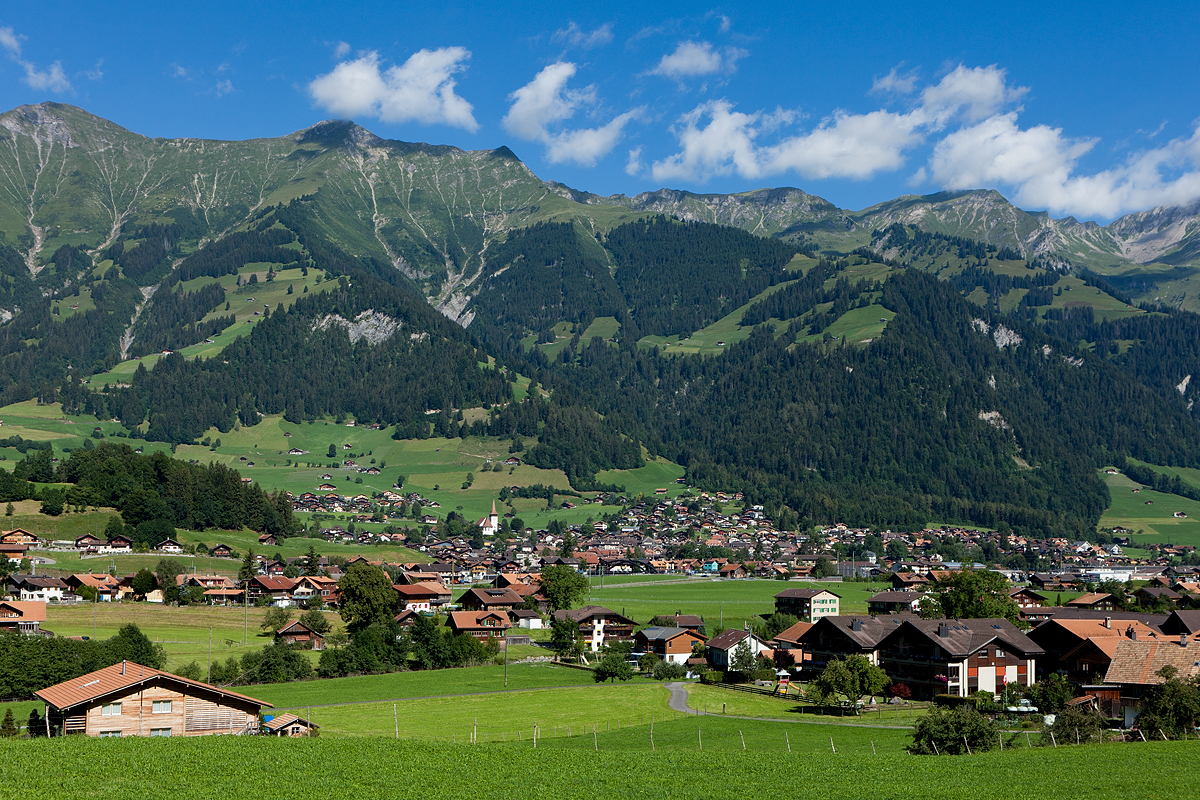
The village sits in a broad alpine valley surrounded by steep, wooded slopes and higher peaks beyond. The Kander river runs through the area, and road and rail links connect Frutigen with the lowlands around the city of Bern and with alpine passes to the south. Frutigen lies close to the northern access to the Lötschberg rail tunnel complex, which has shaped its role as a transport hub for north–south traffic through the Bernese Alps.
History and development
Frutigen has medieval roots as an agricultural and alpine‑pastoral settlement that gradually expanded along valley trade routes. The arrival of regular rail services in the 19th and 20th centuries strengthened its position as a service and distribution centre for nearby mountain communities. In recent decades some light industry and infrastructure related to tunnelling and transport have contributed to local employment.
Economy, tourism and culture
The local economy combines agriculture, small manufacturing, public services and tourism. Visitors come for mountain scenery, hiking, cross‑country routes and access to nearby ski areas. Traditional festivals, local cuisine and community clubs preserve regional customs. Frutigen also functions as a gateway for excursions deeper into the Bernese Alps and to neighbouring valleys of Switzerland.
Practical information and notable facts
- Language: German is the principal local language.
- Transport: served by regional trains and main roads linking to the Bernese lowlands and alpine passes.
- Outdoor activities: hiking, skiing nearby, and mountain biking are common pursuits.
For further local details, municipal and cantonal sources provide up‑to‑date information on administration, services and events (local site, district, cantonal pages).
Related articles
Author
AlegsaOnline.com Frutigen: Swiss municipality in the Bernese Oberland Leandro Alegsa
URL: https://en.alegsaonline.com/art/36874
Sources
- bfs.admin.ch : "Arealstatistik Standard - Gemeinden nach 4 Hauptbereichen"
- bfs.admin.ch : "Ständige Wohnbevölkerung nach Staatsangehörigkeitskategorie Geschlecht und Gemeinde; Provisorische Jahresergebnisse; 2018"