
Cantons of Switzerland
Switzerland is divided into 26 cantons — semi-sovereign member states with their own constitutions, governments and responsibilities within the Swiss federal system.
Overview
Switzerland is composed of 26 cantons, the principal political subdivisions of the Swiss Confederation. A canton functions as a semi-sovereign entity: it adopts its own constitution, elects its government and parliament, raises certain taxes and is responsible for many public services. Cantons participate in federal institutions while retaining substantial autonomy in areas such as education, police, health care, and local administration. For comparisons with federations elsewhere see analogies with other federations.
Image gallery
5 Images



Historical development
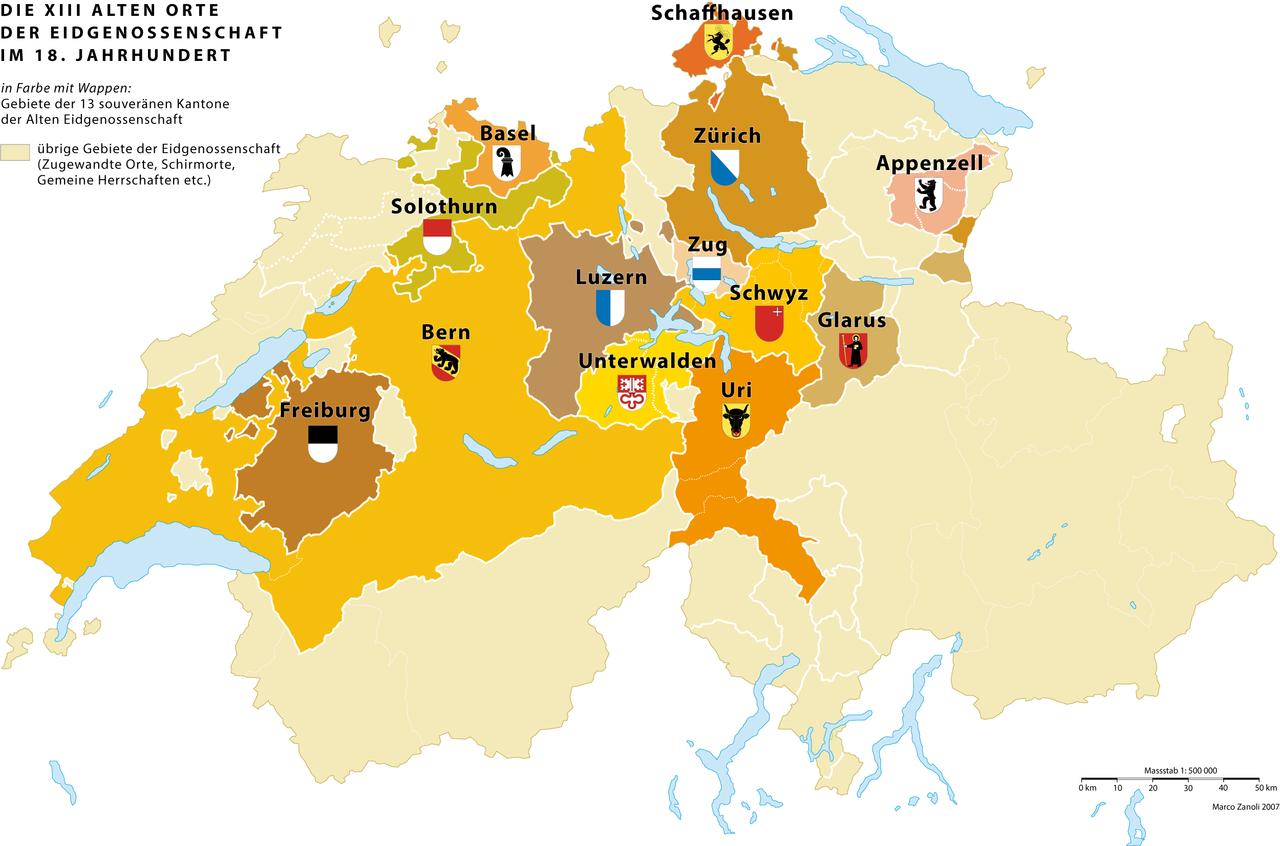
The cantonal system grew from a medieval confederation of largely independent communities. The traditional founding group commonly cited includes Uri, Schwyz and Unterwalden, often called the Urkantone; a founding date traditionally associated with their alliance is 1291. Over the centuries, additional territories entered the confederation through treaties, alliances and political change. Until the 19th century many cantons exercised functions now held by the federal state: they maintained their own militias and issued coinage. The modern federal structure took shape after internal armed conflict in the 1840s and the adoption of a national constitution in 1848, which concentrated some powers at the federal level while preserving strong cantonal authority. A late-20th-century change in the map occurred when the canton of Jura was created in 1978 following a political separation from Bern.
Organization and powers
Each canton has its own constitution and institutions. Typical cantonal responsibilities include primary and secondary education, policing, health services, land-use planning and much of the tax system. Municipalities operate below the cantons and deliver many everyday services. The federal constitution sets general principles and national standards but often leaves detailed implementation to the cantons; this division of competence is a central feature of Swiss federalism. For summaries of cantonal structures see official overviews of cantonal governments and their constitutions.
Language, identity and variation
Cantons reflect Switzerland’s linguistic and cultural diversity. German, French, Italian and Romansh are spoken in different parts of the country, and language boundaries often coincide with cantonal or municipal borders. Citizens frequently feel a strong attachment to their canton of origin, which complements a national Swiss identity. Because cantons set many policy details, practical outcomes vary: school curricula, tax rates, building rules and administrative procedures differ from canton to canton. This variety also makes cantons laboratories for policy innovation.
Half-cantons and representation
A small number of historic entities are referred to as half-cantons (for example, Obwalden and Nidwalden; Appenzell Innerrhoden and Appenzell Ausserrhoden; Basel-Stadt and Basel-Landschaft). In most practical respects they operate as full cantons, but their historical status affects federal representation: each half-canton elects one member to the upper chamber (Council of States) rather than two. Readers may consult notes on representation and canton formation for more context at historical notes and on monetary history at monetary history.
Law, enforcement and cantonal discretion
Federal laws set national prohibitions and penalties in many areas, but cantons have discretion in enforcement, prosecution priorities and administrative sanctions. This can lead to differing practices across the country. For instance, criminal provisions and enforcement relating to drug offences are framed by federal statute, yet cantonal authorities vary in how they handle consumption, possession and prosecution. For broader legal context consult resources on Swiss criminal law and cantonal practice in Switzerland.
Modern role and further reading
Cantons remain the functional backbone of Swiss public life, managing schools, health systems, police forces and much of public finance. Their constitutions and democratic institutions allow citizens to influence policy at a close level; direct democratic mechanisms and referendums frequently operate at cantonal as well as national level. For introductions to the balance between national and cantonal authority and comparative material see summaries of federalism and administrative organization, and consult official sources for current constitutions and contact details via central portals and cantonal websites for further information and general background on policy and governance.
Questions and answers
Q: What is a canton in Switzerland?
A: A canton is similar to a state in the United States and there are 26 of them in Switzerland.
Q: How did the structure of Switzerland change in 1848?
A: In 1848, after a civil war, Switzerland changed its structure so that each canton no longer had its own army or money.
Q: What is an Urkanton?
A: An Urkanton is one of the original cantons that existed since the foundation of Switzerland in 1291. These include Uri, Schwyz, and Unterwalden (Nidwalden and Obwalden together).
Q: When did Jura become a new canton?
A: Jura became a new canton in 1978 when it split from the Canton of Berne after some rioting.
Q: How do certain Swiss cantons differ from others when it comes to voting?
A: For historical reasons, Basel-Stadt, Basel-Landschaft, Appenzell-Innerrhoden, Appenzell-Ausserrhoden, Obwalden and Nidwalden have their voting counted differently than other Swiss cantons during national elections.
Q: How much freedom do municipalities and cantons have in Switzerland?
A: Municipalities and Cantons have quite a bit of freedom as usually only general rules are set by Swiss law at the level of the whole confederation while detailed rules are made by each individual Canton as they see fit.
Q: How does drug abuse punishment vary between different Swiss Cantons?
A: Drug abuse is considered a federal offense but punishments for it can vary greatly between different Cantons with some issuing fines while others may issue prison terms for even light cases depending on how strictly they apply this law.
Tags
Related articles
Author
AlegsaOnline.com Cantons of Switzerland Leandro Alegsa
URL: https://en.alegsaonline.com/art/16664