
Galatea (moon of Neptune)
Galatea (Neptune VI) is a small, irregular inner moon of Neptune discovered in Voyager 2 images in 1989. It orbits close to Neptune and influences the planet's ring material while showing no signs of geologic activity.
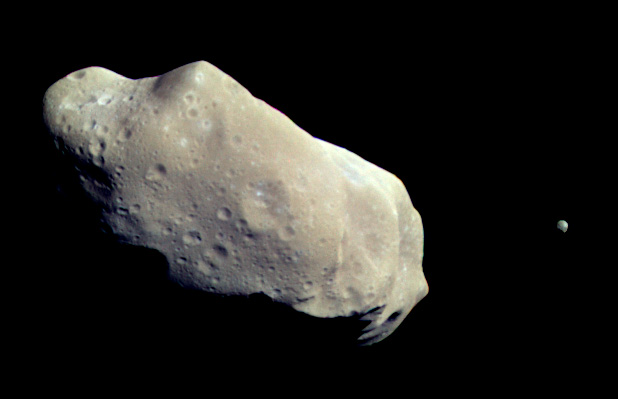
Galatea, also designated Neptune VI and initially catalogued S/1989 N 4, is one of Neptune's inner satellites. It orbits close to the planet on an interior path near the prominent Adams ring and is named after Galatea, one of the Nereids of Greek mythology. The name was officially assigned in the early 1990s; it should not be confused with the main-belt asteroid 74 Galatea (asteroid 74 Galatea).
Image gallery
7 Images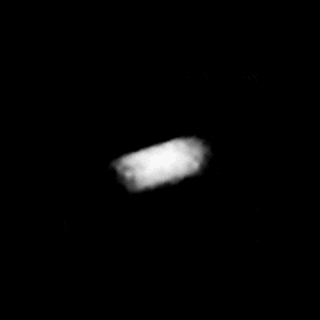



Discovery and designation
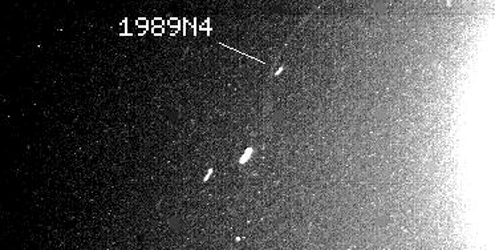
Galatea was identified in images taken by the Voyager 2 spacecraft during its 1989 flyby of the Neptune system. The discovery was announced soon after the flyby based on multiple frames taken over several days; the object received the provisional designation S/1989 N 4 and later the name Galatea. Voyager 2 remains the mission responsible for the detailed first detection of this moon (Voyager 2).
Orbit and relationship to Neptune's rings
Galatea orbits inside Neptune's ring system and is gravitationally linked to the nearby Adams ring. Its presence affects ring particle motions through resonances and shepherding effects, helping maintain some structure in the arcs observed in the Adams ring. The moon's close proximity to Neptune places it among the planet's inner satellites, a region studied for interactions between moons and rings (Neptune).
Physical characteristics
- Shape: irregular, non-spherical, indicating a small body without sufficient gravity to form a round shape.
- Surface: dark and heavily cratered in appearance in Voyager images, with no signs of recent geological activity.
- Composition: believed to be a mix of water ice and darker rocky or carbon-rich material, typical of small outer-system moons.
- Rotation: expected to be tidally locked to Neptune, keeping one face toward the planet.
Origin, evolution and observations
Galatea is generally considered a captured or accreted object from the early Neptune system, or material that coalesced in the planet's equatorial plane. Like other small inner moons, it has likely undergone heavy bombardment early in its history and shows no current endogenic activity. After Voyager 2, follow-up observations have come from Earth-based telescopes and the Hubble Space Telescope, though its proximity to Neptune makes detailed study challenging (Voyager imagery, follow-up observations).
Galatea remains of interest because of its dynamical role with Neptune's rings and as an example of a small, inactive inner satellite around a giant planet. For more information on Neptune's moon system and ring dynamics see the cited mission and survey resources (related asteroid note, Neptune overview).
Questions and answers
Q: What is Galatea?
A: Galatea is the fourth closest moon to Neptune.
Q: How did Galatea get its name?
A: Galatea is named after one of the Nereids of Greek legend.
Q: When was Galatea discovered?
A: Galatea was found in late July 1989 from images taken by the Voyager 2 probe.
Q: What was Galatea's original designation?
A: Galatea's original designation was S/1989 N 4.
Q: Was Galatea's discovery publicly announced?
A: Yes, Galatea's discovery was announced (IAUC 4824) on August 2, 1989.
Q: Does Galatea show any sign of geological changes?
A: No, Galatea is not a sphere and shows no sign of any geological changes.
Q: Is there an asteroid called Galatea?
A: Yes, there is an asteroid called 74 Galatea.
Related articles
Author
AlegsaOnline.com Galatea (moon of Neptune) Leandro Alegsa
URL: https://en.alegsaonline.com/art/37257