
French Armenian Legion
A World War I-era unit formed in 1916 by agreement between French authorities and Armenian national leaders to fight the Ottoman Empire and advance Armenian national aims within the French Army.
Overview
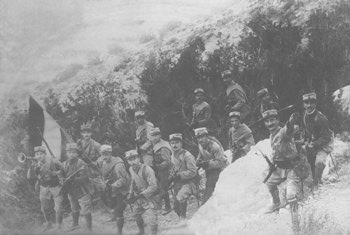
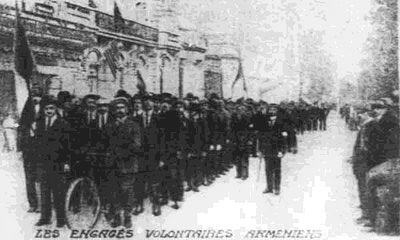
The French Armenian Legion was a military formation created during World War I through an agreement in 1916 between French authorities and Armenian political organizations. Raised as a foreign-unit formation within the French Army, it brought together Armenian volunteers from different regions with the objective of fighting the Ottoman Empire and supporting Armenian national aspirations. The unit is often described in historical sources as evolving from earlier French efforts in the Near East, sometimes linked in name or origin to the so-called "Légion d'Orient".
Image gallery
4 Images

Organization and recruitment
Membership was drawn from a mix of sources: diaspora volunteers from Europe and the Middle East, former Ottoman prisoners of war who chose to fight against the Ottoman state, and survivors from Armenian volunteer detachments that had served in other Allied formations. Armenian political parties, most notably the Armenian Revolutionary Federation (Dashnaktsutyun), played a central role in arranging volunteers and negotiating terms with French authorities.
- Served as a unit under French command and administration.
- Comprised volunteers motivated by both military and political goals.
- Equipped and organized according to French military standards of the period.
Military role and campaigns
Deployed to the eastern Mediterranean and southern Anatolian theatre, the Legion participated in operations aimed at weakening Ottoman control in Cilicia and surrounding areas. Its combat operations were part of the larger Allied strategy in the Middle East, and it sometimes operated alongside other Armenian formations and local militias. The Legion was therefore both a battlefield unit and a political instrument intended to influence postwar negotiations about Armenian territory and autonomy.
Aftermath and legacy
Following the armistice and the collapse of Ottoman imperial authority, members of the Legion were involved in the French occupation of parts of Cilicia. The postwar period was turbulent: emerging Turkish nationalist forces, shifting Allied priorities, and complex local conditions led to tensions and eventual withdrawal of French forces and the disbandment of the Legion around 1920. For many Armenians the unit is remembered as a symbol of national struggle and of the broader wartime mobilization of diasporic communities.
Significance and distinctions
The French Armenian Legion stands out for linking military service directly to a national liberation project under the patronage of a major Allied power. It differs from informal militias and purely volunteer battalions by its formal incorporation into the structures of the French Army, yet it shared aims with independent Armenian volunteer units that fought elsewhere in the conflict. Historians note both its practical military contribution in the Levant and its symbolic role in the history of Armenian nationalism.
Today the Legion is studied in contexts that include military history, the history of the Armenian national movement, and the broader political rearrangements that followed World War I. Its story illustrates how wartime alliances and volunteer formations could be shaped by competing strategic goals and by the aspirations of stateless peoples.
Related articles
Author
AlegsaOnline.com French Armenian Legion Leandro Alegsa
URL: https://en.alegsaonline.com/art/36582