
A Fall of Moondust
Arthur C. Clarke's 1961 hard‑science fiction novel about a lunar passenger vessel trapped in a sea of fine regolith and the methodical rescue effort that follows.
A Fall of Moondust is a 1961 science fiction novel by Arthur C. Clarke. Rather than a broad space epic, it is a concentrated, suspenseful narrative built around a single technological crisis: a tourist passenger vessel becomes buried in a drifting, almost liquid layer of very fine lunar dust and teams on the surface and at mission control must devise a rescue.
Image gallery
2 Images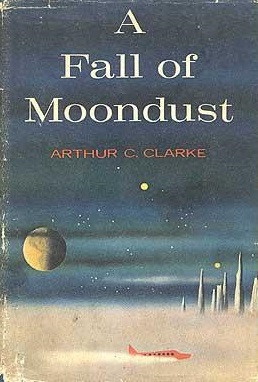

Premise and narrative
The story confines its action to the accident scene, the survivors inside the stranded craft, and the engineers who attempt to reach them. Clarke emphasizes procedural detail and step‑by‑step problem solving: locating the buried craft, estimating survivability, designing a recovery method suited to low gravity and vacuum, and managing time and resources under pressure. The novel reads as a technical thriller as much as a character drama, with suspense generated by constraints and contingencies rather than sensational invention.
Characters and structure
The cast is relatively small and functional: passengers with varying backgrounds whose interactions reveal different human responses to confinement, and specialists whose expertise shapes the rescue. Clarke's prose keeps character depiction economical, using dialogue and action to show competence, fear, humor and leadership under strain. The narrative pacing alternates concentrated technical exposition with moments of personal reflection.
Science and setting
Clarke draws on mid‑20th‑century understanding of the Moon to imagine how extremely fine regolith might behave in low gravity, describing it with analogies to viscous or fluid media and exploring how that behavior complicates movement and rescue operations. Machinery, air management, structural integrity and the physical limits imposed by vacuum are recurring concerns. The novel exemplifies "hard" science fiction in which plausibility and engineering logic drive the plot.
Themes and reception
Beyond the rescue mechanics, the book examines human responses to isolation, the ethics of risk management, and the reliance on expertise and design to solve life‑threatening problems. Critics and readers have long praised Clarke's clear exposition and the novel's sustained tension; some note its deliberate pace and focus on methodical problem solving rather than action sequences.
Publication and resources
First published in 1961 and reprinted in many editions since, the novel remains recommended for readers who prefer scientifically grounded storytelling. For publication details consult a publisher or library entry at publisher or library entry, a concise bibliography at bibliographic resource, and material about the author at Arthur C. Clarke resources.
- Type: hard science fiction, rescue drama
- Setting: lunar surface; emphasis on engineering realism
- Notable for: technical problem-solving, claustrophobic tension
Tags
Related articles
Author
AlegsaOnline.com A Fall of Moondust Leandro Alegsa
URL: https://en.alegsaonline.com/art/36