
A Modest Proposal
Jonathan Swift's 1729 satirical essay that offers a shocking ironic 'solution' to poverty in Ireland, using parody, persona, and statistical mockery to criticize social and political indifference.
Overview
"A Modest Proposal" is a short, highly ironic essay first published in 1729 by Jonathan Swift. Written as a serious economic argument, it proposes an outrageous remedy for widespread poverty in Ireland: selling and eating poor children. The grotesque suggestion is not literal advocacy but a form of satire that exposes cruelty, hypocrisy, and the abuses of power.
Image gallery
3 Images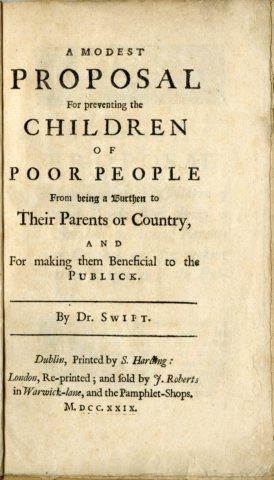


Form and techniques
Swift adopts the voice of a rational, calculating pamphleteer who uses statistics, calculations, and faux‑practical language to normalize monstrous ideas. Key techniques include sustained irony, persona (an unreliable narrator), reductio ad absurdum, and moral inversion. These devices force readers to confront the logic behind exploitation by pushing it to an extreme.
Historical background
Composed during a period of deep economic hardship and political tension between England and Ireland, the essay targets indifferent elites and policy makers rather than the poor themselves. Swift's strategy was to shame readers into moral awareness by showing how detached economic reasoning can dehumanize vulnerable people.
Impact and interpretations
The pamphlet shocked contemporary audiences and has remained a central work in studies of satire and rhetoric. Critics and scholars have read it as social protest, literary performance, and a model of satirical technique. It also sparked debates about ethical limits of satire and the responsibilities of writers addressing social suffering.
Notable features
- Sustained ironic voice that never breaks into sincerity.
- Use of pseudo‑economic calculations to parody cold utilitarianism.
- A short, concentrated form that trades on shock value to provoke reflection.
Today the essay is taught as an example of moral satire and rhetorical skill. Its effectiveness relies on readers recognizing the gap between literal proposal and authorial intent, prompting ethical questions about policy, empathy, and the power of language to both harm and illuminate.
Tags
Related articles
Author
AlegsaOnline.com A Modest Proposal Leandro Alegsa
URL: https://en.alegsaonline.com/art/82