
A Murder of Quality
A Murder of Quality is John le Carré’s early novel featuring George Smiley in a standalone murder mystery that examines class, hypocrisy, and quiet detection outside the spy world.
A Murder of Quality is an early novel by John le Carré that brings his recurring protagonist, George Smiley, into a conventional whodunnit rather than the espionage plots for which the author is best known. The book uses the framework of a murder inquiry to probe social mores and private dishonours in postwar Britain. The title gives a hint of the novel’s concern with status, reputation and the costs of concealment.
Image gallery
1 Image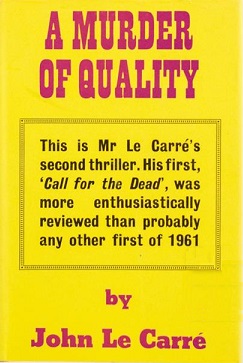
Overview
The story follows Smiley as an outsider investigator who applies careful observation and moral judgment to a murder rooted in a closed community. The narrative emphasises procedural detail and character study rather than action-driven suspense. Smiley’s temperament—methodical, patient and ethically aware—shapes the book’s tone and its resolution.
Form, themes and style
Le Carré adapts his interest in deception and institutional secrecy to a domestic setting, examining class divisions, the private school milieu and religious or social pretence. The prose is measured and analytical, privileging dialogue and small clues over spectacle. Readers familiar with le Carré’s spy fiction will recognise thematic continuities: betrayal, moral ambiguity and the price of truth.
Context and reception
Written early in the author’s career, the novel helped establish George Smiley as a flexible figure who can inhabit genres beyond espionage. It has attracted attention for its mood and character work and has been the subject of adaptations and critical discussion that highlight its distinct place among le Carré’s books.
Notable facts
- A Murder of Quality is the only Smiley title that is primarily a murder mystery.
- The novel showcases le Carré’s interest in institutions and the private compromises that sustain them.
Tags
Related articles
Author
AlegsaOnline.com A Murder of Quality Leandro Alegsa
URL: https://en.alegsaonline.com/art/84
Sources
- criminalelement.com : "A Murder of Quality by John LeCarre: An Old-Fashioned Detective Mystery"
- goodreads.com : "A Murder of Quality (George Smiley) by John le Carré"