
Fort de Joux (Château de Joux) — historic fortress in the Jura mountains
Fort de Joux is a medieval castle turned fortress near Pontarlier in eastern France, notable for centuries of military adaptation, its strategic position in the Doubs, and the prison cell of Toussaint Louverture.
Fort de Joux (also called the Château de Joux) is a fortified castle complex overlooking a mountain pass in the Jura range of eastern France. Perched on a rocky spur above the Cluse valley, it occupies a strategic route between France and what is now Switzerland. The site stands within the commune of La Cluse-et-Mijoux in the department of Doubs and has been adapted repeatedly from the Middle Ages into the modern era.
Image gallery
4 Images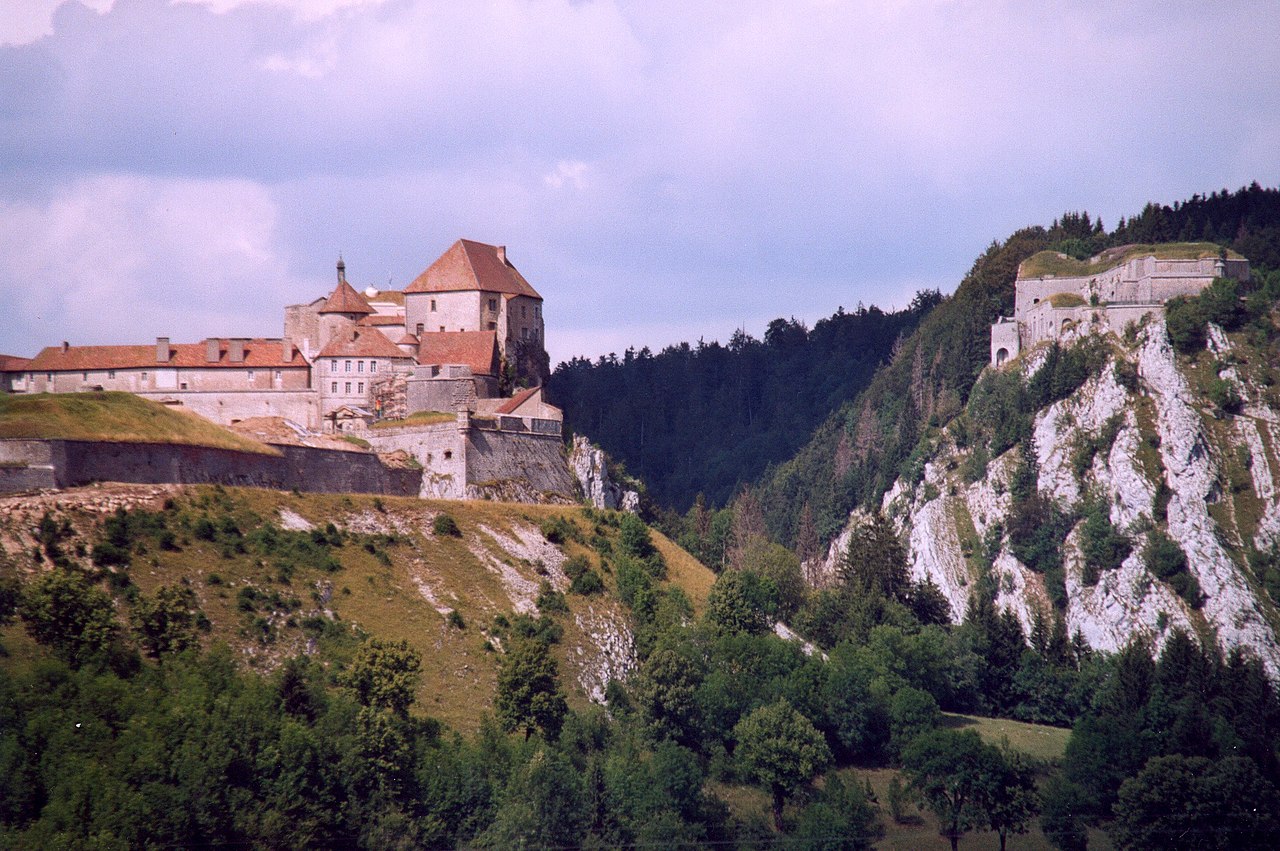


Overview and significance
Originally a medieval stronghold, Fort de Joux was enlarged and modified over many centuries to respond to evolving military technology and regional politics. Its long occupation made it an important border fortress whose towers and ramparts controlled a key Alpine pass. The complex is often referenced under the simple name Fort de Joux.
Architecture and features
The fortress is a layered ensemble rather than a single building: a medieval keep and curtain walls sit below later artillery-era works. Visitors encounter multiple defensive rings, barracks, casemates, and vaulted rooms carved into the rock. Surviving elements illustrate the shift from high-medieval masonry to low-profile bastions designed to resist cannon fire.
History and notable events
Fort de Joux has a long military history as a frontier strongpoint. Over time it served as a garrison, supply depot and state prison. One of the site's best-known prisoners was the Haitian revolutionary leader Toussaint Louverture, who was held there and died in custody in 1803. The fortress therefore links local military history with broader international stories of the revolutionary era.
Today: museum, tours and context
Today the site functions primarily as a heritage monument and museum open to the public. Exhibits commonly display period weapons, models of the fortifications, and rooms interpreted to show garrison life and incarceration. The elevated position also offers panoramic views of the surrounding Jura landscape, making the site of interest to visitors for both history and scenery.
Notable distinctions
- Continuous adaptation: illustrates medieval origin and later artillery-era refortification.
- Cultural resonance: remembered for the imprisonment and death of Toussaint Louverture.
- Strategic siting: controls a passage through the Jura mountains linking regions of eastern France and Switzerland.
Related articles
Author
AlegsaOnline.com Fort de Joux (Château de Joux) — historic fortress in the Jura mountains Leandro Alegsa
URL: https://en.alegsaonline.com/art/35742