
Fort Ouiatenon: French frontier trading post on the Wabash River
An early 18th-century French fort and trading center near present-day West Lafayette, Indiana, central to the fur trade, relations with the Wea and other Indigenous nations, later British occupation, and modern reconstruction.
Fort Ouiatenon was one of the earliest permanent European frontier posts in what is now Indiana. Established by French colonial authorities about 1717 on a bend of the Wabash River, the fort combined defensive works and commercial functions to serve a wide region of the Midwest. Its riverside position and canoe access linked voyageurs and trappers to routes extending toward the Great Lakes, the Ohio country and the interior of the continent. The site lay roughly three miles southwest of present-day West Lafayette and became a focal point for exchange between French traders and local Indigenous nations, most notably the Wea.
Image gallery
3 Images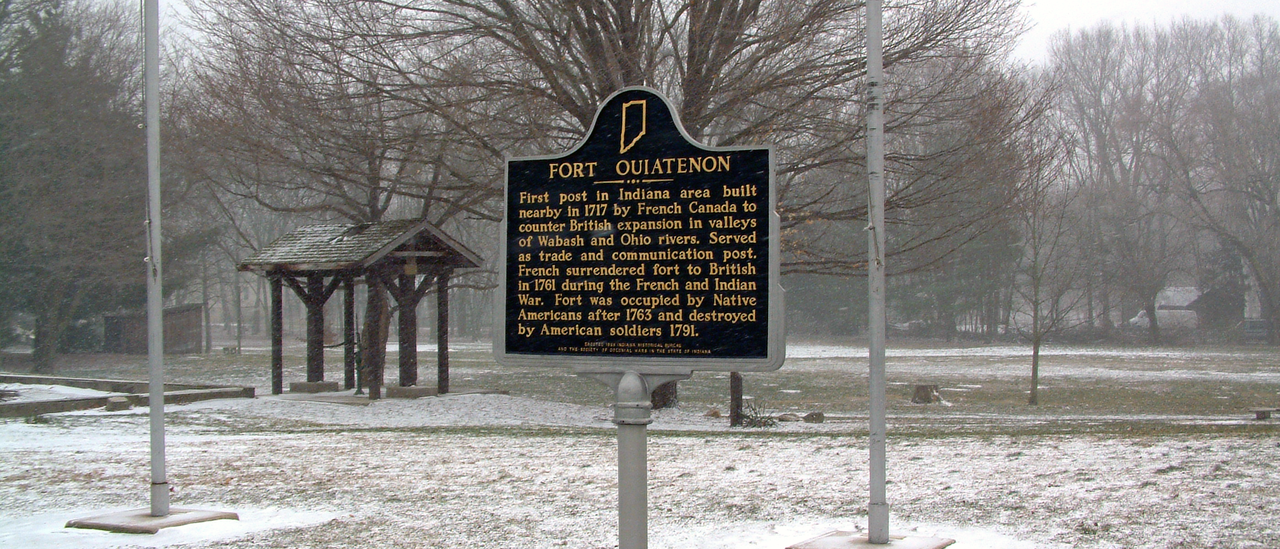


Construction, layout and economic role
Accounts and later reconstructions portray Fort Ouiatenon as a modest palisaded enclosure containing cabins, storehouses and yards used for processing and drying furs. The fort was not primarily a large regular army garrison but a mixed military-commercial establishment operated by colonial officers, independent traders and allied Indigenous people. Its chief economic purpose was to anchor a regional fur-trade network: Indigenous hunters supplied beaver, deer and other pelts, which French merchants then marketed through Quebec and the transatlantic trade. The site also functioned as a local meeting place for diplomacy, gift exchange and seasonal encampments.
History and conflict
During the mid-18th century the post reached its most active period as French influence spread into the Ohio and Wabash valleys. Estimates of population and attendant camp communities vary; contemporary observers suggest substantial seasonal traffic and a sizable local population at the fort’s height. After Britain’s victory in the North American theater of the Seven Years’ War, French positions in the interior were abandoned or surrendered. In 1761 a detachment of British forces under a junior officer occupied Fort Ouiatenon following French withdrawal, an episode connected to the wider transitions of the French and Indian War era.
In 1763 the fort was affected by the widespread Native resistance often referred to as Pontiac’s Uprising, when a coalition of Indigenous groups moved to challenge British occupation of former French posts. Contemporary narratives report that Fort Ouiatenon changed hands without large-scale bloodshed in that campaign. During the later 18th century the site was intermittently used by Indigenous groups and raiding parties as American settlement advanced westward; sources indicate the post was ultimately abandoned or destroyed by federal order in the early 1790s amid frontier tensions.
Archaeology, reconstruction and public memory
Excavations and historical research have sought to document the fort’s remains and the material culture of its occupants. The visible fabric of the original settlement largely disappeared over time, but in 1930 a replica fort was constructed near the historic location by a local physician, Richard Wetherill, to help interpret the colonial period for visitors. The area encompassing the site and its reconstructed elements was placed on the National Register in 1970, reflecting its archaeological and cultural importance. The property is presented to the public as a historic site with interpretive programming and educational materials.
Significance and visiting today
- Fort Ouiatenon illustrates how trade, diplomacy and military presence combined on the trans-Appalachian frontier under French and later British influence.
- The fort is central to local histories of the Wea and other Indigenous nations and to studies of colonial-era intercultural exchange in the Wabash valley.
- Today visitors can explore the reconstructed palisade and attend living-history events such as the annual Feast of the Hunters’ Moon that interpret 18th-century trade fairs, crafts and demonstrations.
For those researching regional colonial history, archaeology or Indigenous-European relations, regional archives, university collections and the site’s interpretive staff provide additional documentation and guidance about ongoing research and public programming at Fort Ouiatenon.
Questions and answers
Q: What is Fort Ouiatenon?
A: Fort Ouiatenon was the first fortified European settlement in what is now the U.S. state of Indiana, located approximately three miles southwest of modern-day West Lafayette.
Q: Why was it constructed?
A: It was originally constructed by the French government in 1717 as a military outpost to protect against Great Britain's western expansion and to serve as a key center of trade for fur trappers.
Q: Who were some of the people who visited Fort Ouiatenon?
A: French merchants and trappers from Quebec would arrive at Fort Ouiatenon in search of beaver pelts and to take advantage of trade relations with the native Wea Native American tribes.
Q: How many residents lived there during its peak level of activity?
A: At its peak level of activity during the mid-18th century, Fort Ouiatenon was home to over 2,000 residents.
Q: What happened during Pontiac's Uprising?
A: During Pontiac's Uprising in 1763, a contingent led by Chief Pontiac of the Ottawa Native American tribe captured Fort Ouiatenon without firing a shot, along with seven other similar posts.
Q: What did President George Washington order regarding Fort Ouiatenon?
A: In 1791 President George Washington ordered for the fort to be destroyed due to local Indian tribes using it as a base for staging raids against American settlers pushing westward.
Q: When was a replica built near its original site?
A:In 1930, a replica of Fort Ouiatenon was built near its original site by Richard Wetherill, a local physician.
Related articles
Author
AlegsaOnline.com Fort Ouiatenon: French frontier trading post on the Wabash River Leandro Alegsa
URL: https://en.alegsaonline.com/art/35769