
Fountain of Apollo (Bassin d'Apollon) — Palace of Versailles
A large baroque fountain in the Gardens of Versailles showing Apollo in his four-horse chariot; commissioned under Louis XIV and installed in 1671, noted for its symbolism and later full-scale replicas.
Overview
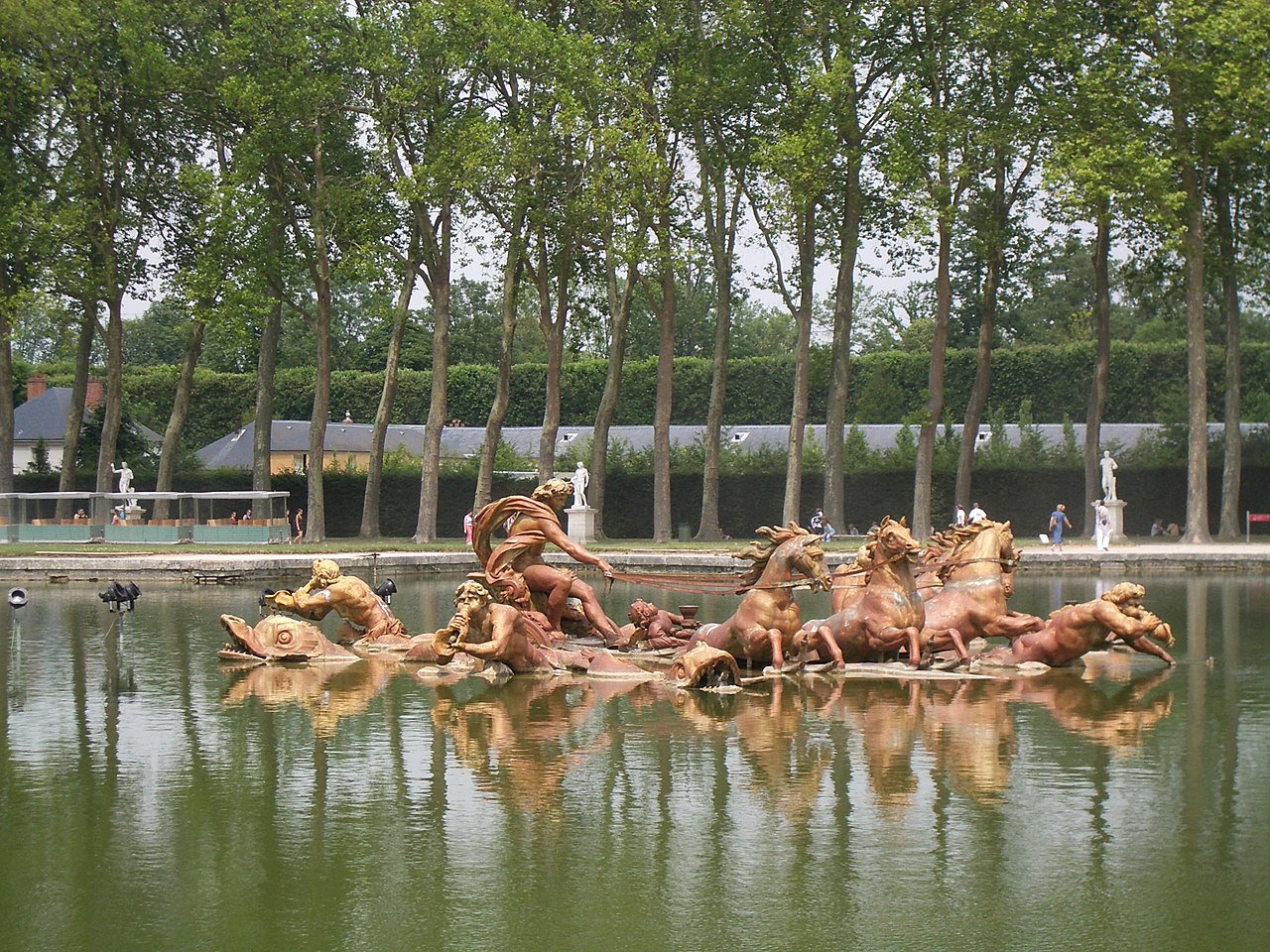
The Fountain of Apollo, known in French as the Bassin d'Apollon, is one of the principal sculptural features in the formal gardens of the Palace of Versailles. It presents the sun god Apollo in a dramatic tableau: the deity seated in a four-horse chariot, drawn up from the sea at dawn and accompanied by tritons and other marine figures. The composition combines royal propaganda, classical myth, and the theatrical language of 17th-century French Baroque art.
Image gallery
10 Images




Design and symbolism
Visually, the fountain arranges figures around a central gilded statue of Apollo on his quadriga. The chariot and horses are poised as if emerging from a grotto, a maritime setting that includes tritons blowing conch shells. The orientation and subject matter deliberately echo the sun and its daily course, an apt emblem for Louis XIV, who styled himself the Sun King. Charles Le Brun, the king's chief painter and designer, proposed the Apollo theme to connect the monarch to classical authority and cosmic order.
Origins and installation
The site began as a small ornamental pond dug under Louis XIII in the early 17th century and called the Pond of the Swans. During the expansion of Versailles under Louis XIV, the water feature was enlarged and transformed into a more elaborate basin. The gilded sculptural group now in the center was executed by the sculptor Tuby (often referred to as Tuby of Rome) and installed in 1671. The fountain sits on the central east–west axis of the gardens, with the Grand Canal lying beyond it, a deliberate alignment within André Le Nôtre's overall landscape plan.
Placement, perspective and a common misconception
Because the fountain faces the west across the gardens, some observers note an apparent inconsistency: the scene shows Apollo rising from the sea, yet the statue faces west rather than the literal east where the sun rises. This has been discussed as a choice driven by sightlines, symbolism and the need to present the figure toward the main approach and the palace. In the period's artistic vocabulary, symbolic orientation sometimes took precedence over geographic accuracy.
Replicas, conservation and influence
The Bassin d'Apollon has inspired reproductions and restorations. In the early 21st century a full-scale replica was commissioned by a museum in Taiwan and work proceeded using laser measurement, molds made in France and marble carving in Italy, resulting in an unveiled copy in 2014. Back at Versailles, the fountain has been conserved, regilded and maintained as part of a continuing effort to preserve the garden ensembles and their hydraulics. The image of Apollo in his chariot remains one of the most recognizable symbols of Versailles and of the Sun King's image in European art.
Notable facts
- The basin occupies a prominent position on the garden's main axis, directly before the Grand Canal.
- Charles Le Brun played a decisive role in choosing Apollo as the subject to reinforce the king's symbolic identity.
- The original sculptural group was installed in 1671 and has undergone conservation and regilding over time.
- A modern full-scale replica was completed and displayed in 2014, based on detailed measurements and traditional carving methods.
External links and references
- French name and general reference
- Art-historical descriptions of the fountain
- Palace of Versailles information
- Apollo in classical mythology
- Iconography of the four-horse chariot
- Tritons and marine figures in sculpture
- Louis XIII and early works at Versailles
- The original pond and its evolution
- Pond of the Swans (historical name)
- Louis XIV and the expansion of Versailles
- Le Brun's design proposals
- Tuby of Rome, sculptor of the group
- Chimei Museum replica in Tainan
- Information on the Taiwanese installation
Questions and answers
Q: What is the Fountain of Apollo?
A: The Fountain of Apollo is a fountain at the Palace of Versailles that depicts the Greek sun god Apollo rising from the sea at daybreak in his four-horse chariot.
Q: Who suggested it be dedicated to Apollo?
A: Le Brun suggested it be dedicated to Apollo based on its east-west orientation.
Q: Who made the gilded statue?
A: The gilded statue was made by Tuby of Rome.
Q: Where does the Grand Canal lie beyond the fountain?
A: Beyond the fountain lies the Grand Canal.
Q: Does the Fountain of Apollo correctly depict Apollo rising in the east or west?
A: The Fountain of Apollo incorrectly depicts Apollo rising in the west rather than in the east.
Q: When was a replica unveiled in Tainan, Taiwan?
A: In 2014, a same-scale replica was unveiled in Tainan, Taiwan, at the entrance of Chimei Museum.
Q: How long did it take for modern laser measuring and molding to make for reproduction sculpture and carving marble for this replica? A: It took three years for modern laser measuring and molding to be made in France for reproduction sculpture, and another three years to carve marble in Italy.
Related articles
Author
AlegsaOnline.com Fountain of Apollo (Bassin d'Apollon) — Palace of Versailles Leandro Alegsa
URL: https://en.alegsaonline.com/art/35871