
Foramen magnum: anatomy, function, and significance
The foramen magnum is the large opening in the occipital bone that connects the brain with the spinal cord. This article explains its anatomy, contents, evolutionary variation, and clinical and anthropological importance.
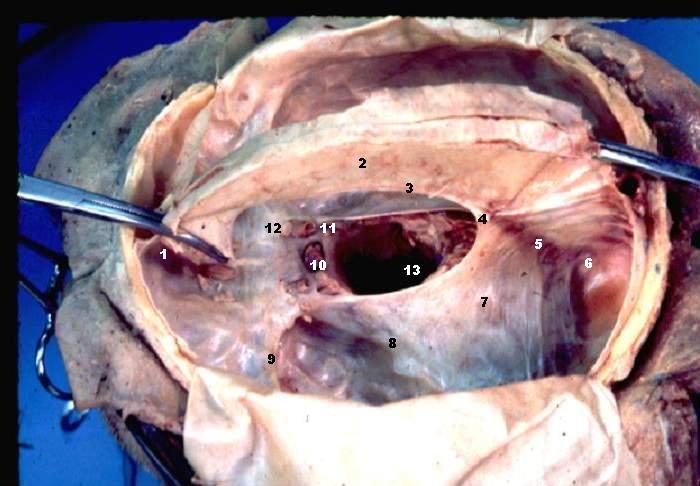
The foramen magnum is the primary opening in the base of the skull that allows continuity between the cranial cavity and the vertebral canal. Located in the occipital bone, it provides passage for neural and vascular structures and marks the point where the brainstem becomes the spinal cord. Its position and orientation are important in anatomy, medicine and the study of vertebrate evolution. For additional anatomical context see the skull base: skull base.
Image gallery
8 Images


Anatomy and contents
The foramen magnum is roughly oval and varies in size and shape between individuals. Structures that pass through or immediately adjacent to it include:
- Central nervous structures: the medulla oblongata (continuing as the spinal cord) and the meninges surrounding them;
- Cranial nerves: the accessory nerve (spinal root of cranial nerve XI) ascends or descends near the foramen;
- Vessels: vertebral arteries and the anterior and posterior spinal arteries;
- Venous and ligamentous tissue: dural venous sinuses and attachments such as the tectorial membrane and alar ligaments.
Comparative anatomy and evolution
The position of the foramen magnum varies with head posture and locomotion. In modern humans it is located more anteriorly (under the skull) compared with many quadrupedal mammals, reflecting upright, bipedal posture. In quadrupeds the opening is set further back on the occiput. Anthropologists use its placement, size and orientation as one of several indicators of locomotor habits in fossil hominins and other vertebrates, though it is interpreted alongside many other skeletal features.
Clinical and practical significance
In medicine the foramen magnum is a site of potential pathology: crowding of posterior cranial fossa structures can lead to brainstem compression or herniation, congenital anomalies (e.g., Chiari malformations) may involve descent through the foramen, and traumatic fractures of the occiput can threaten the structures that pass through it. Surgical approaches to the craniovertebral junction require detailed knowledge of the foramen magnum's relationships.
Anthropology and notable facts
Foramen magnum measurements contribute to forensic identification and paleoanthropological analyses, helping to infer posture and bipedalism when combined with other skeletal evidence. Because the spinal cord and associated vessels traverse this opening, its morphology has direct functional and clinical implications. Variation between species and individuals reflects a balance of protective, structural and biomechanical demands.
Related articles
Author
AlegsaOnline.com Foramen magnum: anatomy, function, and significance Leandro Alegsa
URL: https://en.alegsaonline.com/art/35527