
Flag of Uganda
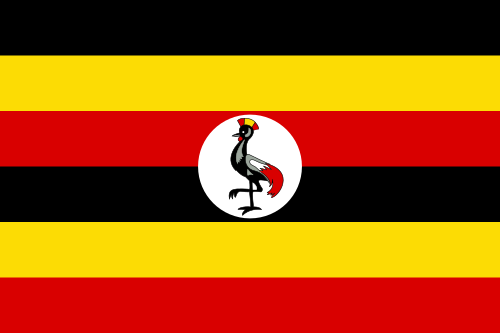
The national flag of Uganda, adopted at independence on 9 October 1962, has six horizontal bands of black, yellow and red and a central white disc bearing the grey crowned crane.
Overview
The flag of Uganda was officially adopted on 9 October 1962, the date the country became independent from the United Kingdom. Commonly called the national flag or, in Swahili, Bendera ya Uganda, it is a distinctive national emblem used by government institutions, public events and on official occasions.
Image gallery
1 Image
Design and symbolism
The design consists of six equal horizontal bands in a repeating sequence and a central emblem. The bands run horizontally across the flag; each color appears twice in the order black, yellow and red. The layout of the bands is often described using the term horizontal rows.
- Black: traditionally represents the people of Uganda.
- Yellow: commonly interpreted as the sun or the country's abundant sunshine.
- Red: stands for the bonds of brotherhood and the common blood shared by all Africans.
Centered on the flag is a white disc showing the grey crowned crane, the national bird. The crane faces the hoist side (the flagpole) and is shown in profile; it has been a symbol of the country since colonial times and was used as a military badge during the protectorate era.
History and adoption
The current flag was chosen at independence to mark a new national identity and to draw on colours associated with Pan-Africanism. While the basic elements date from 1962, the crowned crane motif has older roots as an emblem used in the region and on earlier administrative insignia. The flag's arrangement and the crane's forward-facing posture were deliberately selected to convey progress and unity.
Uses, protocol and notable facts
The flag is flown on public buildings, at official ceremonies and on national holidays. Flag etiquette emphasizes respectful treatment: it should not touch the ground and should be displayed in a position of honor where appropriate. Uganda's banner is notable for featuring a bird rather than a coat of arms or star, and for combining the Pan-African colors in a balanced, repeating pattern. For official references and more details, consult government and historical sources on the flag and national symbols via official pages.
Further reading
For visual guides and the emblem's biology, historical notes, and protocol manuals, see resources on national symbols and ornithological accounts of the grey crowned crane. Additional reference material is available through institutional archives and curated flag collections that explain variations and formal specifications.
Related articles
Author
AlegsaOnline.com Flag of Uganda Leandro Alegsa
URL: https://en.alegsaonline.com/art/34951