
Flag of Vanuatu
National flag adopted at independence in 1980. Features red, green, black and a yellow Y with a boar’s tusk and crossed namele leaves, symbols of Vanuatu’s people, culture and islands.
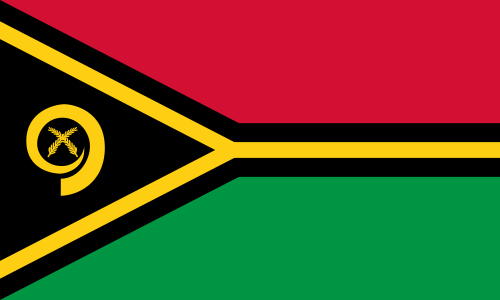
The national flag of Vanuatu was adopted at independence on 30 July 1980. Its composition and motifs were chosen to reflect the islands' natural wealth, the identity of the Ni-Vanuatu people and elements of customary culture. The design is widely used by the state, displayed at public buildings, national celebrations and international events where Vanuatu is represented.
Design and main elements
The design consists of two horizontal bands — red above and green below — separated and edged by a thin, diagonal yellow pall (a Y-shaped band) that converges at the hoist. A black isosceles triangle at the hoist contains a distinctive emblem: a yellow boar’s tusk encircling two crossed namele leaves.
Symbolism
- Black is commonly interpreted as representing the Melanesian people of Vanuatu.
- Green symbolizes the islands' rich vegetation and agricultural resources.
- Red is often associated with the blood of the people and the struggles that led to independence.
- Yellow Y-pall is read as a unifying path or the layout of the archipelago and is sometimes linked with the spread of Christianity.
- Boar’s tusk is a traditional sign of wealth and status in Vanuatu custom.
- Namele leaves (crossed leaves) are regarded as symbols of peace and customary law.
History and adoption
The flag was introduced at the moment of independence following a period of joint British and French administration. The chosen imagery shifts attention away from colonial emblems and emphasizes local culture and unity. For further official background and descriptions see the relevant government or archival pages here.
Usage, variations and notable facts
The flag functions as the national emblem for civil, state and ceremonial use; it is hoisted on public holidays and flown at diplomatic missions. Variations can appear in service flags or protocol contexts, but the basic composition and emblem remain consistent. The combination of a boar’s tusk and namele leaves is distinctive among national flags and links modern national identity to long-standing customary symbols.
Related articles
Author
AlegsaOnline.com Flag of Vanuatu Leandro Alegsa
URL: https://en.alegsaonline.com/art/34956