
Flag of Bosnia and Herzegovina
National flag of Bosnia and Herzegovina: design, symbolism, history, and use. Describes colors, shapes, meaning for constituent peoples, adoption context, and common protocols.
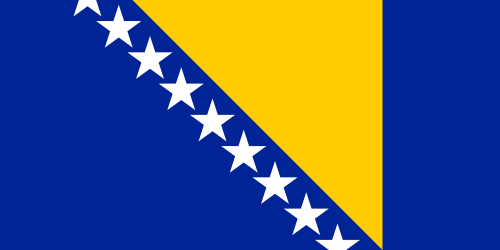
The national flag of Bosnia and Herzegovina features a field dominated by a deep blue background with a prominent yellow triangular shape and a row of white stars. The composition combines geometric forms and a limited palette to convey identity and orientation while avoiding explicit ethnic emblems. The triangle and stars are the flag's most distinctive elements.
Image gallery
2 Images

Design and main elements
Visually, the flag shows a medium blue field interrupted at the fly side by a vertical band; adjacent to that band and touching the top edge is a yellow right triangle whose hypotenuse runs toward the hoist. Along that slanted edge are seven full white stars and two half-stars at the corners, each rendered as a five-pointed star aligned to follow the diagonal. The line of stars runs along the triangle's hypotenuse, giving a sense of motion and continuity across the field.
Symbolism
The three points of the yellow triangle are commonly interpreted as representing the country's three constituent peoples: Bosniaks, Croats, and Serbs. The stars and blue field evoke a European connection and are often read as a visual reference to the flag of Europe, suggesting a desire for unity and international orientation. The choice of neutral geometric imagery was intended to provide a symbol acceptable to multiple communities.
History and adoption
The current design was adopted in the late 1990s during a period of international involvement in the country's post-conflict political arrangements. It replaced earlier flags associated with different entities and political factions and was selected to offer a neutral, state-level emblem. The design process included proposals and revisions intended to balance representational and unifying aims.
Use, protocol, and notable facts
- The flag is used by state institutions and displayed on official buildings and at international events.
- Its colors and stars are the subject of public and political debate at times; some groups have proposed alternative symbols that emphasize regional or ethnic identity while others support the existing flag as a civic emblem.
- Because the design intentionally avoids traditional party or ethnic insignia, it serves primarily as a national identifier and as a signal of European ties.
While straightforward in appearance, the flag embodies compromises typical of multiethnic states: clear, simple visual language intended to represent a shared state without privileging any single group. For further visual details and official specifications, consult national sources and reproductions of the flag as used by state authorities.
Related articles
Author
AlegsaOnline.com Flag of Bosnia and Herzegovina Leandro Alegsa
URL: https://en.alegsaonline.com/art/34746