
First inauguration of Franklin D. Roosevelt
Franklin D. Roosevelt was sworn in as the 32nd U.S. president on March 4, 1933; his inaugural address announced a new approach to the Great Depression and introduced enduring presidential themes.
The first inauguration of Franklin D. Roosevelt took place on Saturday, March 4, 1933, when he was sworn in as the 32nd president of the United States. The ceremony also marked the start of the first term of John Nance Garner as Vice President. This event is commonly identified with the launch of Roosevelt's programmatic response to the economic crisis of the era and with one of the best-known sentences in American political rhetoric.
Image gallery
4 Images


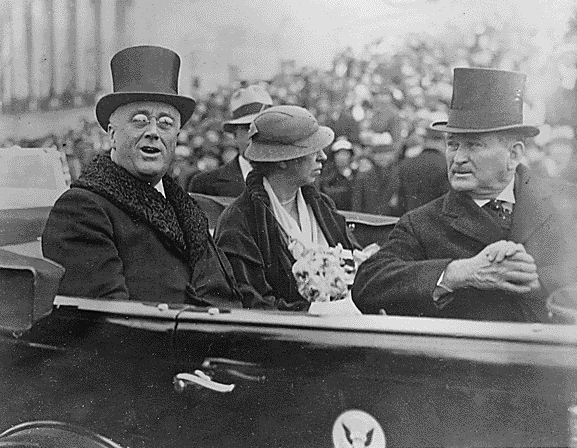
Context and themes
The inauguration occurred against the backdrop of the Great Depression. In his address, Roosevelt set an urgent tone, assuring the public that decisive government action would be taken to address unemployment, banking failures, and economic collapse. The speech emphasized confidence and collective effort; it contains the famous line widely quoted in summaries of the period: "the only thing we have to fear is fear itself." That sentence and the address more broadly framed the political agenda that became known as the New Deal.
Ceremony and particulars
The oath of office was administered on the east portico of the United States Capitol by Chief Justice Charles Evans Hughes. The event followed long-standing inaugurational practice for the time: March 4 was the statutory inauguration day set by earlier law. Roosevelt's 1933 swearing-in was the final presidential inauguration to be held on March 4; the 20th Amendment, ratified in 1933, moved the legal date for future inaugurations to January 20, a change that took effect with the 1937 inauguration.
Roosevelt's inauguration is notable for launching a period of sustained presidential activism. It was the first of four inaugurations for Roosevelt and is often studied as a turning point in the expansion of federal policy during acute economic distress. The address did not spell out every policy detail but signaled a willingness to experiment with new programs and to use the presidency as an engine of national recovery.
Notable facts
- Date: March 4, 1933 — the last inauguration held on that date.
- Principal figures: Franklin D. Roosevelt and John Nance Garner (Vice President).
- Legal change: the 20th Amendment altered future inauguration timing to January 20.
- Historical significance: beginning of the New Deal era and a new, more activist presidency.
Readers interested in the text of the address, contemporary accounts, and subsequent policy developments can consult primary and secondary sources for fuller treatment of how that inaugural moment shaped American government and public expectations. For more information on Roosevelt's life and presidency see biographical resources and materials about the inauguration itself. Contemporary studies of Garner and the vice presidency are available via specialized references indicated by inauguration records and archival collections relating to the presidency.
Related articles
Author
AlegsaOnline.com First inauguration of Franklin D. Roosevelt Leandro Alegsa
URL: https://en.alegsaonline.com/art/34548