
Fill (music) — short instrumental passages in popular music
A fill is a brief instrumental passage used between vocal or melodic lines to ornament, connect, or punctuate a song; distinct from a full solo and common across many popular genres.
Overview
A fill in popular music is a short instrumental passage placed between vocal or melodic phrases. It functions as punctuation or transition inside a song without turning into an extended improvised solo. Fills are usually concise—often a fraction of a measure to a few bars—and appear at phrase endings, before a chorus, to lead into a bridge, or to cover a singer's breath.
Image gallery
1 Image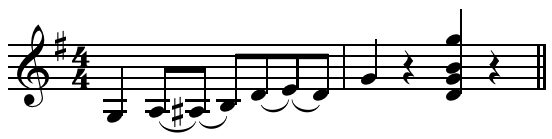
Characteristics
Fills serve several musical roles at once: they add variety, reinforce the song's groove, and emphasize harmonic or rhythmic changes. A well-placed fill interacts with the main melody and the underlying harmony so it feels like an extension of the arrangement rather than a competing idea. In tempo and texture they may echo the song's rhythmic pattern or deliberately contrast it for effect.
Instrumentation and technique
Any instrument can play fills, but some are especially common. Keyboard instruments such as piano or organ often supply short harmonic or arpeggiated fills (keyboard), while single-note or chordal fills on electric or acoustic guitar are staples in rock, pop and country. Wind instruments—saxophone, trumpet, or clarinet—can add melodic punctuation; for example a brief saxophone riff between vocal lines. Bass and percussion also contribute: bass fills outline harmonic movement and drum fills signal phrase endings or transitions.
- Common guitar techniques: hammer-ons, slides, small licks and arpeggios.
- Keyboard approaches: comping stabs, runs, or short countermelodies.
- Drum techniques: tom patterns, snare accents and cymbal crashes.
Function and history
The practice of using short instrumental responses dates back to early jazz and blues, where call-and-response and brief improvised interjections were common. In later popular music and studio production, fills became an essential arranging device—added by band members or session musicians—to create momentum and keep repeated sections interesting. Across genres, fills are tailored to style: tightly metered in disco and pop, more syncopated in funk, and more ornamented in blues and country.
Distinctions and notable facts
Fills are distinct from solos in length and purpose: a solo is typically a featured, extended improvisation, while a fill is short and supportive. The term "drum roll" is often used colloquially for a drum fill, but technically a roll is a sustained, repeated stroke on a single drum while a drum fill usually breaks the regular pattern and may use multiple drums and timbres (drum). Because fills are concise, they are a key way performers and producers add personality to a recording without altering a song's structure.
For further reading on arranging, performance practice, and examples in different styles, consult instruments and production references that discuss phrasing and groove in popular music. Many tutorials illustrate common fills for guitar, keyboard and drum, and recordings across decades show how a small phrase can become a memorable part of a track. Studio session practice also highlights how subtle fills, added in mixing and overdubbing, shape the final arrangement.
Related articles
Author
AlegsaOnline.com Fill (music) — short instrumental passages in popular music Leandro Alegsa
URL: https://en.alegsaonline.com/art/34318