
Feldkirch District (Vorarlberg, Austria)
Administrative district in western Austria centered on the medieval town of Feldkirch; covers alpine foothills and Rhine valley areas and had about 100,656 inhabitants in 2012.
Overview
The Feldkirch District is an administrative district in the western Austrian state of Vorarlberg. It occupies a compact area of 278.26 km² and, as recorded in 2012, had a population of 100,656. The district blends urban centres, smaller market towns and rural communities and serves as an important local hub near Austria's western borders.
Image gallery
2 Images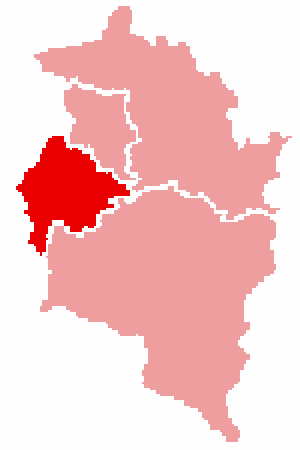

Geography and landscape
Feldkirch District lies in the alpine foreland and Rhine valley region, with a mix of river plains and rising foothills that lead into higher Alpine terrain. This varied topography supports agriculture in the valleys and forestry and recreation opportunities in the surrounding hills. Its location close to neighbouring Liechtenstein and Switzerland gives the district a cross-border character in both landscape and daily life.
Administration and settlements
The district's administrative centre is the town of Feldkirch, a historic urban centre that provides government services, commerce and cultural institutions for the surrounding municipalities. The district comprises a number of towns and smaller communities, each with local councils that handle municipal matters while larger administrative functions are coordinated from Feldkirch.
History and notable sites
Feldkirch developed from medieval origins and retains historic architecture and fortified structures that reflect its past as a regional stronghold. A well-known landmark in the town is the Schattenburg fortress, which overlooks the old streets and is representative of the district's long-settled character. The region's history is tied to trade routes through the Rhine valley and to cross-border exchanges with neighbouring regions.
Economy, transport and culture
The local economy combines services, light industry, retail and tourism. Proximity to international borders encourages commuting and commercial links with Switzerland and Liechtenstein. Transport connections include regional road and rail links that connect the district with other parts of Vorarlberg and wider Central Europe. Cultural life features traditional events, markets and museums that highlight regional customs and history.
Population and significance
With an urban core surrounded by smaller communities, the district exhibits the mixed settlement patterns typical of the region. German is the predominant language, including Alemannic dialects common in western Austria. As part of Austria, Feldkirch District plays a role in cross-border cooperation, local administration and as a gateway between Austria and neighbouring countries.
- Area: 278.26 km²
- Population (2012): 100,656
- Administrative centre: Feldkirch
Related articles
Author
AlegsaOnline.com Feldkirch District (Vorarlberg, Austria) Leandro Alegsa
URL: https://en.alegsaonline.com/art/33906
Sources
- vorarlberg.at : "vorarlberg.at Landesstatistik Bevölkerung"