
Face detection: overview, methods, history, uses, and issues
Face detection locates human faces in images or video. This article explains common techniques, history, applications, limitations, and how it differs from recognition and landmarking.
Overview
Face detection is a computer vision task that finds and localizes human faces in digital images or live video. It returns bounding boxes or regions where faces appear, often as the first step before further analysis such as landmarking, recognition, or expression estimation. Basic detection does not identify who the person is; it only determines where faces are present.
Image gallery
1 Image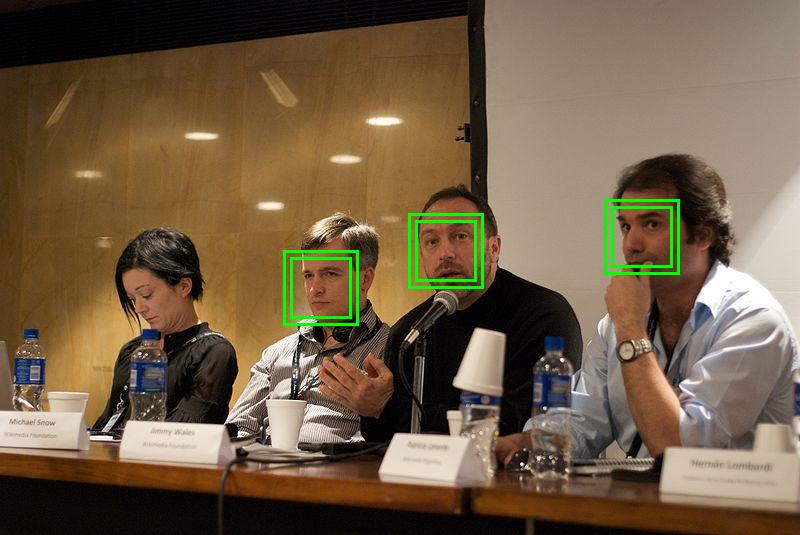
Common techniques
Approaches have evolved from hand-crafted features to deep learning. Typical methods include:
- Classical models: template matching, Haar cascades and histogram-of-oriented-gradients (HOG) with SVMs.
- Deep learning: convolutional neural networks (CNNs) and single-shot detectors adapted to faces (for example multi-task networks that predict boxes and landmarks).
- Hybrid pipelines: stacked stages that combine fast proposal methods with a more accurate classifier or regression stage.
History and development
Early research used simple templates and statistical classifiers. A landmark in practical, real-time detection was a cascade-based method developed in the early 2000s. The rise of deep learning in the 2010s led to substantial gains in accuracy and robustness, enabling detection under varied poses, scales and lighting.
Applications
Face detection underpins many consumer and industrial uses: autofocus and tagging in photography, augmented-reality filters, driver monitoring, human–computer interaction, and preprocessing for biometric systems. It also appears in video analytics for crowd counting and behavior analysis.
Limitations, distinctions and concerns
Performance depends on image resolution, pose, occlusion, and lighting. Face detection is distinct from face recognition (identifying or verifying identity) and from facial landmarking (locating keypoints such as eyes and mouth). Practical deployment raises privacy and ethical questions; systems can misidentify or perform unevenly across demographic groups. For more technical resources and datasets see research surveys, implementation guides at developer pages, and benchmark collections and papers at academic repositories.
Related articles
Author
AlegsaOnline.com Face detection: overview, methods, history, uses, and issues Leandro Alegsa
URL: https://en.alegsaonline.com/art/33185