
Abbottabad Central — historic core and union council of Abbottabad
Abbottabad Central is a union council in Abbottabad city, Khyber Pakhtunkhwa, Pakistan. It contains Old Abbottabad with colonial-era Civil Lines and the Military Cantonment and several notable historic landmarks.
Overview
Abbottabad Central is an administrative Union Council within Abbottabad District, located in Abbottabad city in the province of Khyber Pakhtunkhwa, Pakistan. As part of the city core, it combines residential, commercial and civic functions. The area around the old town remains a focal point for municipal services, marketplaces and public green spaces.
Image gallery
1 Image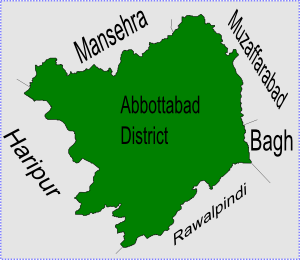
Geography and administrative borders
Abbottabad Central occupies a central position in the urban fabric of Abbottabad and is bordered by neighboring union councils: Malikpura Urban to the north and west, Salhad to the south and Dhamtour to the east. These adjacent divisions reflect the city's mixture of older quarters and expanding residential suburbs. The union council structure provides a level of local governance responsible for community services, minor infrastructure and civic administration.
History and origin
The core known as Old Abbottabad dates back to the mid-19th century. It was established in January 1853 by Major James Abbott, a British officer who lent his name to the town. During the period of the British Raj the settlement grew as a garrison and administrative post. The historic urban plan includes two contrasting sectors: the Civil Lines, intended for civilian officials and residences, and the Military Cantonment, a fenced and regulated area for army accommodation and facilities.
Major landmarks and built heritage
Abbottabad Central contains several well-known heritage sites and civic attractions dating from the colonial era. Many of these remain visible in the townscape and continue to draw local visitors:
- Saddar (Main) Bazaar — the traditional commercial spine of the old town, often called the Old Bazaar.
- St Luke's Church — a colonial-era church that testifies to the town’s British-period community.
- Old Christian Cemetery — a historic burial ground linked to the town’s earlier expatriate and military residents (Old Christian Cemetery).
- Lady Garden Park — a long-established public garden and recreational space (Lady Garden Park).
- Abbottabad Club and other British Indian Army era buildings that reflect the military and social institutions of the time (British Indian Army).
Functions, significance and everyday life
Today Abbottabad Central functions as both a living neighbourhood and a repository of civic memory. Markets, government offices and small businesses operate beside colonial-era residences and military facilities. The Civil Lines area retains older residential streets and administrative buildings, while the Cantonment remains an organized military precinct with its own rules and land use. The coexistence of these sectors shapes traffic patterns, property use and public services.
Conservation, challenges and prospects
Preserving the historic fabric of Abbottabad Central faces several challenges: urban growth pressures, changing land values, and the need to upgrade infrastructure without erasing heritage features. Local authorities, heritage groups and residents debate how to balance conservation with modernization, including maintaining parks and cemeteries, adaptively reusing old buildings and improving municipal services. Well-managed conservation could support cultural tourism and community identity while allowing the area to evolve to meet contemporary needs.
For more information about administrative arrangements, local history and visitor guidance, see resources and official pages related to the district and city: Abbottabad District, Abbottabad city, and provincial information via Khyber Pakhtunkhwa. Historical summaries and site details can be found through archives and regional studies that discuss Major James Abbott and the town’s development during the British Raj.
Tags
Related articles
Author
AlegsaOnline.com Abbottabad Central — historic core and union council of Abbottabad Leandro Alegsa
URL: https://en.alegsaonline.com/art/326
Sources
- abbottabad.gov.pk : District Government Abbottabad