
Éponine — character from Victor Hugo's Les Misérables
Éponine Thénardier, daughter of the Thénardiers in Victor Hugo's Les Misérables, transforms from a pampered child to a streetwise adolescent whose unrequited love and sacrifice make her a memorable tragic figure.
Éponine Thénardier is a supporting character in Victor Hugo's novel Les Misérables. Introduced as the eldest daughter of the Thénardier innkeepers, she appears early on as a spoiled child but later returns as a ragged, worldly adolescent. Hugo portrays her with linguistic color drawn from the argot of Parisian streets and with a mixture of toughness and lingering innocence. Her story is noted for its emotional intensity and for themes of loyalty, unrequited love and moral complexity in an urban setting. For information on the novel itself see the novel.
Image gallery
5 Images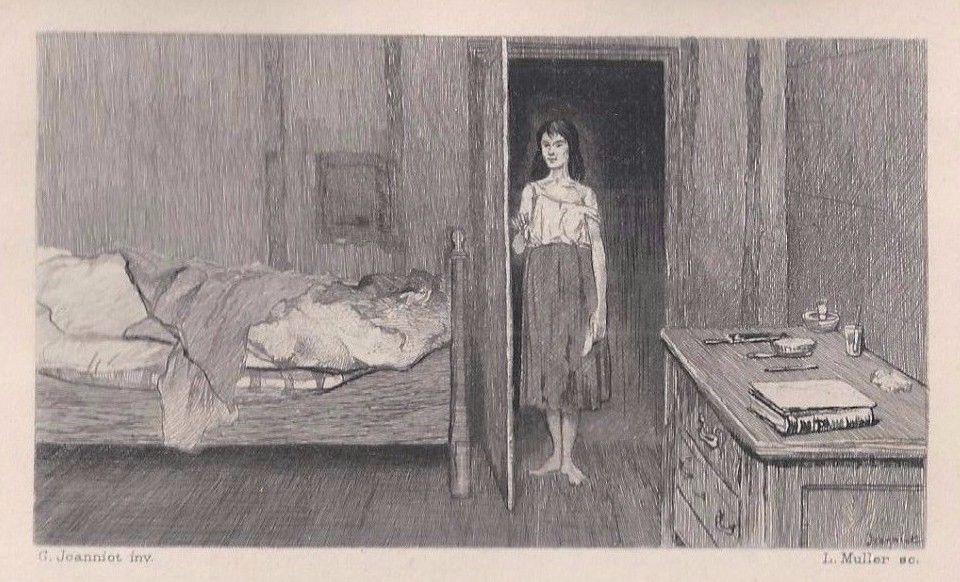


Characteristics and narrative role
Éponine is depicted as intelligent, quick-witted and resourceful. Poverty and neglect harden her, yet she repeatedly demonstrates capacity for sacrifice and tenderness that contrasts with her parents' self-interest. Her love for the young republican Marius Pontmercy is central to her narrative function: it shapes her decisions and ultimately drives her to acts that alter the course of the main plot. Hugo uses her character to explore how personal feeling and social circumstance intersect.
Background and development
Born to Madame and Monsieur Thénardier, Éponine's early life in the novel is marked by indulgence at the family inn; as the Thénardiers' fortunes decline the children suffer neglect and are drawn into petty crime. Hugo emphasizes the change in her appearance and speech to show the effects of urban destitution. Critics have observed that Éponine's shifting social position and occasional aliases reflect the instability of urban life in 19th-century Paris; for context on Hugo and his milieu, see material on Victor Hugo and on social conditions in the period.
Themes, significance and legacy
Éponine embodies several of Hugo's preoccupations: the possibility of moral worth among the poor, the tragedy of wasted potential, and the redemptive value of self-sacrifice. Her final actions—bravely protecting Marius at the barricade and revealing the depth of her devotion—have been read as a moment of personal redemption that complicates simple judgments about virtue and vice. Scholars often discuss Éponine in studies of class representation, language, and the emotional economy of the novel; she remains a frequent subject in literary criticism for her psychological realism and tragic dignity.
Adaptations and portrayals
- Stage: Éponine is a prominent role in the long-running musical adaptation, where songs such as "On My Own" give voice to her inner life and have become iconic in modern theatre.
- Screen: Numerous film and television adaptations present Éponine in varied ways, from a plaintive, sympathetic figure to a harder-edged survivor; musical film versions have further popularized her image.
- Scholarship and culture: Éponine frequently appears in discussions of adaptation, performance history and the reception of Hugo's work; for introductions and performance listings see resources collected here.
As a literary figure Éponine continues to attract attention for the poignancy of her personal arc and for what she reveals about family, poverty and love in Hugo's social imagination. Readers and students often explore her role alongside studies of the novel's political and historical background; introductory materials and editions of the text are available through general guides and academic commentaries about the novel and through biographical and critical resources on Victor Hugo. For broader treatments of Paris and 19th-century social life consult overviews on that era and standard editions of the work itself.
Related articles
Author
AlegsaOnline.com Éponine — character from Victor Hugo's Les Misérables Leandro Alegsa
URL: https://en.alegsaonline.com/art/31770