
Eugene Onegin
A poetic novel by Alexander Pushkin, Eugene Onegin is a foundational work of Russian literature known for its distinctive stanza form, social satire, and enduring influence on arts and letters.
Overview
Eugene Onegin is a novel in verse by Alexander Pushkin that occupies a central place in Russian literature. Written and published in parts during the late 1820s and early 1830s, the work combines narrative energy, lyric reflection and social observation. The poem is narrated by a conversational, omniscient voice — often a lightly fictionalized version of Pushkin himself — whose asides and judgments shape readers' perceptions of character and setting.
Image gallery
7 Images


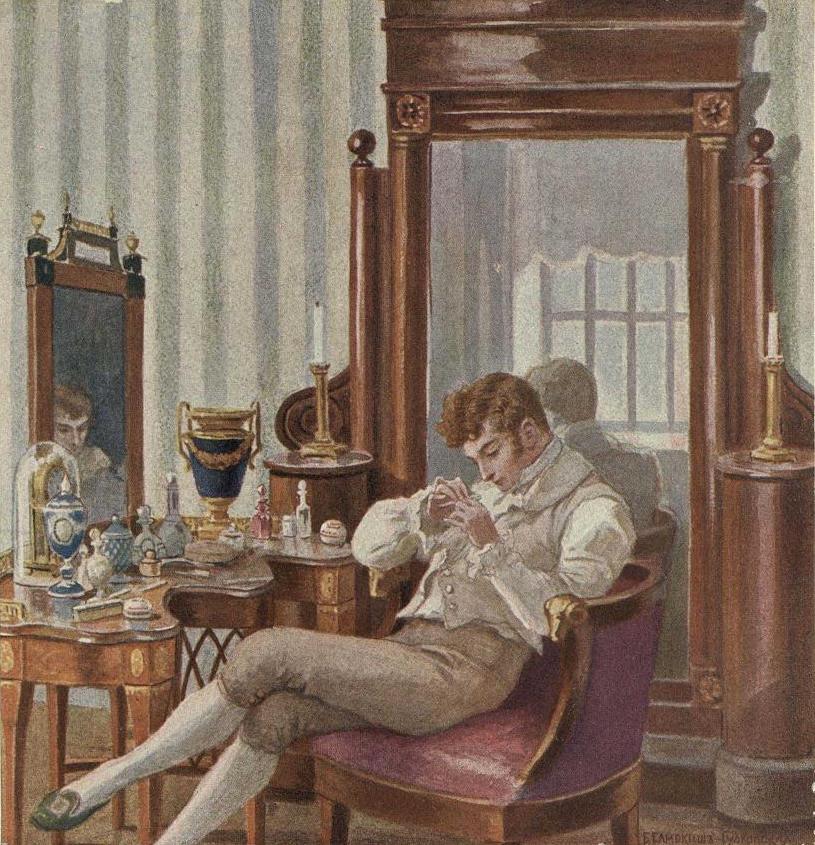


Form and style
The poem is composed almost entirely of 389 stanzas in iambic tetrameter and is famous for a distinctive rhyme pattern sometimes called the "Onegin stanza" or "Pushkin sonnet." The complex scheme (often rendered as AbAbCCddEffEgg) gives the verse flexibility to move between epigram, conversation, reflection and pictorial description. This tightly engineered form presents a particular challenge for translators, who must balance fidelity to sound, rhythm and meaning; consequently, multiple English renderings emphasize different priorities in reproducing Pushkin's effects.
Plot and principal characters
At the center of the story is the disenchanted aristocrat Eugene Onegin, a world-weary man of fashion. Key figures include the introspective young woman Tatyana, her vivacious sister Olga, and the idealistic poet Lensky. The narrative traces social life in St. Petersburg and the countryside, a passionate but unrequited love, and a climactic duel that shapes the fates of the protagonists. The sequence of events — Tatyana's heartfelt letter, Onegin's rejection, the fatal duel with Lensky, and a later reunion marked by reversed feelings — is treated with irony, moral subtlety and psychological insight.
Themes and significance
Pushkin's poem explores themes of ennui, the limits of social ritual, the consequences of rash action, and the tension between individual feeling and public convention. Its narrator repeatedly reflects on history, art, and the manners of the age, turning social comedy into moral meditation. The work has been read as both a critique of fashionable life and a foundational experiment in Russian realism that anticipates later novelistic concerns.
Publication history and critical reception
Published in installments during the 1820s–1830s, the text reached its widely accepted form after several editions and corrections. Readers and critics have long admired Pushkin's technical mastery, his compressive storytelling, and the lively narrative voice that alternates intimacy and irony. Scholarly interest has also centered on the poem's formal invention and its role in shaping modern Russian prose and poetry.
Adaptations, translations, and legacy
The poem has inspired many adaptations across the arts. Most famously, composer Pyotr Ilyich Tchaikovsky based an opera on the story; filmmakers, choreographers and other composers have also drawn on its characters and themes. English readers encounter the work through a number of translations and approaches: some aim to reproduce the stanzaic music and rhyme, while others prioritize literal sense or psychological nuance. Translators and commentators frequently discuss how to render the distinctive verse and the narrator's tone.
- Structure: 389 stanzas of iambic tetrameter forming the Onegin stanza.
- Genre: novel in verse that blends narrative with lyric and satiric elements.
- Language: originally written in Russian; widely translated.
- Cultural importance: foundational text in the Russian literary canon.
Because of its formal innovation, psychological depth and social range, Eugene Onegin remains a frequent subject of study in literature courses and a continuing source of artistic adaptation. Readers encounter in Pushkin a work that is at once of its historical moment and strikingly modern in its exploration of character and chance.
For further reading and resources, consult introductions, annotated editions and performance histories that examine the poem's language, publication variants and its many afterlives in theatre, music and film. See also discussions of translation strategies and specific modern interpretations.
Pushkin scholars and translators continue to debate aspects of tone, nuance and the poem's social critique, underlining its status as an enduring classic.
Additional resources: original Russian title, novel in verse, rhyme pattern, operatic adaptation, stanza structure, verse mechanics, literary context, author biography.
Questions and answers
Q: What is Eugene Onegin?
A: Eugene Onegin is a novel in verse by Alexander Pushkin and is a classic of Russian literature.
Q: When was Eugene Onegin published?
A: It was published in parts between 1825 and 1832.
Q: When was the first complete edition of Eugene Onegin published?
A: The first complete edition was published in 1833.
Q: What is the currently accepted version of Eugene Onegin based on?
A: The currently accepted version is based on the 1837 publication.
Q: What is the rhyme scheme of the stanzas in Eugene Onegin?
A: The rhyme scheme of the stanzas in Eugene Onegin is "AbAbCCddEffEgg", which has come to be known as the "Onegin stanza" or the "Pushkin sonnet."
Q: Who tells the story in Eugene Onegin?
A: The story is told by a narrator, who is a lightly fictionalized version of Pushkin.
Q: What is the tone of the narrator in Eugene Onegin?
A: The tone of the narrator in Eugene Onegin is educated, worldly, and intimate. The narrator digresses at times, commenting on aspects of the social and intellectual world to help develop the characters and drama of the plot.
Related articles
Author
AlegsaOnline.com Eugene Onegin Leandro Alegsa
URL: https://en.alegsaonline.com/art/32490