
Economic sector
An overview of economic sectors: definitions, common classifications (primary, secondary, tertiary and beyond), historical development, measurement, examples, and key distinctions.
The term economic sector denotes a broad category of economic activity within an economy. Sectors group similar kinds of production, services, or institutional roles so governments, businesses and researchers can compare output, employment and trends. Understanding sectors helps explain how economies evolve and where value and jobs are concentrated.
Image gallery
2 Images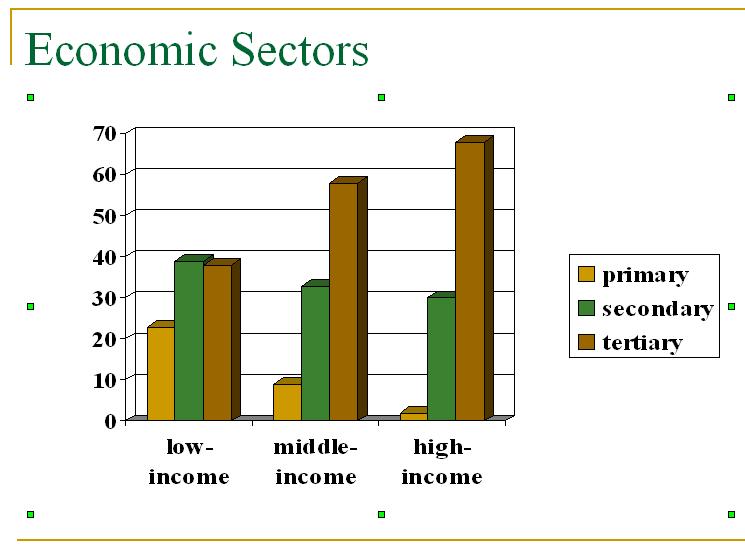

Classification and common types
- Primary: extraction and harvesting of natural resources, such as agriculture, fishing and mining.
- Secondary: transformation of raw materials into goods, including manufacturing and construction.
- Tertiary: services for consumers and businesses, from retail and transport to healthcare and education.
- Quaternary and quinary: knowledge-based and high-level decision services, such as information technology, research, executive management and public administration.
Characteristics and measurement
Sectors are distinguished by inputs, capital intensity, skill requirements and supply chains. Statistical systems often assign activities to sectors so gross domestic product (GDP), employment and trade can be reported by category. Sectoral composition influences productivity, wages and resilience to shocks.
History and development
Analysts have long used sectoral frameworks to describe structural change. The idea that economies shift from agriculture toward industry and then to services is captured by the three-sector hypothesis, a model discussed by several twentieth-century economists. That progression is not uniform: technological change, policy and global trade alter the timing and balance between sectors.
Importance and examples
Policymakers and investors track sectors to guide industrial policy, education and infrastructure. For example, a country with a large primary sector may prioritize rural development, while one with an expanding quaternary sector may invest in universities and digital networks. Multinational firms often organize by sector to manage strategy and regulation.
Distinctions and notable facts
- Sectors overlap: many firms operate across categories (manufacturing firms with service divisions, for example).
- The informal economy and nonmarket activities (household work, volunteer services) complicate measurement.
- Comparative studies use standardized classifications such as national industry codes to ensure consistency.
Related articles
Author
AlegsaOnline.com Economic sector Leandro Alegsa
URL: https://en.alegsaonline.com/art/29961