
Earth's core: structure, properties, and significance
The Earth's core is a dense central region with a liquid outer core and a solid inner core. It is characterized by extreme temperatures and pressures and drives the planet's magnetic field and internal heat flow.
Overview
The Earth's core is the innermost part of the planet, lying beneath the mantle and centered beneath the surface of Earth. It is conventionally divided into two major regions: a fluid outer core and a solid inner core. These regions differ in physical state, composition, density and dynamics. Knowledge of the core comes primarily from the study of seismic waves, laboratory experiments on materials at high pressure, and theoretical models of planetary interiors.
Image gallery
4 Images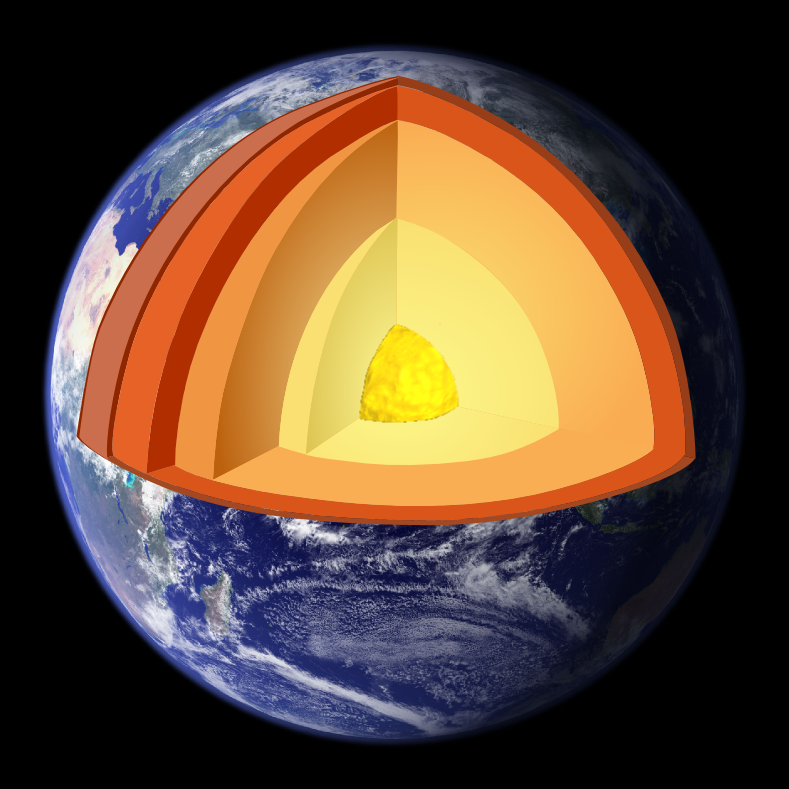


Structure and physical properties
The outer core is a convecting, electrically conducting liquid layer that surrounds the inner core. Its outer boundary with the mantle, the core–mantle boundary (CMB), lies at a depth of about 2,900 km. The outer core extends inward to the inner core boundary. Estimates place the outer core's mean radius around 3,400 km and its density in the range of roughly 9,900 to 12,200 kg/m3. Temperatures in the outer core are estimated to lie between about 4,400 °C in its cooler outer parts and roughly 6,100 °C near the inner core boundary.
The inner core is a compact, largely solid sphere whose radius is estimated at about 1,220 km. Its density is higher than the outer core, with typical values cited around 12,600 to 13,000 kg/m3. The inner core is thought to be composed predominantly of iron with some nickel and light elements; its crystallization from the surrounding liquid is a slow, ongoing process that releases latent heat and light elements into the outer core.
Seismic evidence and discovery
Seismology provides the primary evidence for the core's layered structure. Compressional (P) waves travel through both the mantle and core, but transverse (S) waves do not pass through the liquid outer core, producing a seismic shadow zone that indicates a fluid layer. Refractions and reflections of seismic waves reveal the inner core as a distinct solid region. The existence of a solid inner core was first inferred in the 20th century through detailed analysis of seismic records.
Role and importance
The core plays several central roles in Earth's behavior. Motion and convection within the electrically conducting outer core generate the geomagnetic field through the geodynamo process; this magnetic field shields the surface from much of the solar wind and cosmic radiation. Heat flowing from the core into the mantle helps drive mantle convection, which in turn influences volcanism, mantle plumes, and plate tectonics at the surface.
Composition, dynamics and notable facts
- Composition: Dominated by iron with nickel and lighter alloying elements; precise light-element inventory remains active research.
- Phase differences: Solid inner core vs. liquid outer core—this contrast explains key seismic observations.
- Thermal and chemical effects: Inner-core growth releases heat and buoyant elements that sustain outer-core convection.
- Scientific history: The layered core model and observations such as the seismic shadow zone were milestones in understanding Earth's interior.
Understanding the core remains an active field: improved seismic networks, high-pressure experiments, and numerical models continue to refine estimates of composition, temperature, and dynamic behavior. For concise context on the planet as a whole, see summaries of Earth and for more on inner-core studies consult resources linked under inner core investigations and structural estimates such as the inner and outer core radii.
Related articles
Author
AlegsaOnline.com Earth's core: structure, properties, and significance Leandro Alegsa
URL: https://en.alegsaonline.com/art/29586
Sources
- science20.com : Bruce A. Buffett 2010. Tidal dissipation and the strength of the Earth’s internal magnetic field.
- woodrowshew.com : Woodrow L. Shew, Daniel P. Lathrop 2005. Liquid sodium model of geophysical core convection. Physics of the Earth and Planetary Interiors 153 136–149
- ceo.scec.org : "Module title"
- bbc.co.uk : Heart of Earth's inner core revealed.