
Earth's inner core
The inner core is Earth's central, solid region—mostly iron–nickel—revealed by seismic waves; it influences the planet's magnetic field, thermal evolution, and deep-Earth dynamics.
Overview
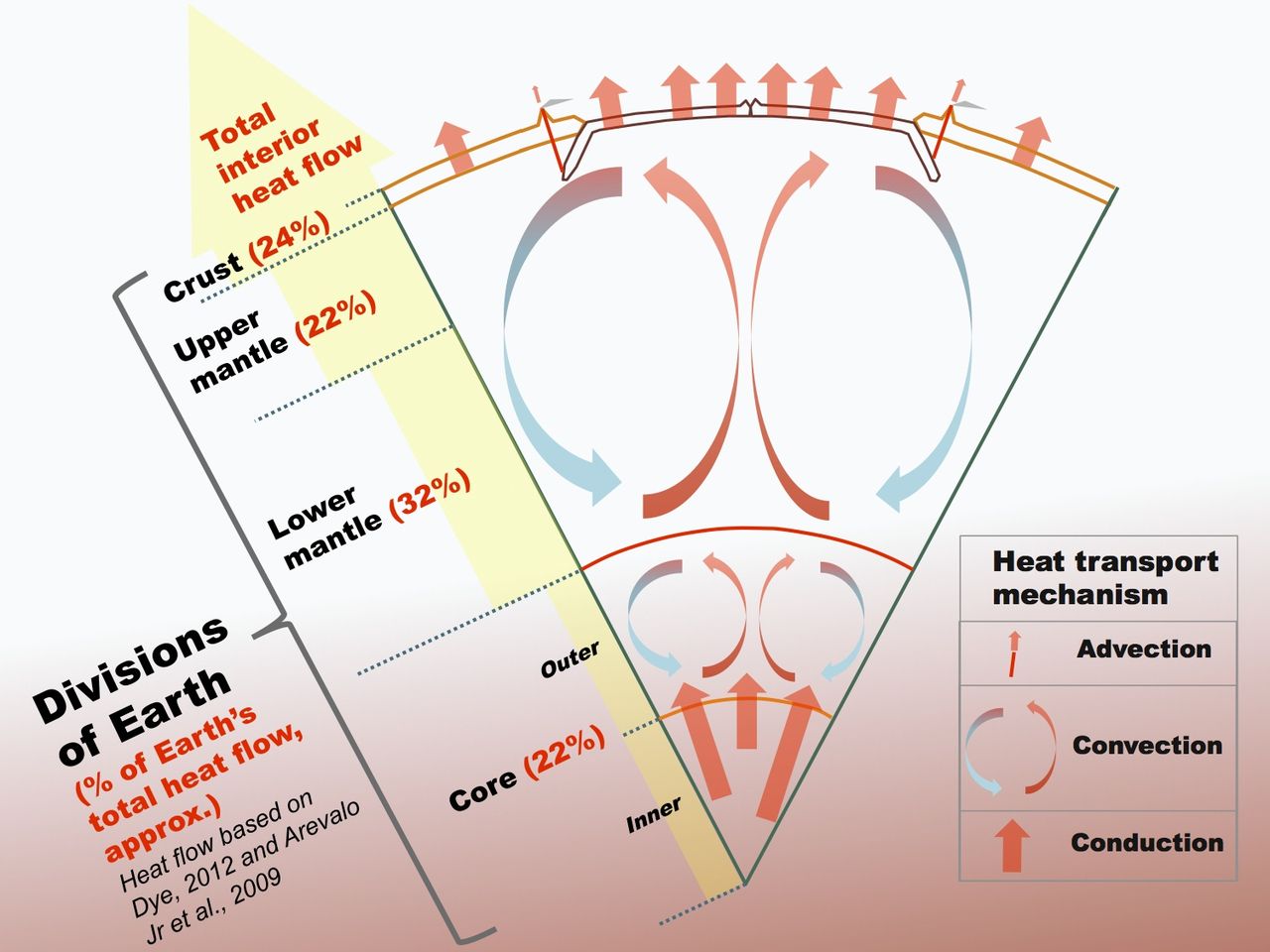
The inner core is the very center of Earth, a dense, primarily metallic sphere that is distinct from the overlying fluid outer core. It is small compared with the whole planet but plays an outsized role in deep-Earth processes. Estimates from seismic data put its radius at roughly 1,220 km and its temperature near several thousand kelvins. Its composition is believed to be dominated by iron with a significant admixture of nickel and lighter elements.
Image gallery
3 Images

Structure and physical conditions
The inner core is mechanically solid, while the surrounding outer core is liquid. That contrast in physical state produces characteristic signatures in seismic records and sets up the boundary that separates different types of wave propagation. Pressure at the center of the planet is enormous, and the combination of extreme pressure and temperature determines whether iron can remain crystalline. Under core conditions the melting temperature of iron rises, allowing a solid phase to exist despite temperatures comparable to the hot parts of the Sun's surface.
How we know: seismology and discovery
Information about the inner core comes almost entirely from seismic waves generated by earthquakes and other large seismic sources. Waves that travel through Earth are bent, slowed or blocked by changes in material and state; careful analysis reveals a small, distinct central region. The solid inner core was inferred by Danish seismologist Inge Lehmann in 1929 when she noted puzzling arrivals from a large earthquake in New Zealand. Her interpretation of seismic travel times led to the two-part core model (solid inner, liquid outer) that is now well established.
Composition, temperature and pressure
Laboratory experiments, mineral physics, and geochemical arguments point to an iron–nickel alloy as the main constituent of the inner core. Light elements such as sulfur, silicon, oxygen or hydrogen may be present in smaller amounts. Estimates of temperature at the inner-core boundary are in the thousands of kelvins, and central pressures are on the order of millions of atmospheres; these factors together control phase relations and the behavior of metals under core conditions.
Dynamics, role and open questions
The inner core grows slowly as the liquid outer core solidifies at the inner-core boundary, releasing latent heat and chemical buoyancy that help drive convection in the outer core and sustain Earth’s magnetic field. Seismologists have also detected subtle anisotropy (direction-dependent seismic speeds) and differences between the outermost and innermost parts of the inner core, leading to hypotheses of an "inner inner core" or variations in crystal alignment. Other active research topics include the precise age of the inner core, whether it rotates slightly differently from the mantle, and how its evolution ties to Earth’s thermal history.
Key points and resources
- Center and size: the inner core occupies Earth's central sphere with a radius ~1,220 km; see Earth's center and size estimates.
- State: solid inner core vs liquid outer core—seismic evidence is summarized in seismology basics and detailed studies at seismological research.
- Composition: predominantly iron and nickel with lighter elements; further reading at iron in the core and nickel content.
- Discovery: Inge Lehmann's 1929 work is documented in historical accounts—see Lehmann's discovery and the 1920s New Zealand earthquake context at New Zealand quake.
- Seismic sources: earthquakes produce the waves that probe the core; a primer is available at earthquakes and waves.
- Temperature and pressure: high temperatures (thousands of kelvins) and extreme pressures explain solid iron at core depths; for temperature comparisons see temperature estimates and numerical values.
- Materials physics and pressure effects are discussed at materials under core conditions and pressure regimes.
Further reading
- Overview of Earth's center
- Seismology fundamentals
- Inner core size and radius
- Seismological studies and datasets
- Iron in the core
- Nickel's role in core composition
- High-pressure material science
- Temperature estimates for the inner core
- Representative temperature values
- Inge Lehmann and the discovery
- The New Zealand earthquake studied by Lehmann
- How earthquakes generate seismic waves
- Pressure at Earth's center
Questions and answers
Q: What is the inner core?
A: The inner core is the very center of the Earth.
Q: What is the temperature of the inner core?
A: The inner core is believed to be about the same temperature as the surface of the Sun: about 5700 K (5400 °C).
Q: What is the radius of the inner core?
A: The inner core has a radius of about 1,220 km (760 mi), according to seismological studies.
Q: What is the inner core believed to consist of?
A: The inner core is believed to consist mostly of an iron–nickel alloy.
Q: Who discovered the inner core and how?
A: The inner core was discovered by Inge Lehmann in 1929 using seismology. Lehmann was studying a large New Zealand earthquake and saw that vibrations seemed to be moving across something solid in the center of the planet, which she called the inner core.
Q: When was the existence of the inner core finally proven?
A: The existence of the inner core was not proved until 1970, even though Inge Lehmann wrote about it for many years.
Q: What is the pressure in Earth's inner core?
A: The pressure in Earth's inner core is about 3,500,000 atmospheres.
Related articles
Author
AlegsaOnline.com Earth's inner core Leandro Alegsa
URL: https://en.alegsaonline.com/art/29588
Sources
- ui.adsabs.harvard.edu : 2010Sci...328.1014M
- doi.org : 10.1126/science.1186212
- pubmed.ncbi.nlm.nih.gov : 20395477
- ui.adsabs.harvard.edu : 1974GeoJI..39..457E
- doi.org : 10.1111/j.1365-246X.1974.tb05467.x
- sciencedirect.com : sciencedirect.com/science/article/pii/S0012821X01005684?via%3Dihub
- stacks.iop.org : "Iron melting curve with a tricritical point"
- arxiv.org : cond-mat/0701283
- ui.adsabs.harvard.edu : 2006JSMTE..12..015A
- doi.org : 10.1088/1742-5468/2006/12/P12015
- arxiv.org : arxiv.org/pdf/cond-mat/0701283
- arxiv.org : arxiv.org/pdf/0807.0187