
Dio Chrysostom: Greek orator, moralist, and author of the Discourses
Dio Chrysostom (c. 40–115 AD) was a Greek orator and moral philosopher from Prusa. His eighty Discourses, letters and essays blend rhetoric, ethical reflection, and practical politics within the Second Sophistic.
Overview
Dio Chrysostom (Greek: Διών Χρυσόστομος), often called Dion of Prusa or Dio Cocceianus, was a leading Greek orator, writer and moral philosopher active in the Roman imperial world around 40–115 AD. A prominent figure of the Second Sophistic, he composed a series of speeches and essays — the most famous body of which is the collection known as the Discourses or Orations — that mix rhetorical skill with practical ethical advice and commentary on public life in the Roman Empire.
Image gallery
1 Image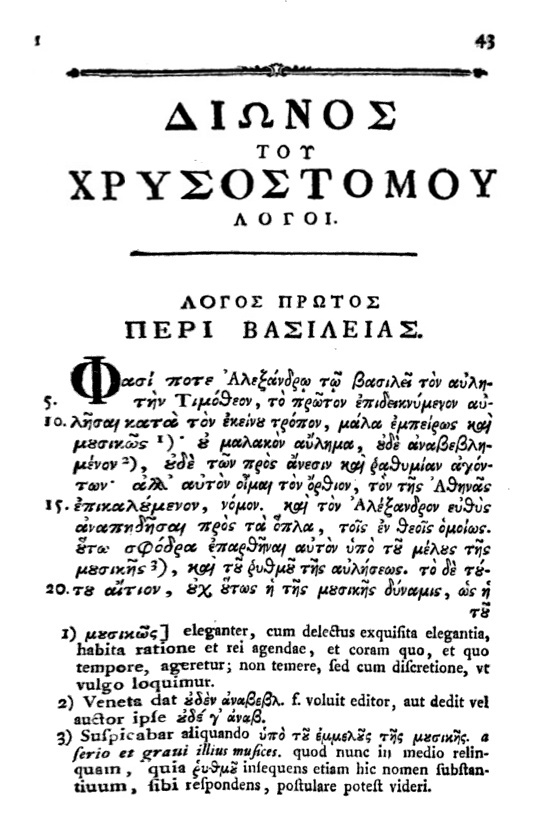
Life and historical context
Dio was born in Prusa (in Bithynia, modern Turkey) and lived through the turbulent later decades of the first century AD. Ancient accounts indicate he suffered exile during the reign of the emperor Domitian, returning to public activity after Domitian's death and the change of regime. During his mature years he traveled widely — to Greece, Italy and possibly to Rome itself — taking part in the intellectual networks of the time and addressing civic audiences across the Greek-speaking provinces.
Writings and main themes
About eighty Discourses survive, together with a number of letters, a few shorter essays (including the playful "In Praise of Hair") and some fragments. The Discourses vary in form and purpose: some are forensic or civic speeches delivered before a city assembly, others are philosophic essays modeled on the Socratic or Platonic tradition, and several present practical guidance on rulers, education and conduct. Common themes include virtue and moral improvement, the responsibilities of leadership, the role of the orator in public life and the value of self-control.
- Surviving genres: orations (Discourses), letters, essays and fragments.
- Recurring topics: ethics, civic duty, kingship, competition between cities and the ideal character.
- Notable short works: the light-hearted In Praise of Hair and various exhortatory speeches.
Style and philosophical outlook
Dio's manner combines rhetorical polish with moral seriousness. He is often pragmatic and conversational, using anecdotes and imagined dialogues to persuade. Philosophically he is eclectic: his ethics show affinities with Stoic and Cynic emphasis on self-discipline and virtue, but he also draws on Platonic forms of moral argument and the practical concerns of civic life. His eloquence earned him the epithet "Chrysostom," literally "golden-mouthed," a label that later readers used to praise his speaking gifts.
Influence and significance
Dio's corpus is an important window on Greek intellectual life under Roman rule and on the Second Sophistic movement, which celebrated classical Greek culture and rhetorical performance. His Discourses preserve details about civic institutions, social expectations and attitudes toward imperial power. Over centuries scholars and translators have studied him for insights into ancient rhetoric, everyday ethics and the interaction between Greek cultural identity and Roman political structures.
Distinctions and common confusions
Because of similar names, Dio Chrysostom is sometimes confused with other figures. He is not the Roman historian Cassius Dio, nor is he the later Christian bishop John Chrysostom of Constantinople. Contemporary descriptions occasionally emphasize his role as an orator and teacher rather than as a systematic philosopher, and modern readers typically approach his works as a blend of rhetoric, moral instruction and social commentary.
Dio's writings survive in Greek manuscripts and in later compilations; they continue to be edited and translated, and they remain a principal source for students of classical rhetoric, imperial-era Greek culture and ancient ethical thought.
Related articles
Author
AlegsaOnline.com Dio Chrysostom: Greek orator, moralist, and author of the Discourses Leandro Alegsa
URL: https://en.alegsaonline.com/art/27514