
Dinitrogen tetroxide (N2O4)
Dinitrogen tetroxide (N2O4) is the colorless dimer of nitrogen dioxide, a reversible oxidizer used in rocketry and industry; it exists in equilibrium with NO2 and is a toxic, corrosive oxidant.
Overview
Dinitrogen tetroxide is a chemical compound with the formula N2O4. It is best understood as the dimer of nitrogen dioxide (NO2): two NO2 units join to form a neutral N2O4 molecule. At lower temperatures and higher pressures the dimer predominates as a colorless or pale yellow liquid; as temperature rises it partially dissociates into brown NO2 gas, producing a temperature-dependent equilibrium. For general reference see compound summary.
Image gallery
4 Images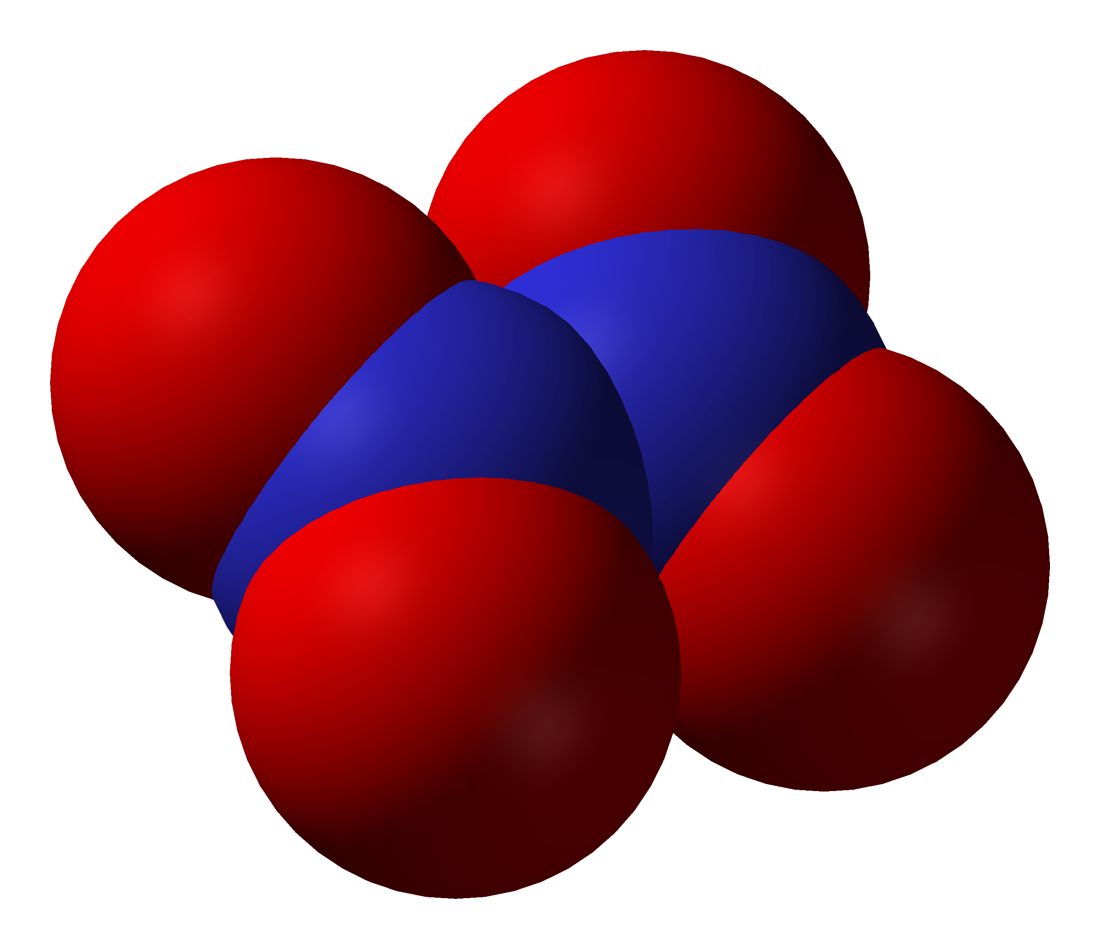


Structure and properties
N2O4 consists of two nitrogen atoms bridged by a single N–N interaction, with each nitrogen bonded to two oxygen atoms. Unlike NO2, which is a paramagnetic radical, the paired electrons in N2O4 make it diamagnetic. Its physical state and color change with temperature because of the reversible dissociation to NO2; this feature affects its handling and storage. Additional technical data is available at properties and data.
Production and history
Industrially, nitrogen oxides are obtained from the oxidation steps used to make nitric acid; NO2 can dimerize to N2O4 when conditions favor the paired form. The compound has been known since studies of nitrogen oxides in the 19th century and later found specialized applications in propulsion and chemistry. Historical and process context is discussed in specialist sources such as industrial chemistry overview.
Uses and applications
N2O4 is primarily valued as a strong oxidizer that can be stored as a liquid under moderate conditions. Its most notable application is as the oxidizer in storable bipropellant rocket systems, where it is used with hypergolic fuels that ignite on contact. It also serves as a reagent in laboratory and industrial oxidations and in studies of nitrogen oxide chemistry. More operational guidance appears at propulsion applications.
Safety, handling and environmental notes
- Hazardous: N2O4 and NO2 are highly toxic, irritating to respiratory tissues, and can cause severe pulmonary injury on exposure.
- Corrosive and a strong oxidizer; it reacts with water to form nitric and nitrous acids and can corrode materials; appropriate materials and containment are required.
- Environmental impact: nitrogen oxides contribute to atmospheric pollution and acid deposition; releases must be controlled.
Practical guidance and regulatory information are provided by safety databases and chemical suppliers; see safety resources for details.
Questions and answers
Q: What is dinitrogen tetroxide?
A: Dinitrogen tetroxide is a chemical compound that contains nitrogen in its +4 oxidation state.
Q: What is the chemical formula of dinitrogen tetroxide?
A: The chemical formula of dinitrogen tetroxide is N2O4.
Q: What are the other names for dinitrogen tetroxide?
A: Dinitrogen tetroxide is also known as nitrogen tetroxide or dinitrogen tetraoxide.
Q: What does dinitrogen tetroxide contain?
A: Dinitrogen tetroxide contains nitrogen and oxide ions.
Q: In which oxidation state nitrogen is present in dinitrogen tetroxide?
A: Nitrogen is present in its +4 oxidation state in dinitrogen tetroxide.
Q: What is the significance of the +4 oxidation state of nitrogen in dinitrogen tetroxide?
A: The +4 oxidation state of nitrogen in dinitrogen tetroxide indicates that it has lost or shared four electrons in bonding.
Q: Is dinitrogen tetroxide a naturally occurring compound?
A: No, dinitrogen tetroxide is not a naturally occurring compound; it is a man-made chemical.
Related articles
Author
AlegsaOnline.com Dinitrogen tetroxide (N2O4) Leandro Alegsa
URL: https://en.alegsaonline.com/art/27490
Sources
- itcilo.it : International Chemical Safety Card