
Data Encryption Standard (DES)
DES is a symmetric block cipher with a 56-bit key and 64-bit block, widely used in the late 20th century and later superseded by stronger algorithms such as AES.
The Data Encryption Standard (DES) is a symmetric-key block cipher that was widely adopted for commercial and government use in the 1970s and 1980s. DES operates on 64-bit blocks and uses a 56-bit effective key. It is a Feistel cipher composed of repeated rounds of substitution and permutation, and was specified as a U.S. federal standard for several decades.
Image gallery
3 Images

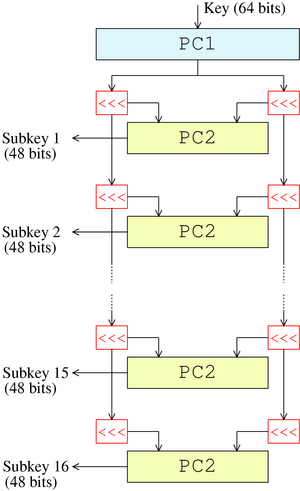
Characteristics and structure
DES transforms a 64-bit input block through 16 rounds of processing. Each round applies a round function that combines the data with a portion of the key, performs expansion, substitution through nonlinear S-boxes, and permutation. The design relies on bit-level permutations and fixed substitution tables; a separate key schedule derives subkeys for each round. Because DES uses the same key for encryption and decryption, it is categorized as a symmetric cipher.
History and development
DES originated from work at IBM and was adopted as a Federal Information Processing Standard (FIPS) in the 1970s. Its standardization provoked debate: some observers questioned the relatively small key size and changes made during standardization. Over time, cryptanalytic advances and increases in computing power exposed DES's vulnerability to exhaustive key search.
Security, attacks, and notable events
By the 1990s researchers and engineers demonstrated tools and projects capable of breaking DES by brute force. A high-profile demonstration was a specialized machine known as Deep Crack, built with support from the Electronic Frontier Foundation, which successfully recovered DES keys by exhaustive search. Such demonstrations underscored that DES's 56-bit key space was too small to resist dedicated attackers using relatively affordable hardware.
Successors, variants, and legacy
- Triple DES (3DES): A stopgap that applies DES three times with two or three keys to extend effective security while remaining compatible with DES implementations.
- Advanced Encryption Standard (AES): Selected in the early 2000s to replace DES-based standards; AES uses larger block and key sizes and stronger design principles (AES).
Today DES is considered obsolete for new systems because of its limited key length and susceptibility to brute-force attacks. It remains important historically as a milestone in cryptographic engineering and standardization. Practical guidance is to migrate legacy systems to AES or other modern, well-reviewed algorithms and use authenticated encryption modes to meet contemporary security requirements.
Related articles
Author
AlegsaOnline.com Data Encryption Standard (DES) Leandro Alegsa
URL: https://en.alegsaonline.com/art/25631