
Decagon (ten-sided polygon)
A decagon is a ten-sided polygon. This article explains its geometry, key measurements, symmetry, construction, variants such as star decagrams, and common uses and distinctions.
Overview
A decagon is a polygon with ten sides and ten vertices. In general use the term refers either to any ten-sided figure (a simple decagon) or specifically to a regular decagon, whose sides and interior angles are all equal. The name derives from the Greek roots deka- (ten) and -gonia (angle).
Image gallery
9 Images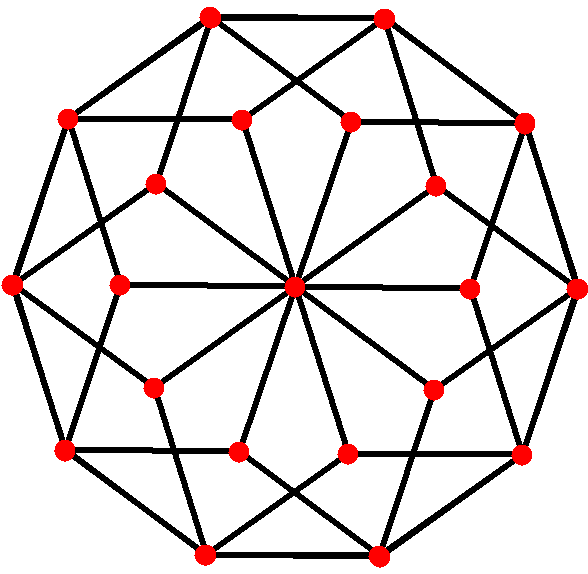




Basic properties
For any decagon the sum of interior angles is 1,440 degrees, obtained from the formula (n-2)×180° with n=10. A regular decagon has each interior angle equal to 144°, and each exterior angle is 36°. The central angle subtended by one side in a regular decagon is also 36°.
- Number of sides: 10
- Number of diagonals: 35 (computed as n(n-3)/2)
- Triangles in a triangulation: 8 (n-2)
- Symmetry group (regular): dihedral group D10 of order 20
Formulas and construction
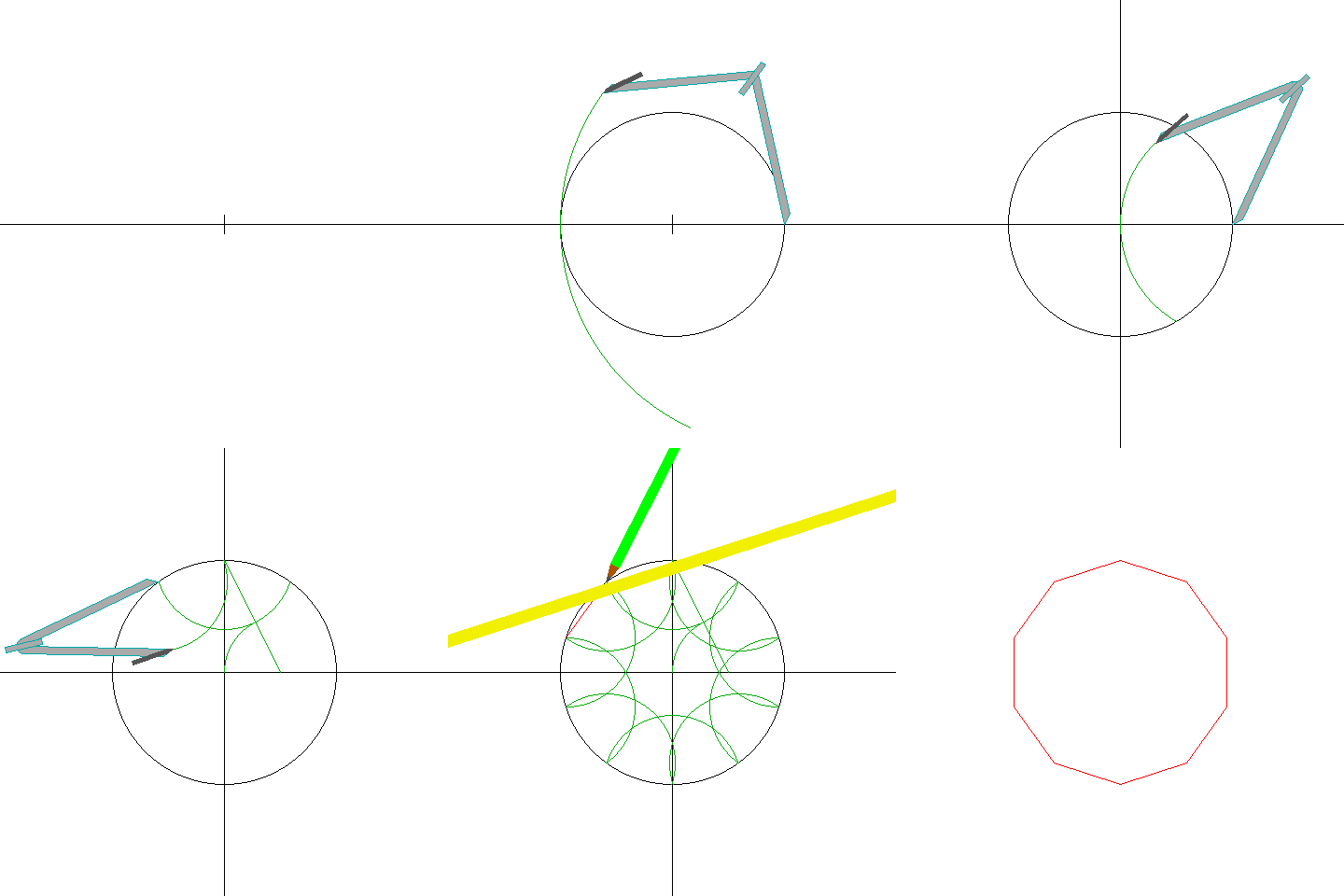
The area A of a regular decagon with side length s can be expressed by the standard regular-polygon formula A = (1/4) n s^2 cot(π/n) with n=10, or by equivalent trigonometrical forms involving the apothem or circumradius. Because 10 = 2×5 and a regular pentagon is constructible with straightedge and compass, a regular decagon is likewise constructible using classical methods.
Variants, history and notable facts
Beyond the convex regular decagon, there are star polygons called decagrams, commonly denoted {10/3} or {10/4}, which connect every third or fourth vertex to form 10-pointed stars. The geometry of the regular decagon is closely related to that of the regular pentagon; ratios of diagonals and side lengths involve the golden ratio in familiar ways. The concept has been known since antiquity and appears in decorative patterns and tiling motifs where tenfold repetition is desired.
Uses and examples
Decagonal shapes appear in architecture, design, coinage, and game boards where tenfold symmetry or ten segments are useful. Although a regular decagon does not tile the plane by congruent copies alone, it appears within composite tilings and ornamental layouts. For a general introduction to polygons and related construction techniques see polygons.
Related articles
Author
AlegsaOnline.com Decagon (ten-sided polygon) Leandro Alegsa
URL: https://en.alegsaonline.com/art/26098