
Alfonso VII of León and Castile
Medieval Iberian monarch (1105–1157), called "the Emperor" for asserting overlordship of Christian Spain; ruled León, Castile and Galicia and shaped succession and relations with Portugal.
Alfonso VII (1105–1157), often styled "el Emperador" (the Emperor), was a major Christian ruler on the Iberian Peninsula in the first half of the 12th century. Born Alfonso Raimúndez to Queen Urraca of León and Raymond of Burgundy, he was raised in a period of dynastic rivalry and territorial fragmentation. From early childhood he held power in Galicia and, after his mother's death in 1126, he succeeded to the crowns of León and Castile, beginning a reign that lasted until his death in 1157.
Image gallery
3 Images
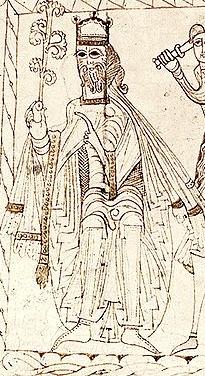

Reign and the imperial title
Alfonso adopted an imperial style in official documents to assert a primacy among the Christian monarchs of Iberia. His charters used an elevated title that claimed broader authority and he was publicly acknowledged with this dignity in a ceremonial setting at León in 1135. The use of an imperial style reflected both political ambition and medieval conceptions of hierarchy among kings, rather than a direct equivalence with contemporary Holy Roman emperors.
Territorial rule and politics
During his reign Alfonso VII governed a composite realm made up of León, Castile and Galicia. He relied on traditional royal institutions — charters, noble alliances and ecclesiastical support — to maintain control. His court issued documents and hosted councils that regulated land tenure and royal privileges. Those interested in primary documents can consult reproductions of his charters and acts, often cited as examples of his imperial rhetoric: imperial charters and the ceremonial record of 1135 is discussed in many narrative sources: ceremonial account.
Relations with neighbouring polities
Alfonso's reign coincided with important developments elsewhere on the peninsula. In the northwest the county that became Portugal moved toward independence under Afonso Henriques: a decisive step occurred in 1128 and Portuguese sovereignty received wider diplomatic acknowledgement by the 1140s. Contemporary and later accounts note these events alongside interactions between Alfonso's court and other Iberian rulers. For general context on Iberian politics of the period see compilations and surveys: Iberian political context, regional chronicles.
Succession and legacy
Alfonso VII died in 1157 after a long reign and his realms did not remain united. He divided his inheritance between his sons: the senior line continued in Castile while León passed to another heir, a partition that shaped later centuries of Iberian history. His use of imperial titulature, patronage of monasteries and the balance he struck between noble families and the church left a lasting imprint on medieval Spanish kingship. For studies on his dynastic legacy and the contemporary emergence of Portuguese independence see: dynastic studies and Portuguese independence.
- Born: 1105; son of Urraca of León and Raymond of Burgundy.
- Acceded: King of Galicia as a child; King of León and Castile from 1126.
- Imperial recognition: 1135 ceremonial acknowledgment at León.
- Died: 1157; realms divided between his sons.
Alfonso VII stands as a representative of 12th-century monarchy in Iberia: a ruler who sought both territorial control and symbolic supremacy, whose policies intersected with the wider Reconquista and with the emergence of new political entities such as Portugal. His reign illustrates how medieval kings combined legal forms, ceremonial display and military action to build authority amid competing dynastic and regional claims.
Related articles
Author
AlegsaOnline.com Alfonso VII of León and Castile Leandro Alegsa
URL: https://en.alegsaonline.com/art/2473
Sources
- commons.wikimedia.org : Alfonso VII of León and Castile