
Alex (parrot): African grey studied for animal cognition and communication
Alex (1976–2007) was an African grey parrot studied by Irene Pepperberg; his ability to use vocal labels, label absence, and perform concept-based tasks influenced research on avian intelligence.
Alex (1976–2007) was a male African grey parrot (African grey parrot) kept and studied by psychologist Irene Pepperberg. Over three decades of careful experimental work, Alex became widely known for using a repertoire of vocal labels to identify objects, colors, shapes and materials and for demonstrating behaviors that researchers interpreted as conceptual understanding rather than simple mimicry.
Image gallery
1 Image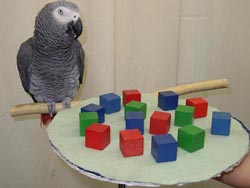
Abilities and notable behaviors
Alex learned to produce and apply a range of spoken labels and was tested on tasks that required perceptual discrimination and categorical judgments. His documented skills included:
- labeling colors, shapes and materials;
- making same/different judgments between objects;
- identifying quantities of small sets and using number labels for those amounts;
- using a vocal label for absence or "none," demonstrating an abstract category beyond concrete items.
Research approach and interpretation
Pepperberg used a social, interactive training method often called the model/rival technique: a human acted as both model and rival to demonstrate and compete for a desired object while the parrot observed. Trials emphasized conversational turn-taking and corrective feedback. Researchers argued that Alex's correct responses to novel combinations of questions and objects showed comprehension of labels and relations, not only rote responses.
Not everyone agreed on interpretation. Some scientists cautioned that trained responses might reflect sophisticated conditioning or cueing rather than fully human-like language use. Nonetheless, Alex’s performance pushed researchers to refine methods for testing animal cognition and to rethink assumptions about the relationship between vocal ability and conceptual thought.
Alex’s life spanned 1976 to 2007. He lived and worked closely with Pepperberg and her students; his training and testing took place in lab and home settings over many years. His unexpected death in 2007 ended the long-running study but did not end interest in avian intelligence.
Legacy: Alex influenced how scientists, ethicists and the public view bird minds. His case stimulated further research into problem solving, communication and social learning in parrots and other species, and it contributed to discussions about animal welfare, enrichment, and the cognitive capacities that underlie communicative behavior.
Related articles
Author
AlegsaOnline.com Alex (parrot): African grey studied for animal cognition and communication Leandro Alegsa
URL: https://en.alegsaonline.com/art/2329