
Allosaurus — large Jurassic theropod and Morrison Formation predator
Allosaurus was a large carnivorous theropod of the Late Jurassic, best known from the Morrison Formation of North America. Many specimens exist; its ecology, anatomy and possible social behavior are well studied and debated.
Overview
Allosaurus was a large bipedal theropod dinosaur that lived during the late Jurassic period. It is commonly interpreted as a meat-eating carnivore and one of the most familiar predatory dinosaurs in paleontology because of the number and quality of its fossils. Most known material comes from deposits in western North America, especially the highly productive Morrison Formation, where it is frequently recovered as the dominant large predator.
Image gallery
10 Images



Anatomy and size
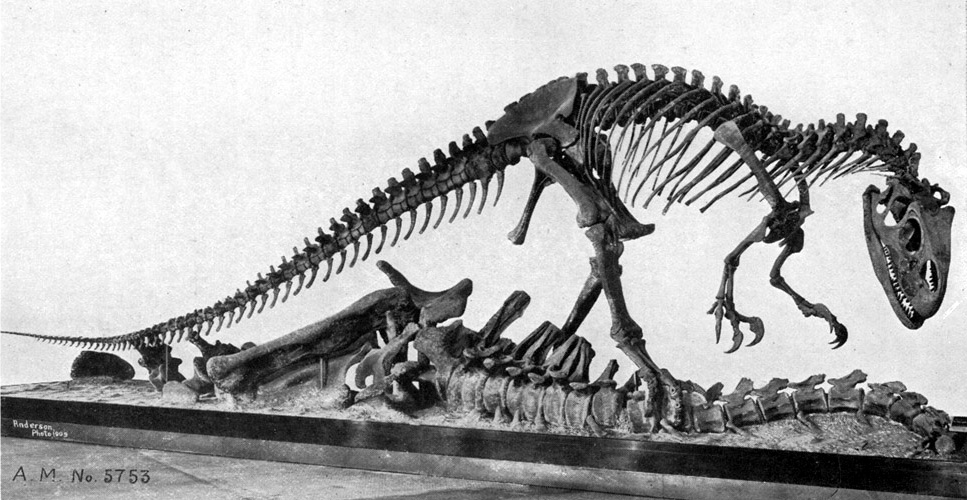
Allosaurus had a relatively large skull with sharp, serrated teeth, and short but muscular three-fingered forelimbs. Its strong hind limbs and long, heavy tail balanced the body for an active, carnivorous lifestyle. Adult length is commonly given as roughly 8.5 metres on average, with some specimens interpreted as exceeding 12 metres; mass estimates vary but often fall around two tonnes (roughly 2.3 tonnes in some studies). Distinctive features include cranial ornamentation in the form of ridges or small crests above the eyes and a lightly built skull that suggests a fast, powerful bite combined with precision handling of prey.
Paleoecology and diet
In its ecosystem Allosaurus occupied a top-predator role and appears to have preyed on a wide range of large herbivorous dinosaurs. Suggested prey items include stegosaurs, various ornithopods and even juvenile or vulnerable sauropods. Typical candidates for interaction include ornithopods, stegosaurs and long-necked sauropods. As the most common large carnivore in many Morrison localities, it would have been a major influence on community dynamics and trophic relationships throughout its range (apex predator concept).
Behavioral interpretations
Remains of multiple individuals have been found in proximity at several sites, which has prompted debate about social behavior. Some researchers propose coordinated hunting or at least temporary aggregations (sometimes described as pack-like behavior), while others argue these groupings could result from solitary animals converging on carcasses or from transport and burial processes. Evidence from bone beds and injury patterns has been interpreted both in favor of aggressive intraspecific interactions and occasional cooperative behavior. Comparisons are often drawn with other large contemporaneous theropods such as Ceratosaurus, which shared the same habitats.
Fossil record and species
Allosaurus is represented by dozens of specimens, including many partial skeletons and several near-complete individuals, making it one of the best-known Jurassic predators. Classic material from the Morrison Formation has been assigned to multiple named species in the genus; one species alone is known from over sixty specimens, giving researchers a robust sample for studying growth, variation and pathology. While most remains are concentrated in North America, fragmentary fossils from other continents have sometimes been compared to Allosaurus, though such referrals remain debated and require careful taxonomic study.
Significance and distinctions
Allosaurus is important both scientifically and culturally. It serves as a key reference taxon for understanding large theropod anatomy, predator–prey relationships in Jurassic ecosystems, and the evolution of hunting strategies among carnivorous dinosaurs. It can be contrasted with later large theropods by its lighter skull, different tooth shape and limb proportions. For further introductions and specimen information see: theropod overview, dinosaur resources, and regional accounts such as Morrison Formation summaries. Additional reading or museum exhibits often cite comparative taxa and regional faunas (Jurassic context, North American discoveries, carnivore ecology, size estimates, ecosystem role, Ceratosaurus comparisons, ornithopod prey, sauropod interactions).
Questions and answers
Q: What was Allosaurus?
A: Allosaurus was a large theropod dinosaur from the Jurassic period, a predatory carnivore.
Q: How long was Allosaurus on average?
A: Allosaurus averaged 8.5 meters (28 ft) in length.
Q: Could Allosaurus be longer than 12 meters (39 ft)?
A: Yes, some remains suggest it could reach over 12 meters (39 ft).
Q: What was the weight of Allosaurus?
A: Allosaurus weighed 2.3 tons.
Q: What did Allosaurus eat?
A: Allosaurus probably preyed on large herbivorous dinosaurs and perhaps even other predators.
Q: What was the most common large predator found in the Morrison Formation of North America?
A: Allosaurus was the most common large predator found in the Morrison Formation of North America.
Q: Was there any evidence of Allosaurus hunting in packs?
A: Yes, some paleontologists think Allosaurus had cooperative behavior, and hunted in packs.
Related articles
Author
AlegsaOnline.com Allosaurus — large Jurassic theropod and Morrison Formation predator Leandro Alegsa
URL: https://en.alegsaonline.com/art/2854
Sources
- mnhn.ul.pt : "Brontosaur killers: Late Jurassic allosaurids as sabre-tooth cat analogues"
- worldcat.org : 0871-5424
- doi.org : 10.1038/35059070
- pubmed.ncbi.nlm.nih.gov : 11234010
- doi.org : 10.1038/416387a
- pubmed.ncbi.nlm.nih.gov : 11919619
- doi.org : 10.1038/416388a
- doi.org : 10.1671/0272-4634(2006)26[321:BVITD]2.0.CO;2
- thehistorychannel.co.uk : Evolve: Eyes
- youtube.com : Transcript
- mnhn.ul.pt : "Strength indicator values of theropod long bones, with comments on limb proportions and cursorial potential"
- ui.adsabs.harvard.edu : 1945Sci...101..115S
- doi.org : 10.1126/science.101.2614.115-a
- pubmed.ncbi.nlm.nih.gov : 17799203