
Constitution of Argentina
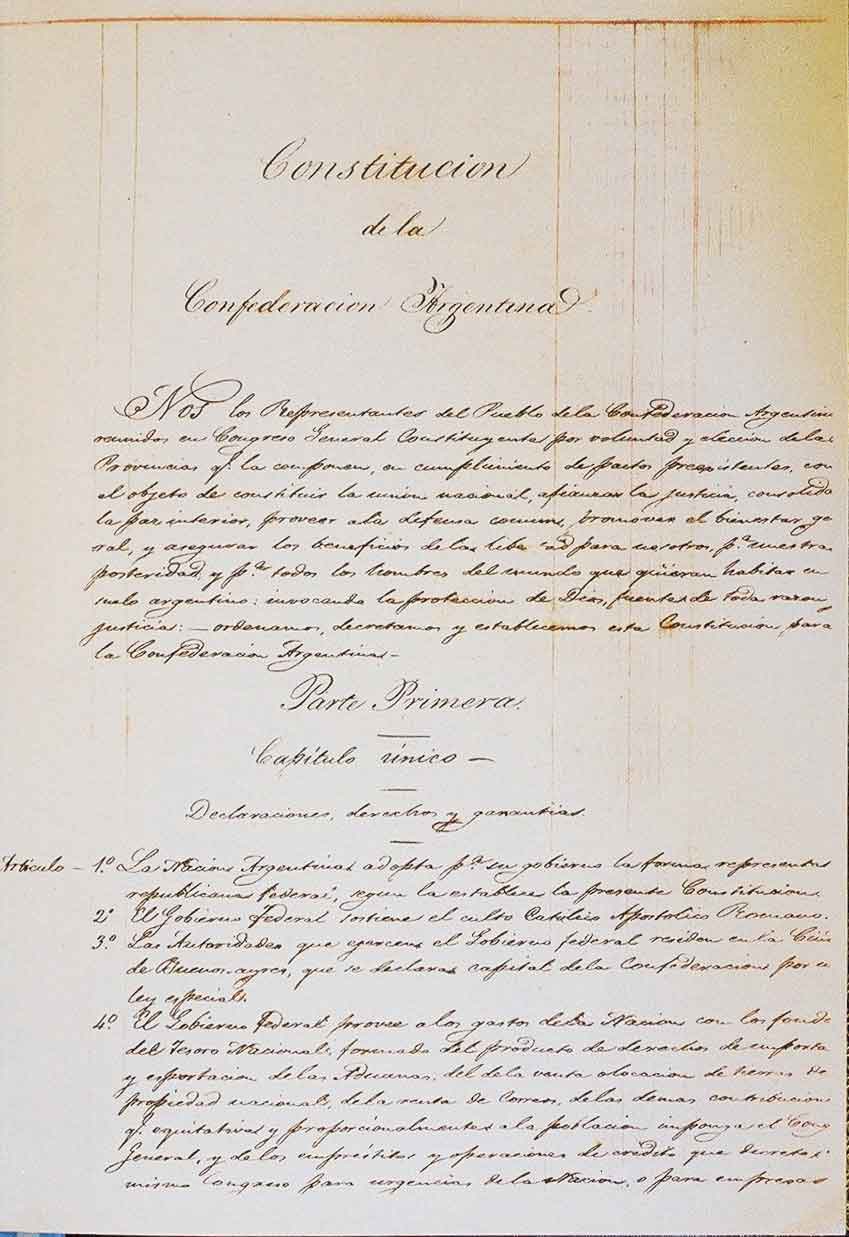
The foundational law of Argentina, adopted in 1853 and amended several times (notably 1994). Establishes the federal republic, separation of powers, provincial autonomy and guarantees a range of civil and political rights.
Overview
The Constitution of Argentina is the supreme law that organizes the Argentine state and defines the rights of its people. The original charter was drafted in 1853 by a Constitutional Assembly gathered in Santa Fe and drew upon liberal models, including influences from the United States Constitution. It has been revised at several moments in Argentine history; the consolidated text in force today reflects the reform of 1994.
Image gallery
3 Images

Structure and key principles
At its core the constitution sets out the basic structure of government and fundamental guarantees. Main features include:
- Federalism: powers are divided between the national government and the provinces.
- Separation of powers: executive, legislative and judicial branches with distinct roles.
- Rights and guarantees: civil and political protections and procedural safeguards for citizens.
- Provincial autonomy: provinces retain their own constitutions and institutions within the federal framework.
History and development
The constitution was framed in the aftermath of the early independence period that followed the May Revolution. The 1853 text provided a federal foundation for a country emerging from regional conflicts. Over time it underwent multiple modifications and interpretations — with notable reform efforts occurring in later nineteenth-century and twentieth-century decades — culminating in a major modernization enacted in 1994 that adjusted institutional rules and updated rights-protections.
Uses and legal importance
As the supreme law, the constitution governs the enactment and interpretation of ordinary legislation and guides public institutions. Courts, and ultimately the Supreme Court, evaluate whether laws and official acts conform to constitutional norms. Its provisions are the reference point for debates about public policy, civil rights, and the limits of government power.
Notable features and contemporary significance
The Argentine constitution is notable for balancing national unity with provincial diversity, and for being a living document subject to amendment and judicial interpretation. The 1994 reform introduced procedural and substantive updates that many commentators regard as an effort to align domestic law with evolving international human-rights standards. For historical context see the Constitutional Assembly in Santa Fe and the earlier political movements such as the May Revolution that helped shape the nation's path to constitutional government.
Ongoing relevance
Debate continues about how best to apply constitutional principles to contemporary challenges: federal relations, social rights, institutional reform and the interpretation of guarantees in light of international norms. The constitution remains the central reference for civic life, public administration and legal dispute in Argentina.
Related articles
Author
AlegsaOnline.com Constitution of Argentina Leandro Alegsa
URL: https://en.alegsaonline.com/art/22669
Sources
- senado.gov.ar : Official translation to English
- www1.hcdn.gov.ar : Complete text
- cervantesvirtual.com : Reforms to the original 1853 Constitution