
Complex analysis
Branch of mathematical analysis studying functions of complex numbers, focusing on holomorphic (analytic) functions, contour integrals, singularities, conformal maps and applications across math and physics.
Complex analysis is the study of functions defined on the complex numbers and the special properties that arise from complex differentiation. It belongs to the broader field of mathematical analysis and concerns functions whose variables and values lie in the set of complex numbers. A central concept is holomorphy: functions that are complex-differentiable on an open set. Such functions are also analytic, which means they can be represented locally by power series. This dual nature produces strong constraints and powerful tools not available in the real-variable setting.
Image gallery
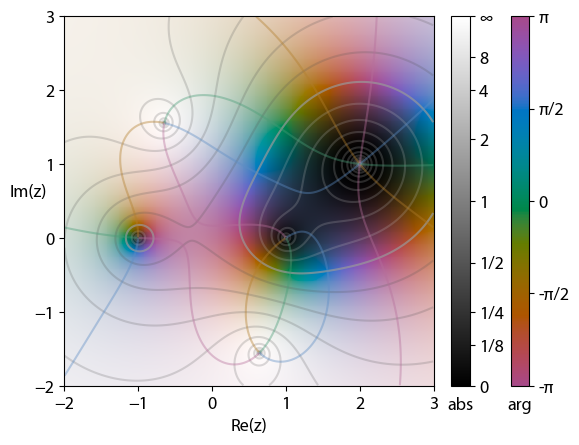
3 Images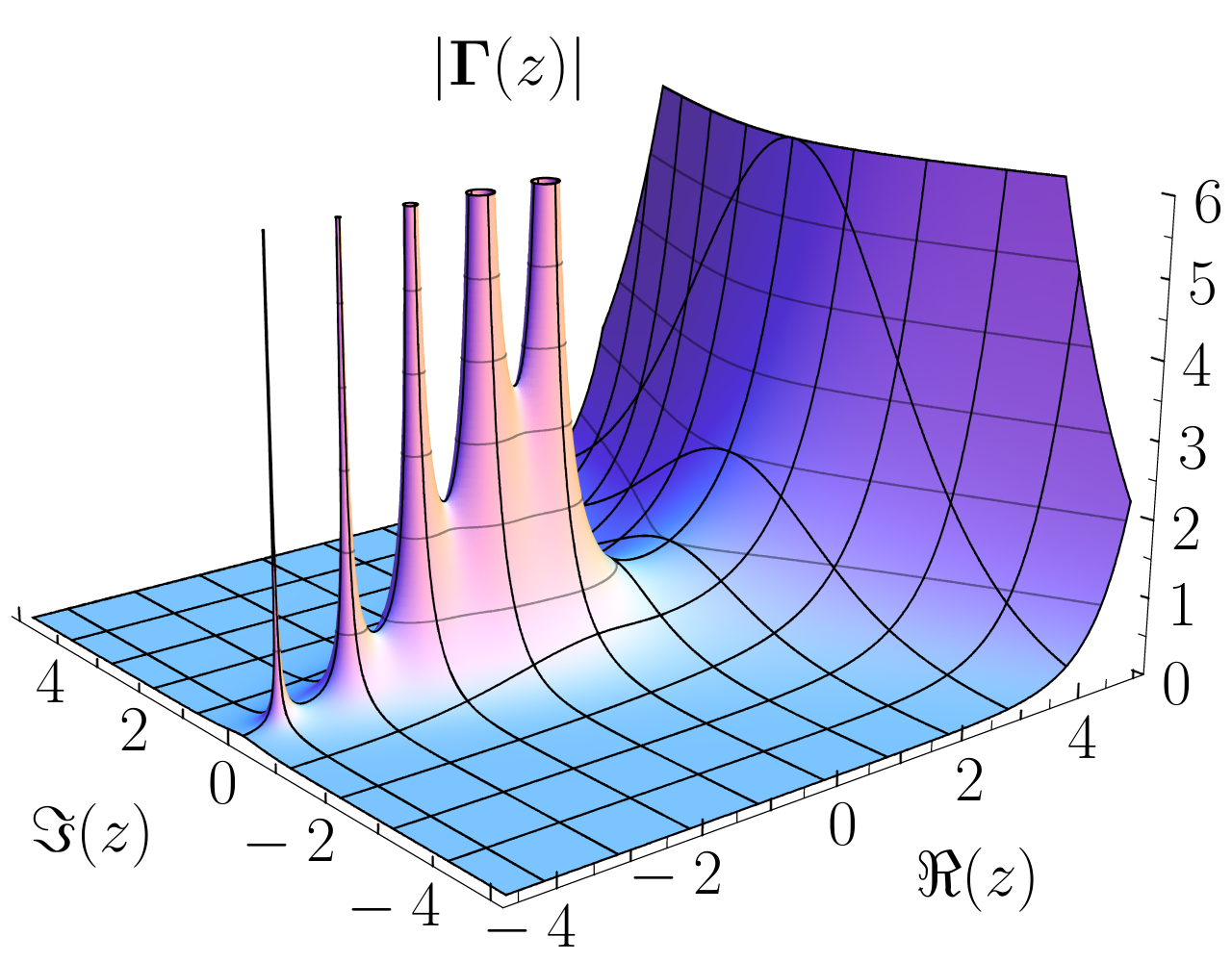

Core concepts
The subject centers on a handful of interlocking ideas and results:
- Holomorphic (analytic) functions: complex differentiability implies convergent power series expansion.
- Cauchy integral theorem and formula: contour integrals depend on topological properties of the domain and yield explicit values for derivatives.
- Series and singularities: Laurent series classify isolated singular points as removable, poles, or essential.
- Residue theorem: computes many real and complex integrals via residues at poles.
- Conformal mappings: angle-preserving maps with applications to boundary value problems.
Historical development
The modern discipline took shape in the nineteenth century. Early contributions came from Euler and Gauss; formal foundations were established by Augustin-Louis Cauchy, who introduced contour integration and many core theorems. Bernhard Riemann brought geometric ideas, introducing Riemann surfaces to treat multivalued functions, while Karl Weierstrass and others emphasized rigorous power-series methods. Twentieth-century contributors such as Kiyoshi Oka and Lars Ahlfors extended the field into several complex variables and conformal mapping theory.
Applications and examples
Complex analysis appears across mathematics and the sciences. It underpins methods in algebraic geometry and analytic number theory, and it supplies tools for theoretical and applied physics. Contour integration and analytic continuation are used in physics, including in models from string theory to quantum mechanics. Engineers use conformal maps to solve planar flow and electrostatics problems. Typical examples of holomorphic functions are the exponential e^z, polynomials, and rational functions away from poles; 1/z illustrates a simple pole and essential singularities appear in functions like e^{1/z}.
Notable results and distinctions
Several theorems make complex analysis particularly powerful: the maximum modulus principle, Liouville's theorem (bounded entire functions are constant), and Morera's theorem (an integral criterion for holomorphy). The field supplies concrete computational tools — especially the residue theorem — that convert difficult integrals into algebraic sums. Compared with real analysis, complex analysis exhibits greater rigidity: complex differentiability is a much stronger condition and leads directly to global consequences such as analytic continuation and classification of singularities.
Overall, complex analysis is both a theoretical cornerstone and a practical toolbox. Its blend of algebraic, geometric and analytic viewpoints connects disparate areas of mathematics and supports applications in physics and engineering, making it a central subject in advanced undergraduate and graduate curricula.
Related articles
Author
AlegsaOnline.com Complex analysis Leandro Alegsa
URL: https://en.alegsaonline.com/art/22248