
BI Cygni — a luminous red supergiant in Cygnus
BI Cygni is a red supergiant star in the constellation Cygnus, notable for a radius exceeding 1,000 times that of the Sun and for its role as an example of late-stage massive stellar evolution.
Overview
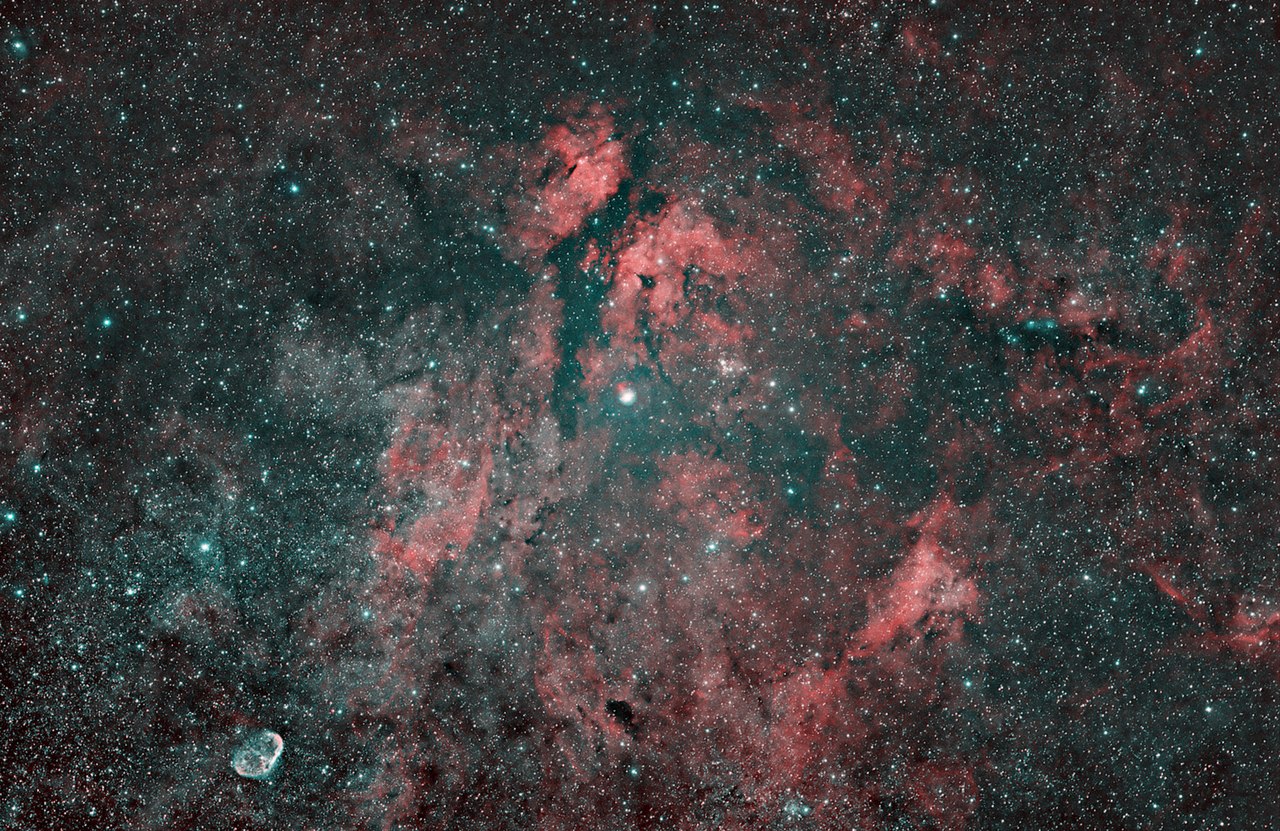
BI Cygni is classified as a red supergiant located in the northern sky within the Cygnus region. It is an evolved, luminous star with a physical size that has been estimated to exceed 1,000 times the radius of the Sun. The designation links BI Cygni to the late stages of massive-star evolution and to the population of very large, cool stars visible in our Galaxy.
Image gallery
2 Images
Characteristics
Red supergiants like BI Cygni have cool surface temperatures compared with hotter blue stars, extended atmospheres and high luminosities. Their spectra and brightness can change over time as convection and pulsation alter their outer layers. Determining exact properties for BI Cygni is challenging because its extended envelope and uncertain distance affect radius and luminosity estimates.
- Radius: reported to be more than 1,000 times that of the Sun, making it among the physically largest known stars.
- Temperature: relatively cool for a luminous star, producing a red appearance.
- Variability: exhibits irregular or semi-regular changes in brightness, a common trait among red supergiants.
Many observations focus on BI Cygni's mass-loss processes. Like other red supergiants, it is expected to shed substantial material into its surroundings, forming dusty circumstellar envelopes. This mass loss affects both the star's future evolution and the enrichment of the interstellar medium with heavier elements.
Origin and astronomical context
Stars that become red supergiants begin life with considerably more mass than the Sun. Over millions of years they exhaust core hydrogen, expand enormously and cool at the surface. BI Cygni represents a stage before a massive-star end point: for such objects the final outcome may be a supernova, but the timing and exact path depend on mass loss and internal structure.
BI Cygni is often mentioned alongside other well-known red supergiants — such as Betelgeuse and VY Canis Majoris — when astronomers discuss the extremes of stellar size and luminosity. Comparisons help illustrate the diversity within this class and highlight uncertainties in measuring distant, diffuse stellar photospheres.
Importance and study
Studying BI Cygni and similar stars helps astronomers understand convection in giant atmospheres, dust formation, and the final stages of massive-star evolution. Observations at optical and infrared wavelengths probe the star's surface structure and surrounding dust, while long-term monitoring tracks variability. Those efforts inform models of how massive stars lose mass and prepare for their ultimate fate.
For further general background on massive stars and stellar evolution see the constellation guides and spectral classification resources, or consult specialized literature and databases maintained by observatories and stellar catalogs (constellation resources). Researchers continue to refine distance and size estimates for BI Cygni as instrumentation and techniques improve.
Tags
Related articles
Author
AlegsaOnline.com BI Cygni — a luminous red supergiant in Cygnus Leandro Alegsa
URL: https://en.alegsaonline.com/art/11203