
Butterfly effect: sensitive dependence and consequences in complex systems
The butterfly effect describes how tiny differences in initial conditions can produce widely divergent outcomes in nonlinear systems. It explains limits to prediction in weather, ecology, economics and other fields.
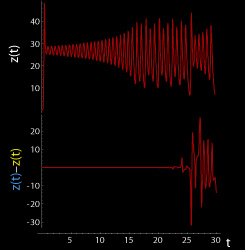
The butterfly effect is a concept from the study of complex, nonlinear systems that emphasizes how very small changes to initial conditions can lead to large and unexpected differences in later states. It is most often associated with sensitive dependence on initial conditions: two nearly identical starting points can follow radically different trajectories when a system amplifies small perturbations. The phenomenon does not imply mystical causation or that any tiny action will always produce a dramatic result; rather it identifies a structural property of many deterministic systems that makes long-term prediction difficult or effectively impossible in practice.
Image gallery
5 Images


Key characteristics
Several features distinguish systems that exhibit the butterfly effect. They are typically:
- Nonlinear: outputs are not proportional to inputs, so small inputs can be amplified;
- Deterministic but unpredictable: the rules governing evolution may be fixed, yet long-term behavior is sensitive to tiny uncertainties in starting values;
- High-dimensional or coupled: many interacting variables provide routes for small perturbations to propagate and grow;
- Chaotic rather than random: apparent randomness arises from deterministic dynamics rather than stochastic noise.
Origins and popularization
The idea entered modern science through studies of atmospheric dynamics in the mid-20th century, when researchers using numerical weather models found that minute differences in input data produced large differences in forecasts. That work, often associated with meteorologist Edward Lorenz, led to the phrase and mental image of a butterfly’s wingbeat as a metaphor for tiny causes with large effects. Popular culture and literature have spread the image further; for example, the short story "A Sound of Thunder" explores a fictional scenario in which a small change in the past produces major changes in the future, an illustration of the same intuitive idea rather than a literal scientific claim (Ray Bradbury).
Examples and practical importance
Weather and climate are classic contexts for the butterfly effect. Small measurement errors or tiny atmospheric fluctuations can grow, limiting useful deterministic weather forecasts to days rather than weeks. This sensitivity motivates methods such as ensemble forecasting, where many slightly different simulations are run to estimate probabilities of outcomes rather than a single definitive prediction. In climate science, long-term forcings (for example, changes in Earth orbit known as Milankovitch cycles) act on different time scales and can produce large climate shifts, showing how small orbital variations become important when they interact with the system’s feedbacks. Other areas where sensitive dependence matters include ecology, finance, engineering systems, and some social dynamics, where cascading effects and tipping points can amplify small shocks.
Common misconceptions and limits
Popular descriptions sometimes overstate the idea by suggesting any minuscule action will cause arbitrarily large outcomes; that is not what the concept asserts. For a small perturbation to grow it must be applied to a system and at a time and location where the dynamics amplify changes. Many systems damp small perturbations instead of amplifying them. Furthermore, chaotic sensitivity does not mean there is no order: chaotic systems can show well-defined statistical properties, recurring patterns, and attractors that shape overall behavior even while precise prediction of individual trajectories remains limited.
Why it matters
Recognizing the butterfly effect shifts how scientists and decision makers approach prediction, risk, and control. It encourages probabilistic thinking, robust design, and monitoring to detect early signs of amplification. It also provides a cautionary perspective in interpreting cause and effect in complex systems: apparent coincidences or dramatic outcomes often trace back to many interacting factors rather than a single trivial cause. For further reading on the mathematical and conceptual foundations, see introductions to chaos theory and to practical techniques such as ensemble methods and sensitivity analysis.
Related articles
Author
AlegsaOnline.com Butterfly effect: sensitive dependence and consequences in complex systems Leandro Alegsa
URL: https://en.alegsaonline.com/art/15687