
Milankovich cycle
Regular, long-term variations in Earth’s orbit and axis that change solar radiation patterns and influence long-term climate rhythms such as ice ages.
An individual Milankovich cycle describes a slow, regular change in the geometry of the Earth–Sun system that alters how solar energy reaches the planet. The term is commonly used to refer collectively to the family of astronomical variations that affect the distribution and intensity of incoming sunlight and thereby help pace long-term changes in climate. These variations are gradual — measured in tens to hundreds of thousands of years — and their combined effects modulate regional and seasonal insolation more than global annual totals.
Image gallery
8 Images


Key components and timescales
Three primary orbital parameters underlie Milankovich cycles. Each parameter changes on characteristic timescales and contributes differently to climate forcing:
- Eccentricity — the shape of Earth’s orbit around the Sun, varying between more circular and more elliptical forms on roughly 100,000- and 400,000-year rhythms. (eccentricity)
- Obliquity (axial tilt) — the angle between Earth’s rotational axis and the orbital plane, which oscillates with a principal period near 41,000 years and alters contrast between seasons. (axial tilt)
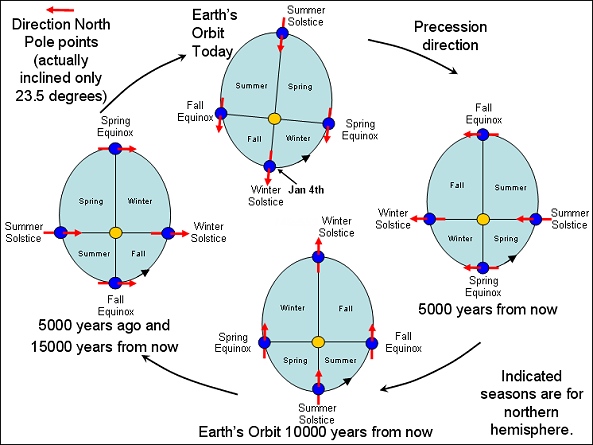
- Precession — the wobble and gradual change in the timing of perihelion and the orientation of Earth’s axis, with a principal cycle of about 21,000 years; this affects which hemisphere receives stronger summer or winter insolation. (precession)
Mechanisms and climate impact
Milankovich effects operate by changing the seasonal and latitudinal distribution of sunlight rather than total energy received annually. Small changes in high-latitude summer insolation, for example, can control whether winter snow melts completely; persistent summers with slightly reduced insolation favor ice-sheet growth. Scientists analyze these mechanisms using radiative calculations and models drawn from applied mathematics and physics to translate orbital changes into insolation maps and climate responses.
The concept that astronomical cycles drive ice ages and long climate swings was developed mathematically and popularized by Milutin Milanković, who predicted the roles of eccentricity, obliquity and precession in pacing glacial cycles. Earlier thinkers had proposed similar ideas in the nineteenth century, but direct, dated evidence emerged only after the advent of deep-sea sediment and ice cores, and became widely persuasive following a landmark paper in Science in the 1970s.
Milankovich forcing is a cornerstone concept in paleoclimatology but not the sole driver of past climate change. Internal feedbacks — ice-albedo, greenhouse gas concentrations, ocean circulation — and tectonic boundary conditions amplify or modulate the orbital signals. Researchers therefore treat orbital variations as a pacing mechanism whose ultimate climatic expression depends on Earth system responses.
Applications and examples include dating and interpreting paleoclimate archives (sediments, ice cores, stalagmites), testing climate models against past climates, and understanding the timing of Quaternary glacial-interglacial cycles. Ongoing work refines how multiple orbital frequencies combine, how nonlinear feedbacks influence the 100,000-year glacial cycles, and how Milankovich forcing interacts with other climate drivers in past and future contexts.
For more introductory overviews and technical summaries see resources on planetary astronomy and paleoclimate science: Earth system basics, Sun–Earth relations, axial tilt, and reviews of orbital forcing and insolation calculations (solar forcing, climate records). Additional mathematical background and historical context are available through treatments of applied mathematics, the work of Milanković, and discussions of how he predicted orbital influences on climate. See also summaries of modern observational confirmation (precession, eccentricity, obliquity) and the pivotal Science article that helped establish the orbital theory of ice ages.
Questions and answers
Q: What is a Milankovich cycle?
A: A Milankovich cycle is a slow, regular change in the Earth's orbit around the Sun and the tilt of the Earth's axis that affects the amount of sunlight falling on parts of the Earth and leads to cycles of climate.
Q: How many cycles of climate on Earth are caused by Milankovich cycles?
A: Milankovich cycles cause cycles of climate on Earth at about 21,000, 41,000 years, 100,000 and 400,000 years.
Q: Who predicted that variations in eccentricity, axial tilt, and precession of the Earth's orbit caused climate patterns on Earth?
A: Milutin Milanković predicted that variations in eccentricity, axial tilt, and precession of the Earth's orbit caused climate patterns on Earth using applied mathematics.
Q: When were astronomical theories of Milankovich cycles first advanced?
A: Similar astronomical theories of Milankovich cycles had been advanced in the 19th century by Joseph Adhemar, James Croll, and others.
Q: What was the issue with Milankovich cycles until 1976?
A: Until 1976, there was no reliable dated evidence to settle the issue of the role of Milankovich cycles in climate patterns on Earth.
Q: When was the evidence for Milankovich cycles in climate patterns on Earth settled?
A: The evidence for Milankovich cycles in climate patterns on Earth was settled with the publication of a paper in Science in 1976, after deep-ocean cores were taken.
Q: Is the field of Milankovich cycles still under active research?
A: Yes, the whole field of Milankovich cycles and their effects on climate patterns on Earth is still under active research.
Tags
Related articles
Author
AlegsaOnline.com Milankovich cycle Leandro Alegsa
URL: https://en.alegsaonline.com/art/64924
Sources
- ncdc.noaa.gov : "Astronomical theory of climate change"
- sciencemag.org : sciencemag.org/content/194/4270/1121
- doi.org : 10.1126/science.277.5323.215
- muller.lbl.gov : "Origin of the 100 kyr Glacial Cycle: eccentricity or orbital inclination?"