
British Rail Class 418 (2Sap): two‑car Southern Region electric multiple unit
Summary of the British Rail Class 418 (2Sap), a two‑car EMU formed in the 1970s by declassifying first‑class accommodation on 2Hap sets for inner suburban services on the Southern Region.
Overview
The British Rail Class 418, commonly referred to by the designation 2Sap, was not a newly built type but a practical conversion implemented by the Southern Region of British Railways. In the 1970s selected two‑car 2Hap electric multiple units were reclassified after removal or declassification of first‑class accommodation, producing uniformly standard‑class sets better suited to dense short‑distance commuter flows in and around England.
Image gallery
2 Images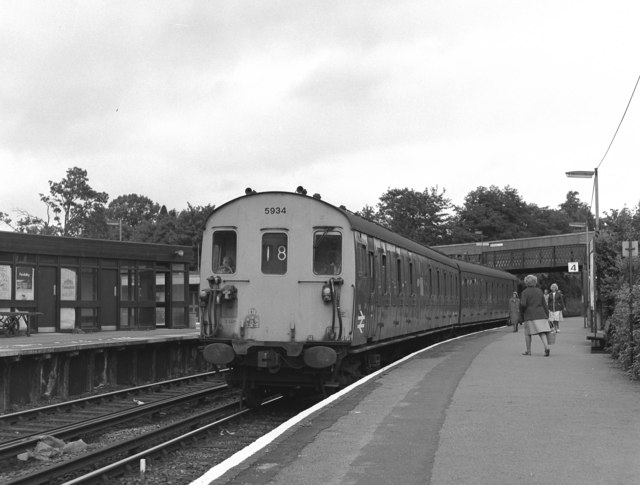
Design and characteristics
Conversions to Class 418 were intentionally modest and economical. Electrical and traction equipment of the donor 2Hap sets was retained, including compatibility with the Southern Region's DC third‑rail system, while internal changes focused on passenger seating and signage. The units remained two‑car formations with driving cabs at each end, enabling rapid turnarounds on suburban workings.
- Two‑car formations providing only standard‑class accommodation.
- Third‑rail DC compatibility appropriate to Southern Region electrification.
- Interior alterations limited to reclassification, minor seat changes and revised signage rather than major rebuilds.
History and development
The creation of 2Sap/ Class 418 reflected shifting travel patterns after mid‑20th century urban growth: short commuter journeys increased while demand for first‑class on inner suburban services fell. Rather than procure new stock, British Rail applied a low‑cost policy of repurposing existing vehicles to increase standard‑class capacity and simplify timetable planning.
Operation and routes
Class 418 sets were used on intensive inner suburban routes where seating capacity and frequent stops were prioritized over long‑distance comfort. They commonly worked duties on loops and short branch services, notably including the Hounslow Loop and comparable circuits across the Southern Region. Their two‑car size made them suitable for high‑frequency timetables and platforms with limited length.
Withdrawal and legacy
As successive modernisation programmes introduced newer multiple units with improved acceleration, passenger facilities and accessibility, the converted 2Sap units were gradually withdrawn and replaced. The Class 418 conversion is often cited by railway historians as an example of pragmatic fleet management: a simple administrative and interior change that matched rolling stock to evolving local demand without major capital works.
Notable distinctions
It is important to distinguish Class 418 from newly designed EMU classes: the 418s were essentially reclassified 2Hap vehicles following declassification of first class, rather than a purpose‑designed type. The informal name 2Sap conveyed the two‑car standard accommodation nature of the sets and was used in operational practice and depots when assigning duties.
Related articles
Author
AlegsaOnline.com British Rail Class 418 (2Sap): two‑car Southern Region electric multiple unit Leandro Alegsa
URL: https://en.alegsaonline.com/art/14444