
British Rail Class 27
A Type 2 diesel-electric locomotive built by BRCW in 1961–62. Sixty-nine units served mixed-traffic roles on British Rail, primarily in Scotland and northern regions; several survive on heritage railways.
The British Rail Class 27 is a group of Type 2 diesel locomotives built in 1961–62 by the Birmingham Railway Carriage and Wagon Company. Designed as a development of the earlier Class 26, the batch of 69 machines formed part of British Rail's mid‑20th century transition from steam to diesel traction. These locomotives were commonly used for both passenger and freight workings and are often described as representative of the small to medium power Type 2 designs introduced in that era. The class is frequently referred to in documents as having been a BRCW Type 2 product and is widely noted as a diesel locomotive built for flexible, mixed-traffic use.
Image gallery
10 Images
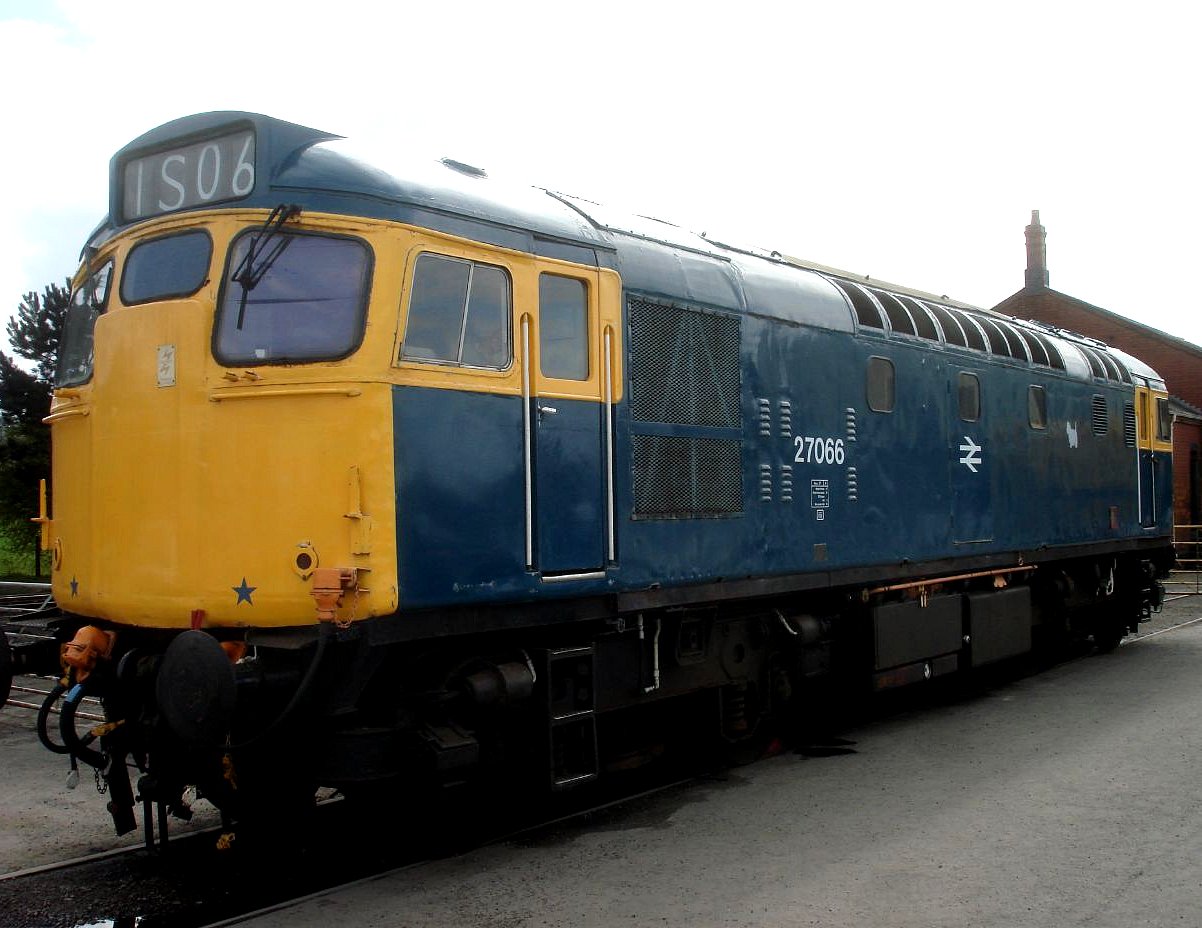


Characteristics
Class 27 locomotives shared a number of practical features typical of Type 2 design philosophy: relatively compact dimensions, a four-axle arrangement for balanced route availability, and equipment intended to allow both short-distance passenger diagrams and local freight turns. Builders' practice and BR operating requirements led to a straightforward, robust layout emphasizing reliability over experimental complexity.
History and development
Produced by the Birmingham Railway Carriage and Wagon Company, the Class 27 emerged as an incremental improvement on preceding Type 2 designs. Built between 1961 and 1962, the class reflected lessons learned from earlier batches in terms of mechanical layout and operational fit. Under the later TOPS classification system these locomotives were identified collectively as Class 27, although during their early careers they were commonly referenced by builder/type codes and departmental numbers.
Operations and uses
In service the Class 27s performed mixed-traffic duties: suburban and regional passenger services, parcels and mail trains, and local freight movements. Their size and route availability made them suitable for secondary main lines and branch work, and they were deployed where larger Type 4 or Type 5 locomotives would have been uneconomic. Over time some members of the class were adapted for specific regional roles, with modifications to fit particular multiple‑working or commuter duties.
Preservation and legacy
Withdrawals from front-line service began as diesel fleets were modernized and standardized. A number of Class 27 locomotives have survived into preservation and can be found on heritage railways and at museums, maintained by volunteer groups and enthusiasts. Their continued presence in preservation underscores the class's role as a practical, versatile example of early British diesel traction.
Notable distinctions
- Built as a cohesive batch in the early 1960s and numbered 69 in total.
- Developed from the immediately preceding Class 26 design and commonly associated with the BRCW Type 2 family.
- Remembered for adaptability between passenger and freight tasks and for regional service in Scotland and northern areas.
Related articles
Author
AlegsaOnline.com British Rail Class 27 Leandro Alegsa
URL: https://en.alegsaonline.com/art/14384