
British Rail Class 302 (pre-TOPS AM2) electric multiple unit
British Rail Class 302 (AM2) was a post‑war EMU type introduced 1958–1960 for outer suburban services on the London, Tilbury and Southend route; Mark 1 bodyshell, overhead AC, slam doors.
Overview
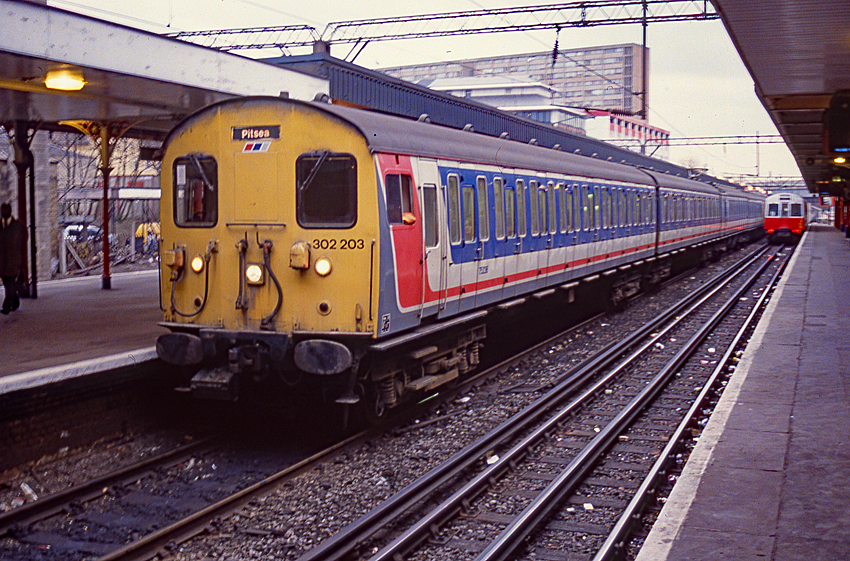
The British Rail Class 302, originally designated AM2 under the pre‑TOPS classification system, was a family of electric multiple units introduced between 1958 and 1960 to work outer suburban passenger services on the London, Tilbury and Southend route. Built using the then‑standard Mark 1 coach body, these trains were designed for frequent stop/start operation on lines electrified with overhead alternating current equipment rather than third‑rail power.
Image gallery
5 Images



Design and formation
Class 302 units featured the Mark 1 steel-bodied construction and conventional slam doors, reflecting mid‑20th century rolling stock practice. Units were composed of a mix of driving trailers, motor cars and intermediate trailers so that a complete set provided both driver accommodation at each end and the traction equipment required for acceleration between suburban stations. Electrical current was collected from overhead wires, making the sets suitable for the LT&S route and other AC‑electrified lines.
Operations and service history
Introduced to replace steam and older electric stock, these units formed the backbone of outer suburban services for several decades. They worked services with frequent stops and relatively short distances between stations, where reliable acceleration and simple interior layouts suited commuter traffic. Over time, changing operational needs, infrastructure upgrades and newer rolling stock led to reallocation and repurposing of some sets.
Withdrawal, preservation and legacy
From the late 20th century, the Class 302 fleet was progressively withdrawn as modern units with sliding doors, improved crashworthiness and updated electrical systems entered service. A small number of vehicles and components have been preserved on heritage railways and by museums, where they illustrate post‑war British Rail design and the transition to widespread AC electrification.
Notable characteristics
- Pre‑TOPS classification: TOPS era designation was later applied, but AM2 reflects the original naming.
- Type: electric multiple unit intended for outer suburban routes.
- Construction: Mark 1 bodyshell, slam doors and conventional compartment/vestibule interior layouts.
- Power collection: overhead AC equipment suitable for the London, Tilbury and Southend electrified lines.
Today the Class 302 is remembered as a characteristic example of the early AC electrification era in Britain, bridging older steam and newer multiple‑unit generations while reflecting mid‑century design priorities in suburban rail travel.
Related articles
Author
AlegsaOnline.com British Rail Class 302 (pre-TOPS AM2) electric multiple unit Leandro Alegsa
URL: https://en.alegsaonline.com/art/14388