
Downtown Los Angeles: central business district and neighborhood
Downtown Los Angeles is the commercial and cultural core of Los Angeles, California. It spans about 5.84 sq mi, hosts a dense skyline and many neighborhoods, and has roughly 85,000 residents.
Overview
Downtown Los Angeles is the traditional central business district of Los Angeles, in the U.S. state of California. It functions both as the city's commercial core and as a residential neighborhood. The district is compact but diverse: office towers, museums, theaters, markets and apartment buildings share an area of about 5.84 square miles (15.1 km2) and are home to roughly 85,000 people.
Image gallery
10 Images





Geography and population
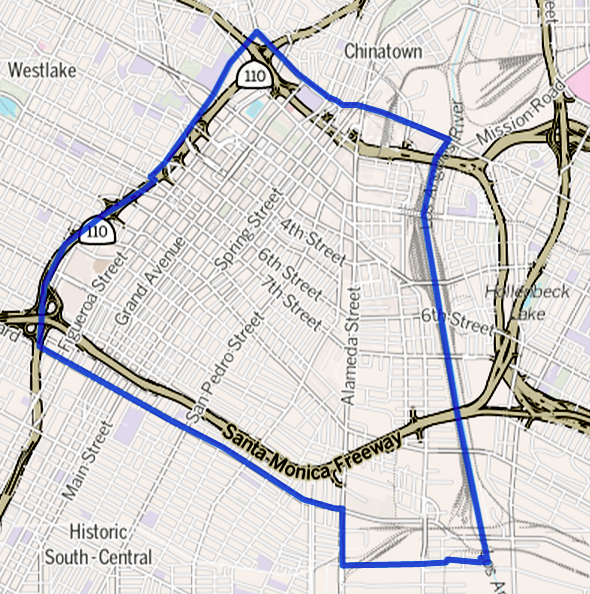
Downtown occupies a roughly rectangular area near the confluence of several freeways and rail lines, which has influenced its growth as a transport and business hub. Population and land use have shifted over recent decades from an almost exclusively daytime workplace district to a mixed-use neighborhood with more permanent residents and services. Residential conversions and new construction have increased the number of people who live within its boundaries.
Skyline and notable buildings
The area is best known for its concentration of skyscrapers, which create one of the most recognizable urban skylines in the western United States. Among these are the Wilshire Grand Center and the U.S. Bank Tower, landmark high-rises that house offices, hotels and observation spaces. The skyline reflects multiple eras of construction, from early 20th-century high-rises to recent mixed-use towers.
Neighborhoods, culture and landmarks
Downtown is not monolithic: it contains a number of distinct neighborhoods and cultural districts that shape its character. Important areas include:
- Bunker Hill — home to museums, performing arts venues and civic institutions.
- Historic Core — older commercial buildings, theaters and restored landmarks.
- Arts District and Little Tokyo — creative spaces, galleries and longstanding cultural communities.
- Fashion District and South Park — wholesale markets, sports and entertainment venues.
History and development
Downtown LA grew from the 19th century onward as the city's commercial center. Over time it experienced cycles of decline, suburban expansion, and reinvestment. Late 20th- and early 21st-century redevelopment emphasized adaptive reuse of historic buildings, new housing, and transit-oriented projects, contributing to a renewed urban vibrancy while also raising questions about affordability and neighborhood change.
Transportation and economic role
The district is a regional transportation node with major rail and bus connections, making it a focal point for commuters and visitors. It remains a center for finance, law, government, hospitality and culture within the wider metropolitan area. Downtown's mixture of workplaces, cultural institutions and residential streets makes it central to Los Angeles's identity and to ongoing debates about urban planning and growth.
Author
AlegsaOnline.com Downtown Los Angeles: central business district and neighborhood Leandro Alegsa
URL: https://en.alegsaonline.com/art/137667