
Braided river: formation, characteristics, ecology and examples
Braided rivers are dynamic networks of interweaving channels separated by transient islands and bars. This article describes their formation, distinguishing features, ecological role and notable examples.
Overview
A braided river is a stream system in which flow is divided into multiple shallow channels that separate and rejoin around transient islands and bars. These systems form a network of channels that shifts over time, producing a broad, often gravelly or sandy channel belt rather than a single continuous waterway. Braided rivers contrast with single-thread meandering rivers by having many active channels and a more complex planform.
Image gallery
10 Images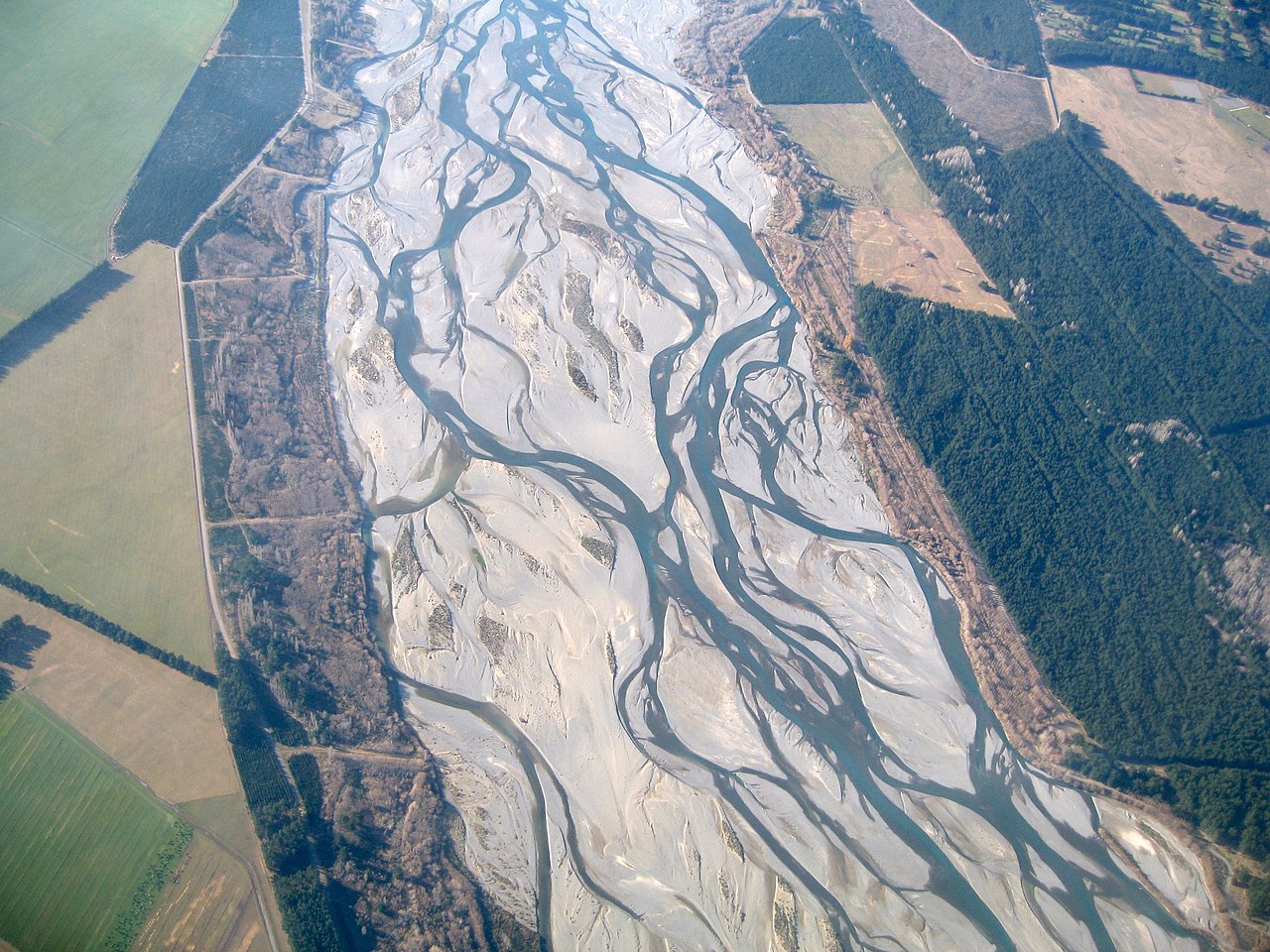


Formation and physical characteristics
Braided rivers typically occur where streams carry a large load of coarse sediment, where the slope is relatively steep compared with lowland meanders, or where discharge varies widely. As flow slows, sediment is deposited as mid-channel bars and islands. These accumulations divide the flow and cause the channel to split; shifting flow paths then erode and reform channels in a continual cycle. The islands and bars are often unstable and may be vegetated or bare depending on how long they persist (vegetated and bare islands).
Processes and parts
Key elements of a braided system include multiple shallow channels, braid bars (mid-channel deposits), and active gravel or sand sheets across the channel belt. Important processes are high sediment supply, frequent deposition, channel splitting, and avulsion (rapid shifting of channels). Seasonal changes in discharge—such as snowmelt or monsoon pulses—can amplify these dynamics, causing channels to broaden or contract quickly.
Ecology and human significance
Braided rivers create a mosaic of habitats—fast-flowing water, shallow riffles, exposed bars, and vegetated islands—supporting specialized plants, invertebrates, and birds. Their dynamic nature makes them important for species that require shifting substrates. For people, braided rivers present both opportunities and challenges: the broad gravel beds may be sources of construction materials and recreational areas, but the instability complicates bridge building, flood control, and land use planning.
Examples and notable occurrences
Braided patterns appear at many scales. Large deltas may display braiding on a vast scale—the delta of the Amazon shows complex channel networks in places—while smaller mountain-fed rivers such as the Waimakariri River demonstrate classic braided forms within a confined valley. Glacial outwash plains and tectonically active regions also commonly host braided systems.
Distinctions and management
Braided rivers differ from meandering rivers, which have a single sinuous channel, and from anastomosing rivers, which have multiple stable channels separated by permanent floodplain islands. Managing braided rivers often requires accommodating their natural mobility—setback levees, flexible infrastructure design, and habitat-focused conservation are preferred to rigid channelization, which can degrade ecological value and increase downstream problems.
- Main components: channels, braid bars, islands.
- Key drivers: abundant coarse sediment, variable discharge, slope and sediment supply.
- Human concerns: infrastructure stability, resource extraction, conservation.
Tags
Related articles
Author
AlegsaOnline.com Braided river: formation, characteristics, ecology and examples Leandro Alegsa
URL: https://en.alegsaonline.com/art/13648