
Bookbinding: craft, techniques, and history
An overview of bookbinding — the craft and industrial processes that assemble and finish books, covering materials, methods, historical development, and preservation.
Overview
Bookbinding is the set of physical operations that assemble the printed or written leaves of a book together and enclose them in a protective cover. At its simplest it involves gathering pages, securing them at the spine, attaching endpapers, and adding front and back covers. The result can range from simple glued paperback volumes to elaborately decorated, hand-sewn bindings intended to last for centuries.
Image gallery
10 Images



Parts, materials, and common types
Most bindings are made from a combination of paper (or parchment), thread, board, cloth or leather, and adhesive. Key components include the signatures (folded groups of pages), the spine, endpapers, boards (covers), and any decorative elements such as headbands or tooling. Typical binding styles include:
- Case (hard) binding — pages are sewn or glued into a text block that is fitted into a separate hard cover.
- Perfect (adhesive) binding — pages are glued at the spine to form a paperback or many trade paperbacks.
- Sewn binding — durable sewing through folded signatures; favored for longevity.
- Exposed spine and stitched bindings — decorative and functional choices in book arts and hand-binding traditions.
Basic processes and workshop practices
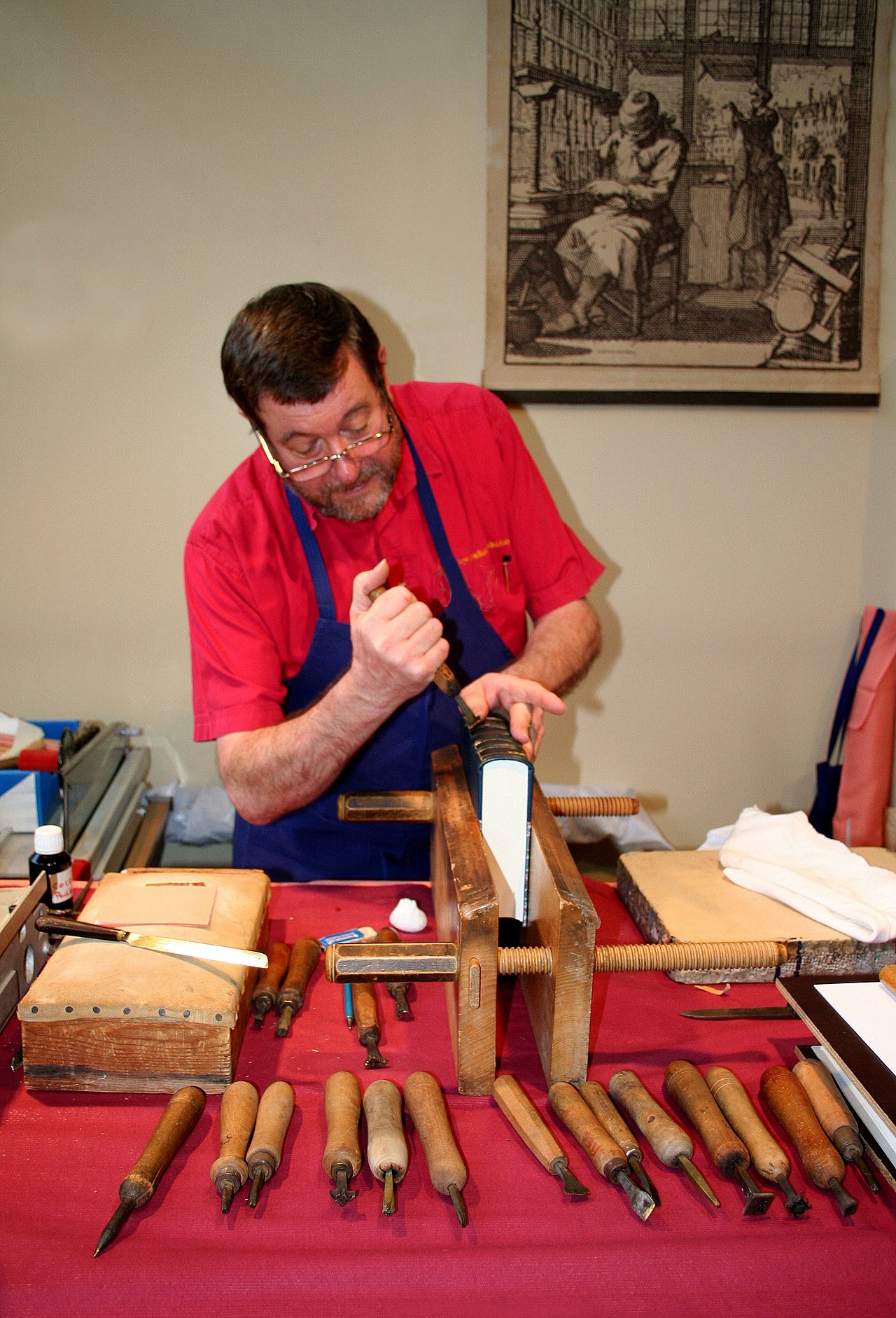
Traditional hand-binding follows several stages: folding and gathering sheets into signatures, sewing signatures onto supports or sewing stations, rounding and backing the spine to shape it, applying endpapers, attaching boards, covering with cloth or leather, and finishing edges and surfaces. Modern industrial processes can replace sewing with adhesive lines or heat-activated glues for speed and economy, while artisanal binders use hand tools — bone folders, sewing frames, presses and knives — to produce bespoke work.
Tools and techniques
Common tools and supplies include needles and linen thread for stitching, various adhesives, bookbinding cloths, leather, boards, a nipping press to flatten and glue, and finishing tools for gilding or blind tooling. Decorative techniques range from stamped titles and gold tooling to marbled endpapers and bespoke closures. Those practicing the craft must combine precision measurement, cutting, material knowledge and aesthetic judgment; historically the trade also overlaps with graphic arts and book design.
History and industrialization
The transition from scroll to codex centuries ago led to bound books becoming the dominant portable form for texts. For much of history bookbinding was a manual craft associated with scribes and workshops producing manuscripts and early printed books. In the 19th century the craft was transformed by mechanization: bookbinding machines and assembly-line techniques enabled high-volume production and greatly reduced costs. Today most mass-market books are produced in factories using these processes, but a market remains for hand-bound, limited and artist books.
Uses, conservation, and distinctions
Bookbinding serves practical, aesthetic and archival functions: it protects text, enables handling, and can assert cultural or commercial value. There is an important distinction between a bookbinder, who constructs or repairs bindings as a craft or trade, and a conservator-restorer, who focuses on stabilizing historic materials with minimal intervention. Binding choices affect a book’s durability, usability and appearance; for collectors and libraries, careful selection and conservation help preserve readable copies over time. The craft remains taught in specialist schools and practiced by artisans, hobbyists and industrial manufacturers alike, linking centuries of technique with contemporary design and preservation needs.
For further reading on production trends and craft instruction, see resources on mass production and the bookbinding trade: industrial processes, specialized trade.
Related articles
Author
AlegsaOnline.com Bookbinding: craft, techniques, and history Leandro Alegsa
URL: https://en.alegsaonline.com/art/12999