
Louis the Stammerer: King of West Francia (846–879)
Louis the Stammerer (846–879), eldest son of Charles the Bald, ruled West Francia 877–879. His brief reign faced Viking raids and noble autonomy; his sons and descendants shaped late Carolingian succession.
Louis the Stammerer (1 November 846 – 10 April 879) was the eldest son of Charles the Bald and Ermentrude of Orléans. Medieval chroniclers recorded his sobriquet, in French Louis le Bègue, commonly explained as a reference to a speech impediment. He succeeded his father as King of West Francia (commonly called King of France in later tradition) in 877 and ruled until his death in 879. Unlike several of his predecessors and relatives, he never became Holy Roman Emperor.
Image gallery
6 Images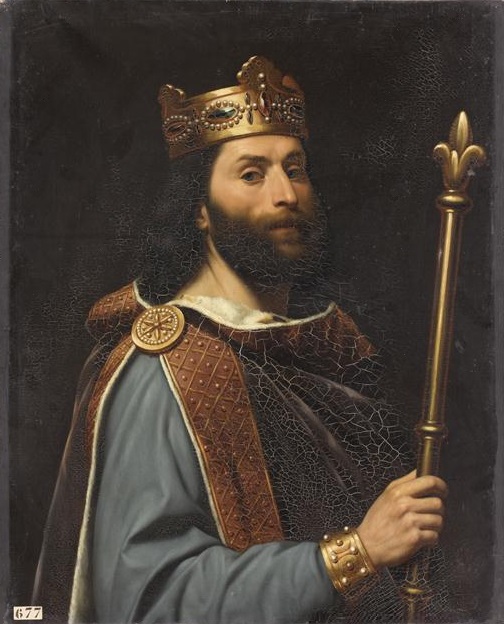


Early life and background
Born into the Carolingian dynasty at a time when the Frankish realms were divided among branches of Charlemagne’s family, Louis grew up amid a network of royal relatives and magnates whose loyalties were often local or familial rather than centralized. His upbringing and position as eldest son made him a natural candidate for succession when his father’s reign ended, but the political realities of the later ninth century — repeated external raids, local aristocratic power, and dynastic fragmentation — limited the scope of any new king’s immediate authority.
Accession and coronation
Louis succeeded to the royal title on the death of Charles the Bald in 877 and was recognized by many of the leading magnates of the realm. Contemporary notices indicate a coronation or formal recognition that involved ecclesiastical sanction; some accounts mention papal contacts and a ritual anointing in 878, though the precise details in surviving records vary. His short reign meant there was little time to establish a long-term program of reform or consolidation.
Reign: challenges and responses
The reign of Louis the Stammerer was marked by continuities rather than dramatic change. Viking incursions continued to threaten the coasts and navigable rivers of the kingdom, placing pressure on local communities and forcing temporary military responses. At the same time, regional magnates—counts, dukes and bishops—exercised increasing autonomy, often negotiating their own arrangements of defence and lordship. Louis relied on traditional Carolingian institutions: assembling armed retinues, securing the loyalty of abbots and bishops, and confirming land grants to supporters, but his limited time and intermittent health issues constrained sustained royal action.
Family and succession
Louis married at least twice. By his first wife, Ansgarde of Burgundy, he had two sons who later reigned jointly and two daughters. His elder son, Louis III, and his younger son Carloman (often called Carloman II) briefly shared kingship after their father’s death. From his second marriage to Adelaide of Paris came a daughter, Ermentrude, and a posthumous son, Charles the Simple, who would later become king of West Francia. Competition between these and other Carolingian claimants, together with the ambitions of powerful regional lords, produced a period of repeated succession disputes in the decades after Louis’s death.
Legacy and historical assessment
Although his reign was short and is sometimes judged by historians to be unremarkable, Louis the Stammerer occupies an important place in late Carolingian history as a transitional figure. His death precipitated a series of successions and power shifts that illustrate the weakening of centralized royal authority in West Francia during the late ninth century. The careers of his children and the later fortunes of his descendants—some of whom became ancestors of European noble houses—show how kinship ties continued to shape political outcomes even as the institutions of Carolingian kingship evolved toward the feudal structures of the tenth century.
Notes and genealogical connections
- His epithet is recorded in older sources and reflected in vernacular use rather than serving as a political title.
- His immediate political impact was limited by the brevity of his reign and by external pressures such as Viking raids.
- Through his daughter Ermentrude and other descendants Louis’s bloodline entered wider European noble networks and later dynastic houses.
For further reading on the later Carolingian period and the reigns of Louis’s sons, consult general medieval surveys and specialized studies on ninth-century Frankish politics and society.
Related articles
Author
AlegsaOnline.com Louis the Stammerer: King of West Francia (846–879) Leandro Alegsa
URL: https://en.alegsaonline.com/art/125403