
List of knots
An organized overview of common knots: definitions, parts, major categories (bends, hitches, loops, stoppers), typical uses in sailing, climbing, fishing and crafts, and notable distinctions.
A "knot" is a fastening made by tying one or more turns of a rope, cord, webbing or similar material so that it holds under load. Practical knots are judged by how secure, strong, easy to tie, and easy to untie they are after loading. The same basic knot can serve different purposes depending on the material and the conditions in which it is used.
Image gallery
7 Images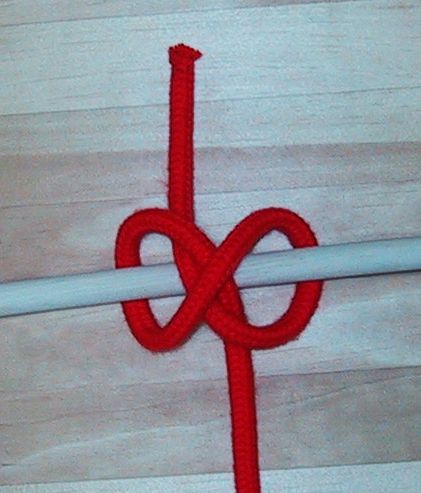


Basic parts and terminology
Common terms help describe knots: the standing part is the length that carries load, the working end is the section used to form the knot, a bight is a U-shaped curve, and a loop is a turn that crosses itself. A knot can jam (become hard to untie) or slip (fail to hold) depending on its design and loading.
Major categories
- Bends – join two lines (e.g., sheet bend, double fishermen's).
- Hitches – attach a line to an object (e.g., clove hitch, bowline when used on a post).
- Loops – create a fixed eye or loop in a line (e.g., bowline, figure-eight loop).
- Stoppers and plugs – prevent rope from passing through an opening (e.g., figure-eight stopper).
- Binding and decorative – secure bundles or create patterns (e.g., reef/square knot, constrictor, macramé knots).
Examples commonly encountered include the bowline (a reliable non-jamming loop), the reef or square knot (binding two ends of similar line, but untrustworthy under certain loads), the clove hitch (quick to tie but can slip), and the figure-eight knot (widely used in climbing as a stopper and loop-forming knot).
History and practical importance
Knots have been used for millennia in fishing, sailing, hunting and building. Sailors and climbers developed specialized techniques to match knots to specific tasks. Collectors and researchers compiled knot practices into references such as the well-known compendium Ashley Book of Knots, which remains a standard starting point for identification and classification.
Beyond practical use, knots have inspired other fields: decorative knotting and textile arts, surgical suturing techniques, and the mathematical study of knot theory, which treats knots as abstract objects. When selecting a knot for any application, consider the materials, the expected loads, whether the knot must be untied easily, and the consequences of slipping or failure.
Related articles
Author
AlegsaOnline.com List of knots Leandro Alegsa
URL: https://en.alegsaonline.com/art/124782