
List of districts of Tamil Nadu
Overview and list of the districts of Tamil Nadu, their administrative role, brief history of changes, and a complete current list of district names with links to official information.
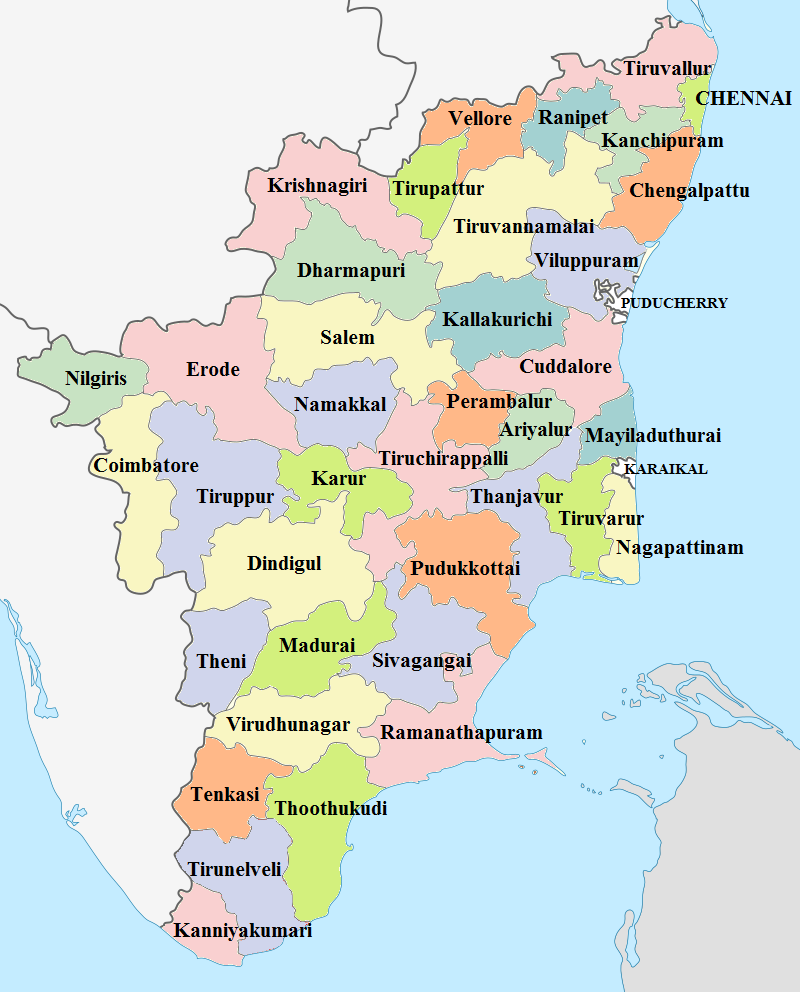
Tamil Nadu, a state in southern India, is administratively divided into districts that serve as the primary sub‑state units for governance, planning and public administration. Each district contains smaller units such as revenue divisions, taluks, blocks and municipalities. Districts are important for implementing government schemes, maintaining law and order and collecting local statistics.
Image gallery
6 Images


Administration and characteristics
Each district is typically headed by a District Collector (also called District Magistrate), an officer responsible for revenue collection, development coordination and disaster management. Districts vary widely in geography and economy: some, like Chennai and Coimbatore, are highly urban and industrialized, while others include large agricultural tracts, forested or hilly terrain such as the Nilgiris.
History and development
The boundaries and number of districts in Tamil Nadu have changed repeatedly since British colonial times and after Indian independence. New districts are usually created by dividing existing ones to improve administrative efficiency and bring government services closer to citizens. The process has continued into the 21st century, producing several new districts in recent decades.
Current list of districts
The following list gives the names of the districts of Tamil Nadu. For authoritative and up‑to‑date information about district boundaries and offices, consult the official list.
- Ariyalur
- Chengalpattu
- Chennai
- Coimbatore
- Cuddalore
- Dharmapuri
- Dindigul
- Erode
- Kallakurichi
- Kancheepuram
- Kanniyakumari
- Karur
- Krishnagiri
- Madurai
- Mayiladuthurai
- Nagapattinam
- Namakkal
- Nilgiris
- Perambalur
- Pudukkottai
- Ramanathapuram
- Ranipet
- Salem
- Sivaganga
- Tenkasi
- Thanjavur
- Theni
- Thoothukudi
- Tiruchirappalli
- Tirunelveli
- Tirupathur
- Tiruppur
- Tiruvallur
- Tiruvannamalai
- Vellore
- Villupuram
- Virudhunagar
Uses and notable facts
Districts provide the framework for local administration, elections to state and national legislatures, and the delivery of education, health and welfare services. They are also used in statistical reporting and development planning. Because boundaries can change, official government sources remain the best place to confirm the current set of districts and their administrative centers.
Questions and answers
Q: What is the text about?
A: The text is about the districts of Tamil Nadu.
Q: How many districts are there in Tamil Nadu?
A: There are 32 districts in Tamil Nadu.
Q: What type of information can be found on these pages?
A: These pages contain information about each district, such as its population, area, and major cities.
Q: Are there any maps of the districts available?
A: Yes, there are maps of all 32 districts available on these pages.
Q: Is there any other information provided besides district data?
A: Yes, additional resources such as contact details for local government offices and tourist attractions are also provided.
Q: Is this information up to date?
A: Yes, all the data is regularly updated to ensure accuracy.
Q: Who created this page?
A: This page was created by the Government of Tamil Nadu.
Related articles
Author
AlegsaOnline.com List of districts of Tamil Nadu Leandro Alegsa
URL: https://en.alegsaonline.com/art/124673