
Jacobus Henricus van 't Hoff — pioneer of physical chemistry and stereochemistry
Dutch physical chemist (1852–1911), first Nobel laureate in Chemistry (1901). Known for laws of chemical dynamics, osmotic pressure, the van 't Hoff factor and the tetrahedral carbon model.
Overview
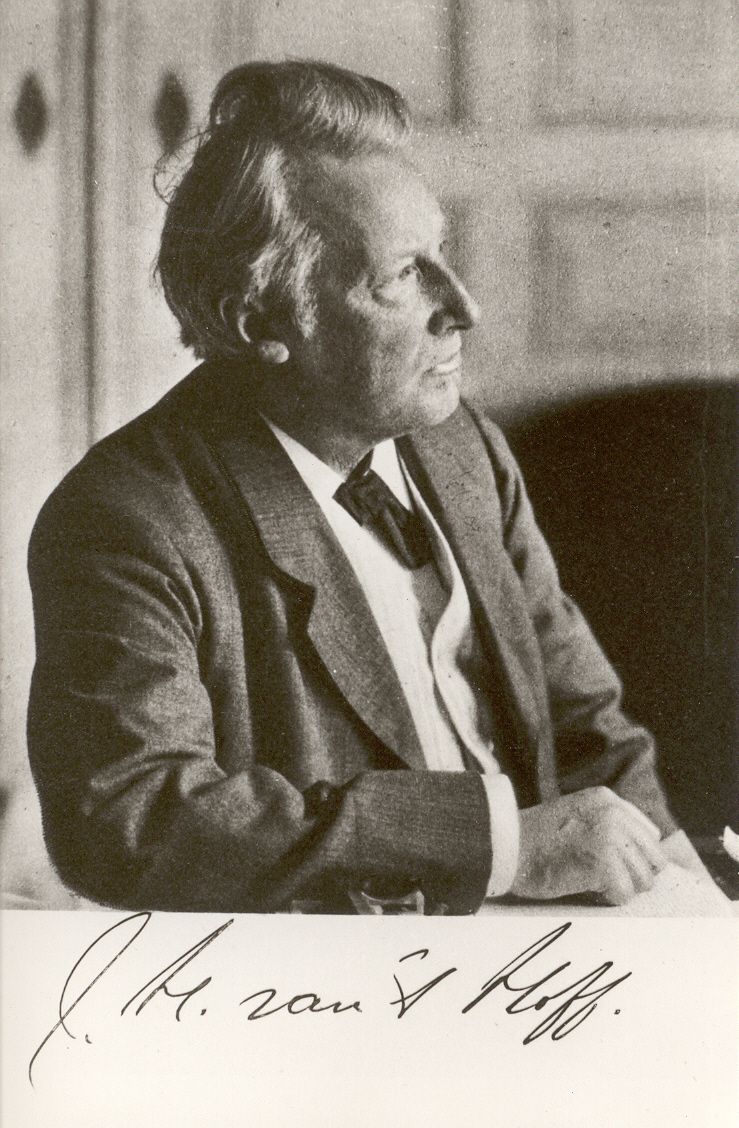
Jacobus Henricus van 't Hoff (30 August 1852 – 1 March 1911) was a Dutch physical chemist who helped establish modern chemical thermodynamics and kinetics. He was the first recipient of the Nobel Prize in Chemistry in 1901, an award that cited his work on the laws of chemical dynamics and osmotic pressure. Van 't Hoff combined mathematical reasoning with experimental observation to bring rigor to many problems then considered qualitative.
Image gallery
4 Images


Major contributions
Van 't Hoff made several enduring contributions to physical chemistry. He formulated quantitative relations for osmotic pressure in dilute solutions and introduced what became known as the van 't Hoff equation for osmotic pressure and concentration. From his work on solutions grew the van 't Hoff factor, a correction used in colligative properties. He also advanced the theory of chemical kinetics and equilibrium, emphasizing the role of molecular interactions and concentration on reaction rates and positions of equilibrium. For more on his scientific work see chemical kinetics and related studies.
Stereochemistry and molecular structure
In the 1870s van 't Hoff proposed that the four valences of a carbon atom are directed toward the corners of a regular tetrahedron. This geometric idea explained optical activity and isomers in organic chemistry. His tetrahedral model, developed independently but contemporaneously with the work of Joseph Le Bel, became a cornerstone of stereochemistry and of how chemists visualize molecular shapes. Further reading on his ideas about molecular geometry is available via general overviews of stereochemistry.
Works, recognition and legacy
Van 't Hoff published influential studies that combined theory with measurement; his writings helped transform chemistry into a more quantitative science. The Nobel Committee recognized the practical and theoretical importance of his results. Today his name is attached to several key concepts and formulas taught in chemistry courses: the van 't Hoff factor, the van 't Hoff rule relating temperature dependence of reaction equilibria, and equations for osmotic pressure and solution behavior. His career is often cited as foundational in the emergence of physical chemistry as a distinct discipline. Contemporary biographical summaries and historiography may be found through a range of scientific histories and archives (biographical sources, academic profiles).
Notable facts and distinctions
- First Nobel Prize in Chemistry, 1901 (award citation).
- Introduced the tetrahedral carbon model that explains stereoisomerism (stereochemistry).
- Contributions to osmotic pressure and solution theory led to the van 't Hoff equation and factor (kinetics and solution theory).
Van 't Hoff's blend of theoretical insight and quantitative experiment left a lasting imprint on chemistry, bridging ideas about molecular form and measurable thermodynamic behavior that remain central to chemical science.
Related articles
Author
AlegsaOnline.com Jacobus Henricus van 't Hoff — pioneer of physical chemistry and stereochemistry Leandro Alegsa
URL: https://en.alegsaonline.com/art/121156