
Henry Moseley: X‑ray Spectroscopy and the Physical Atomic Number
English physicist Henry G. J. Moseley (1887–1915) established Moseley's law linking X‑ray frequencies to atomic number, reorganizing the periodic table and shaping modern atomic physics before his early death in World War I.
Henry Gwyn Jeffreys Moseley (23 November 1887 – 10 August 1915) was an English experimental physicist whose measurements of X‑ray spectra clarified the meaning of the atomic number and reshaped the arrangement of the chemical elements. His concise experimental results and clear empirical law gave a physical basis to a quantity that had been treated largely as a chemical ordering device.
Image gallery
4 Images
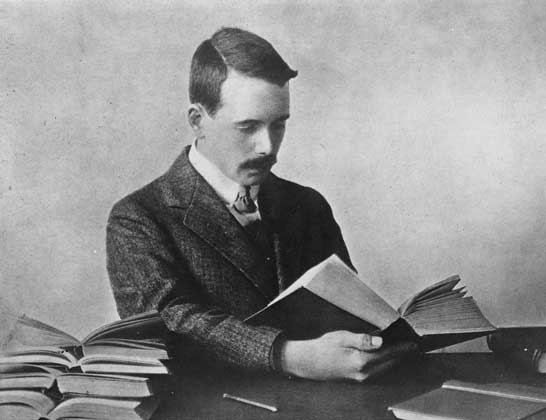


Key contributions and Moseley's law
Moseley found a simple, regular relationship between the frequencies of characteristic X‑rays emitted by elements and their place in the periodic table. The pattern he reported, now known as Moseley’s law, showed that X‑ray frequencies change in a systematic way with increasing nuclear charge. This made the atomic number an experimentally measurable physical property rather than a convenient ordinal label, and it supported emerging atomic models that linked spectral lines to nuclear charge.
Methods and experimental context
Working with X‑ray spectroscopy techniques available in the 1910s, Moseley measured the wavelengths of the characteristic lines produced when atoms were excited. His work was performed in leading British laboratories of the time and built on both experimental X‑ray methods and contemporary atomic theory. The clarity of his measurements provided strong empirical support for theoretical advances in atomic structure.
Impact on chemistry and physics
By demonstrating that atomic number corresponds to an element’s nuclear charge, Moseley resolved several anomalies where ordering by atomic weight produced inconsistencies. His results helped identify missing places in the periodic table that pointed to yet‑undiscovered elements and guided later discoveries. The work had immediate importance for both chemistry and the nascent field of quantum atomic theory, influencing how scientists understood spectral series and element classification.
Death and legacy
Moseley was killed in action during the Gallipoli campaign in World War I at age 27. His early death is widely regarded as a serious loss to science; some historians note that, had he lived, he might have continued to make foundational contributions to atomic physics. His loss also contributed to a change in attitude about deploying capable scientists to front‑line service during later conflicts.
Further reading
Related articles
Author
AlegsaOnline.com Henry Moseley: X‑ray Spectroscopy and the Physical Atomic Number Leandro Alegsa
URL: https://en.alegsaonline.com/art/120553
Sources
- books.google.com : H. G. J. Moseley: The Life and Letters of an English Physicist, 1887-1915