
Henri Coandă
Romanian inventor and aerodynamics pioneer best known for the Coandă effect and the experimental Coandă-1910 aircraft; his work influenced fluid dynamics, aviation design, and later aeronautical education in Romania.
Henri Marie Coandă (7 June 1886 – 25 November 1972) was a Romanian-born inventor and engineer whose experiments in propulsion and fluid flow left a lasting mark on aerodynamics. He is widely remembered for describing the behavior now called the Coandă effect, for experimenting with unconventional aircraft designs, and for a long career that combined practical engineering, demonstration projects and institutional leadership.
Image gallery
4 Images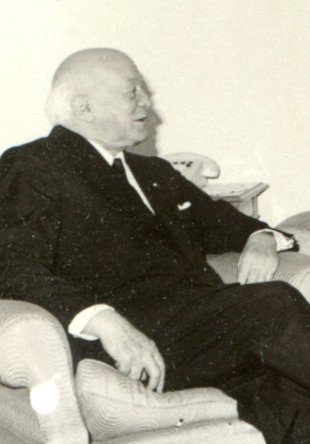


Overview
Coandă worked across several countries and disciplines during the first half of the 20th century. Although he produced many devices and filed patents on novel ideas, public attention has focused on two themes: his discovery of a flow phenomenon in which a jet of fluid tends to adhere to a nearby surface, and his early experimental aircraft, the Coandă-1910, which has been described by some as an early attempt at jet propulsion. Opinions differ about how to classify that machine, and historians continue to debate its technical status.
The Coandă effect
The Coandă effect describes the tendency of a fluid jet to follow a curved surface rather than to continue in a straight line. This behavior arises from entrainment of surrounding fluid and pressure differences that cause the stream to stick to the surface. The effect has practical consequences across engineering: it informs flow-control techniques, nozzle and diffuser design, and some lift-augmentation or boundary-layer control systems used in aeronautics and industrial equipment. Technical literature uses the term widely, and it is one of the concepts most closely associated with Coandă's name. Further reading on aerodynamic concepts can be found at aerodynamics resources.
Coandă-1910 and the jet controversy
The Coandă-1910 was an experimental aircraft that Coandă built and demonstrated in 1910. It used an unconventional propulsion arrangement in which combustion gases or an accelerated airstream were directed through a ducted arrangement instead of driving a traditional exposed propeller. Some historians and popular accounts have described the machine as the first jet-powered aircraft; others argue that it lacked several features of later true turbojets and that its propulsion was fundamentally different from the engines developed in the 1930s and 1940s. The dispute hinges on definitions of "jet propulsion," the specific engineering details of the Coandă-1910, and the distinction between conceptual precedent and operational technology.
Other inventions and designs
- Patents and prototypes: Coandă filed and promoted various patents covering fluidic devices, control mechanisms and vehicle concepts, some intended for industrial or military use.
- Unconventional craft: Later in life he proposed several unusual aircraft configurations and conceptual designs, including disc-like or "flying saucer" ideas that attracted public curiosity though not large-scale adoption.
- Applications: Engineers have applied the Coandă effect in diverse devices such as air curtains, nozzles, mixers and active flow control elements on wings and rotorcraft.
Later life and legacy
Coandă spent years working in France and elsewhere during the mid 20th century and returned to Romania in 1969. He later headed the Institute for Scientific and Technical Creation (INCREST) and in 1971 helped reorganize aeronautical engineering education alongside colleagues such as Elie Carafoli. He died in Bucharest on 25 November 1972 and was buried at Bellu cemetery. Today his name endures in textbooks and engineering practice through the Coandă effect, while the early aircraft he built remains a subject of historical interest and technical debate.
Significance and notable facts
- The term "Coandă effect" has become standard in fluid dynamics to refer to jet attachment to surfaces and associated entrainment phenomena.
- Discussion about the Coandă-1910 highlights how early experiments can anticipate later technologies without being direct technical predecessors.
- Coandă combined inventive activity with institutional roles that influenced Romanian aeronautical education in the late 20th century.
For concise introductions to the ideas associated with Coandă, readers can consult general aerodynamics sources and historical surveys of early propulsion experiments. His work illustrates how experimental observation—coupled with inventive thinking—can produce concepts that reverberate across engineering disciplines long after the original devices have disappeared.
Related articles
Author
AlegsaOnline.com Henri Coandă Leandro Alegsa
URL: https://en.alegsaonline.com/art/120508
Sources
- militaryfactory.com : "Coanda 1910 Thermojet-Powered Aircraft (1910)"
- books.google.com : "Ducted Fan or the World's First Jet Plane? The Coanda claim re-examined"
- flightglobal.com : "Augmented Flow"
- books.google.com : Mémorial aéronautique: qui était qui?