
Gene Amdahl: architect of mainframes and originator of Amdahl's law
Gene Amdahl (1922–2015) was an American computer architect and entrepreneur best known for System/360-era mainframe design, founding Amdahl Corporation, and formulating Amdahl's law on parallel speedup.
Overview
Gene Myron Amdahl was an American computer architect and entrepreneur whose engineering work shaped commercial mainframe design and whose theoretical insight into parallel processing remains widely cited. He collaborated with other leading designers on large-scale systems and later founded companies that competed in the mainframe market. His practical designs and his statement about limits on parallel speedup — now known as Amdahl's law — are standard topics in computer architecture and high-performance computing discussions.
Image gallery
3 Images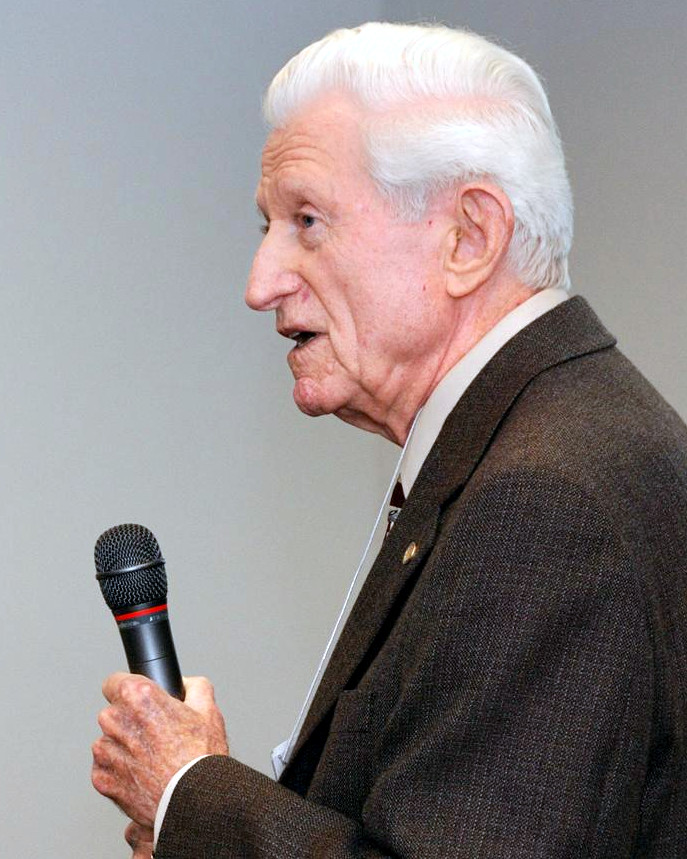


Career and contributions to mainframes
Amdahl worked on large commercial computers while at IBM, contributing to projects alongside colleagues such as Fred Brooks and Gerrit Blaauw. His work influenced the architecture and microarchitectural choices that defined a generation of mainframes. Later he left to lead private ventures that produced systems compatible with dominant mainframe standards, offering customers alternatives in price, performance and maintenance.
Amdahl's law and its significance
One of Amdahl's most enduring legacies is the principle known as Amdahl's law, which expresses an upper bound on parallel speedup for a task that contains both parallel and serial components. In formula form it is commonly written as:
Speedup(N) ≤ 1 / ((1 - p) + p / N),
where p is the fraction of work that can be parallelized and N is the number of processors. The law shows that if part of a computation must be performed sequentially, adding more processors yields diminishing returns; for example, if 95% of a job is parallelizable, the theoretical maximum speedup as N grows without bound is 20×. This observation has guided expectations and designs for multi-core CPUs, clusters and supercomputers, and it is often discussed alongside alternative scaling models such as Gustafson's law when evaluating real workloads.
Entrepreneurship and industry impact
In addition to engineering, Amdahl was an active entrepreneur. He founded and led companies that built mainframes compatible with prevailing standards, challenging incumbents on cost and reliability. These efforts helped create a market for plug-compatible systems and influenced how enterprise customers procured computing resources. His firms and designs also fostered competition that pushed improvements in system performance and service models.
Recognition, distinctions and legacy
Amdahl's combination of practical system design and clear theoretical insight earned him recognition from peers and institutions. In 1998 he was named a Fellow of the Computer History Museum for contributions to architecture, project management and leadership. His name endures in textbooks, research papers and in the informal vocabulary of engineers evaluating parallel systems.
Later life and death
In his later years Amdahl lived in the San Francisco Bay Area. He suffered from Alzheimer's disease and ultimately died of pneumonia in Palo Alto, California, shortly before his 93rd birthday. His technical contributions, entrepreneurial ventures and the law that bears his name continue to be taught and applied across computer science and engineering.
- Worked on large-scale commercial systems and mainframes (mainframe computers).
- Collaborated with notable designers (Brooks, Blaauw).
- Originated a limiting principle for parallel computing (parallel computing).
- Recognized by professional and historical institutions (computer architect community and museums).
For further reading on related topics and archives, see institutional collections and oral histories that document mid-20th-century mainframe development and the transition to commercially competitive hardware companies.
Related articles
Author
AlegsaOnline.com Gene Amdahl: architect of mainframes and originator of Amdahl's law Leandro Alegsa
URL: https://en.alegsaonline.com/art/119482
Sources
- computerhistory.org : Gene Amdahl 1998 Fellow
- purl.umn.edu : Oral history interview with Gene M. Amdahl
- computerhistory.org : Amdahl, Gene oral history
- doi.org : 10.1109/N-SSC.2007.4785613