
BitTorrent: peer-to-peer file distribution protocol and original client
BitTorrent is a peer-to-peer protocol and the name of the original client. It fragments files into pieces, coordinates swarms with trackers or DHT, uses magnet links, and emphasizes seeding and integrity checks.
BitTorrent is both a decentralized protocol for distributing large files efficiently across many computers and the name of the first widely used client that implemented that protocol. Designed to reduce dependence on a single server, BitTorrent works by dividing content into many small pieces and allowing participants to download and upload pieces to one another simultaneously. This cooperative model spreads upload cost across the network and enables high aggregate throughput for large files.
Image gallery
1 Image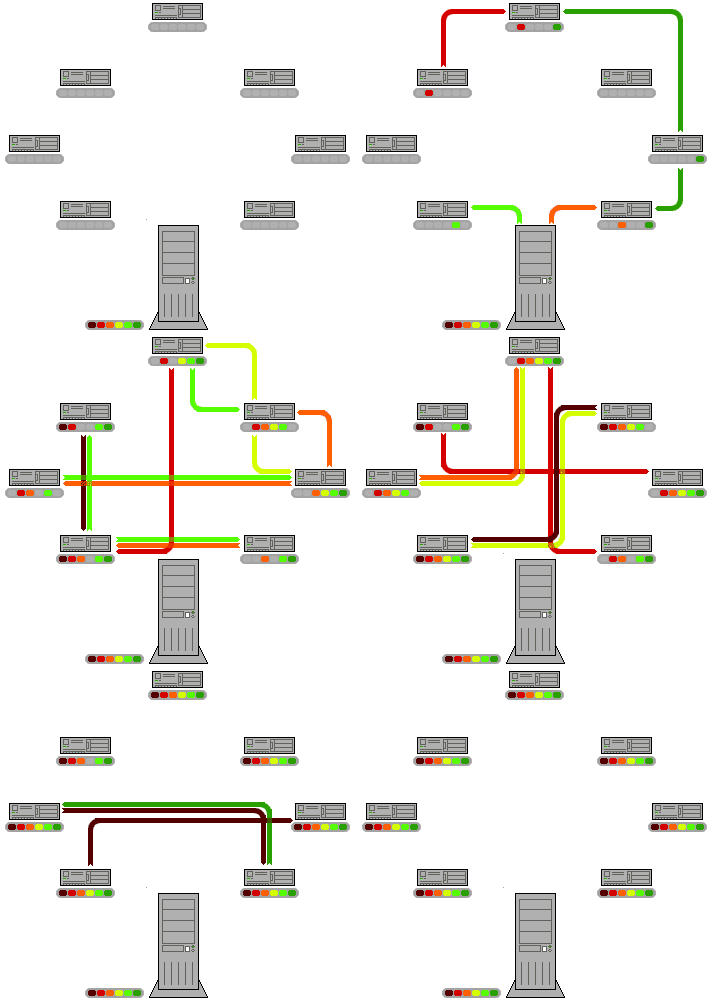
Basic mechanics
The protocol splits a file or collection of files into fixed-size blocks called pieces. Each piece is hashed so clients can verify integrity before using it. A small metadata file (a ".torrent") or a magnet link contains the information needed to identify the content and find peers. A tracker is a server that maintains a list of peers currently participating in a swarm; it helps peers discover each other but does not host the actual file data. For authoritative text on how the protocol operates see protocol documentation.
Roles in a swarm
- Seeder: a peer that holds the complete set of pieces and uploads them to others.
- Leecher: a peer that is still downloading one or more pieces; leechers often upload simultaneously.
- Swarm: the collection of peers (seeders and leechers) sharing a specific torrent.
Discovery and trackerless operation
In addition to trackers, modern torrents use a Distributed Hash Table (DHT) to discover peers without a central server, and Peer Exchange (PEX) to share peer lists among connected clients. Magnet links identify content by hash so a download can begin without first obtaining a .torrent file. These mechanisms increase resilience and decentralization of swarms.
Integrity, incentives and performance
Piece hashing ensures data integrity: every downloaded piece is checked against its hash before it becomes part of the assembled file. Clients implement strategies to encourage fairness, such as prioritizing uploads to peers that reciprocate (a "tit-for-tat" approach) and favoring rare pieces to improve swarm health. Other performance considerations include connection limits, choking/unchoking algorithms, and settings for maximum upload and download rates.
Client ecosystem and development
The protocol has spawned many independent clients, from lightweight implementations to feature-rich applications. Popular examples include µTorrent, qBittorrent, Transmission and Vuze. Developers consult implementation notes and API guidance when building or extending clients; for developer-oriented materials see client developer guides and for protocol-level details see the protocol reference.
History and licensing of the original client
The original BitTorrent client was created in 2001 by Bram Cohen, who published the initial implementation that popularized the protocol. Early versions were written in Python and released under open-source licences, which encouraged wide experimentation and many alternative clients. Over time the project and its commercial offshoots evolved in codebase and licensing approach; for background on the creator see Bram Cohen.
Legal, ethical and practical considerations
BitTorrent is an efficient distribution method for legitimate uses such as distributing operating system images, public datasets, large media releases, and software updates because it reduces hosting costs. The same efficiency has made it a conduit for unauthorized distribution of copyrighted material, prompting legal action and monitoring efforts in some jurisdictions. Users and organizations should be aware of local law and respect copyright and licensing when sharing content.
Privacy and security
By design, peers reveal their IP addresses to one another while participating in a swarm. Some clients offer optional encryption to make traffic less amenable to rudimentary traffic shaping by ISPs, but encryption does not provide anonymity. For privacy-conscious uses, additional measures—such as anonymizing networks or legal distribution channels—should be considered, and one should understand the limits of any tool used.
Best practices for creating and seeding torrents
- Create accurate metadata and include a meaningful folder structure so recipients can verify content easily.
- Seed long enough to ensure initial availability: the more complete copies provided, the healthier the swarm.
- Use appropriate piece sizes: larger files benefit from larger pieces, small files from smaller pieces, balancing overhead and parallelism.
- Monitor client settings for connection counts and upload share to maintain fair and efficient distribution.
BitTorrent remains a widely used tool and protocol more than two decades after its introduction. Its combination of piecewise distribution, integrity checking, decentralized discovery, and client-side incentives has influenced many subsequent peer-to-peer designs and continues to be a practical option for distributing large files at scale.
Related articles
Author
AlegsaOnline.com BitTorrent: peer-to-peer file distribution protocol and original client Leandro Alegsa
URL: https://en.alegsaonline.com/art/11854
Sources
- history-computer.com : "BitTorrent - History of Computers, Computing and Internet"